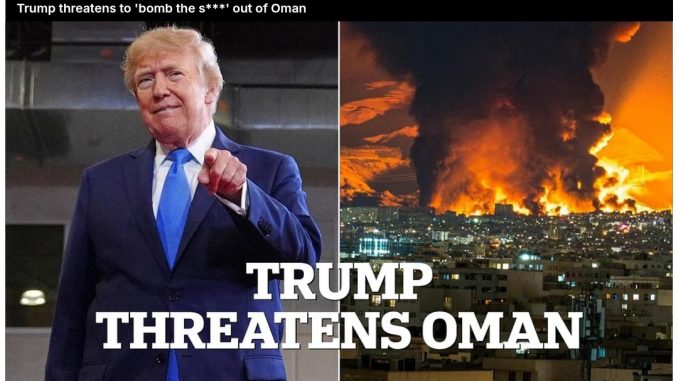
Donald Trump threatened to ‘bomb the s***’ out of Oman if it continues negotiations with Iran without American approval as the ceasefire with Tehran nears its expiration
Reported by:

Cherry Meigh Timbol
News Content Editor
Published August 17, 2026
WASHINGTON — President Donald Trump has issued a dramatic warning to Oman, threatening military action if the Gulf ally interferes with U.S. efforts to resolve the confrontation with Iran and restore shipping through the strategically vital Strait of Hormuz.
The warning came as a 60-day negotiating period between Washington and Tehran expired without a broader agreement, leaving the Middle East crisis at a potentially dangerous crossroads.
 Oman, a major US defense ally in the Middle East, is negotiating with Iran over a plan to reopen the Strait of Hormuz by placing the narrow waterway under joint control
 Trump’s threats against his own ally come as the 60-day US-Iran ceasefire is set to expire today, raising fears of renewed fighting that could further destabilize the region and disrupt global oil supplies
Trump made the comments during an interview with Fox News correspondent Trey Yingst, warning that the United States would take military action against Oman if it “gets in the way” of Washington’s objectives.
The remarks are particularly significant because Oman has historically maintained diplomatic channels with both Washington and Tehran and has frequently played the role of intermediary between the two countries.
Trump Escalates Warning to Oman
Trump’s comments represent a major escalation in rhetoric toward Oman, a country that has maintained close relations with the United States while also preserving diplomatic ties with Iran.
Oman has been involved in discussions surrounding the Strait of Hormuz, the strategically important waterway connecting the Persian Gulf with the Gulf of Oman and the Arabian Sea.
The waterway has become a central flashpoint in the conflict as Iran and the United States remain divided over how shipping should be restored.
Trump has demanded that the strait be reopened, while Iran has sought to use its strategic position around the waterway as leverage during negotiations.
Iran Peace Deadline Expires
The threat came as the deadline established under a June U.S.-Iran memorandum of understanding expired.
The agreement provided a 60-day period for negotiations toward a broader settlement, including discussions over Iran’s nuclear program and the reopening of the Strait of Hormuz.
However, the deadline passed without a final agreement.
The expiration of the negotiating window has increased concerns that the conflict could enter another phase of escalation.
 An oil tanker burns after being hit by an Iranian strike in the ship-to-ship transfer zone at Khor al-Zubair port near Basra, Iraq, in March
 Trump has previously stated that Iran will not be allowed to control the waterway by charging levies or taxes from US-backed oil tankers
Trump Demands Iranian Surrender
Trump has simultaneously intensified his rhetoric toward Tehran.
The president called on Iran to raise a “white flag of surrender,” signaling that Washington’s demands remain substantially broader than simply reopening the Strait of Hormuz.
Trump has repeatedly insisted that Iran must not be allowed to acquire a nuclear weapon.
At the same time, he has indicated that he is not operating under a rigid timetable and remains prepared to continue applying pressure rather than accept an agreement he considers inadequate.
Why Oman Matters
Oman’s role is particularly important because of its long-standing position as a diplomatic bridge between the United States and Iran.
Unlike countries directly involved in the confrontation, Oman has traditionally maintained communication with both sides and has helped facilitate negotiations.
That makes Trump’s warning particularly consequential.
If Oman becomes directly involved in the military confrontation, one of the region’s most important diplomatic channels could be placed at risk.
The Strait of Hormuz at the Center of the Crisis
The Strait of Hormuz remains one of the most important pressure points in the conflict.
The narrow waterway is critical to international energy markets because large volumes of oil and gas normally pass through it.
Shipping through the strait has been severely disrupted during the conflict, raising concerns about energy supplies, transportation costs and inflation.
Any prolonged disruption could have consequences far beyond the Middle East.
 Iran has effectively shut down the strait by deploying suicide drones, naval mines and speedboats against US-aligned tankers to gain leverage in negotiations with Trump
 Since the war began, 18 US service members have been killed and hundreds more wounded over the last six months
A Dangerous Diplomatic Contradiction
The Trump administration now faces a difficult challenge.
Washington wants regional countries to help restore freedom of navigation and facilitate negotiations with Iran. At the same time, threatening Oman with military action could undermine one of the diplomatic channels that Washington may need to reach a settlement with Tehran.
Oman’s ability to communicate with Iran has historically made the country an important intermediary.
If those channels disappear, Washington could have fewer options for communicating with Iranian officials during an already volatile confrontation.
Iran Warns of Further Escalation
Iran has also indicated that it could take additional military measures if Washington does not honor the interim agreement.
Iranian officials have warned that Tehran could challenge U.S. military pressure and defend its position around the Strait of Hormuz if diplomatic progress fails.
The result is a dangerous combination of military pressure and diplomatic uncertainty.
Washington is threatening additional action against Iran.
Iran is threatening further resistance.
Oman is attempting to mediate.
The Strait of Hormuz remains heavily disrupted.
And the negotiating deadline has expired without a final settlement.
Global Economic Risks
The consequences could extend well beyond the Middle East.
A prolonged disruption of the Strait of Hormuz could affect oil prices, shipping costs and inflation around the world.
Countries heavily dependent on energy imports from the Persian Gulf could be especially vulnerable to prolonged instability.
A direct confrontation involving Oman would introduce another major actor into an already complicated conflict and could potentially draw additional countries into the crisis.
What Happens Next?
The immediate question is whether Trump’s warning represents a negotiating tactic or a genuine indication that Washington is prepared to use military force against Oman.
For now, the rhetoric itself is the most significant development.
With the 60-day diplomatic window expired and negotiations apparently stalled, Washington and Tehran have fewer diplomatic guardrails than they had when the memorandum was established.
Oman’s continued mediation could therefore become even more important in the days ahead.
Overall Takeaway
President Donald Trump’s threat against Oman marks a dramatic escalation in the already volatile U.S.-Iran confrontation.
The warning comes at a particularly sensitive moment, with the U.S.-Iran negotiating deadline expired, Iran resisting Washington’s demands and Oman attempting to mediate arrangements involving the Strait of Hormuz.
The coming days could determine whether the threats remain part of a high-pressure negotiating strategy or become the beginning of an even wider regional confrontation.
SOURCES: DAILYMAIL ONLINE – Trump threatens to ‘BOMB the s*** out of’ US ally in unhinged tirade as ceasefire runs out
THE NIGHTLY – Middle East latest: Donald Trump threatens to bomb Gulf ally Oman if it gets in the way of Iran deal
UNILAD – Trump makes direct bomb threat to US ally in bizarre rant
LOCAL3NEWS – RAW: TRUMP THREATENS TO ‘BOMB THE S***’ OUT OF US ALLY