Reported by:

Cherry Meigh Timbol
News Content Editor
Published August 17, 2026
BEIJING — Chinese President Xi Jinping has invoked one of the most sensitive episodes in modern Chinese history while praising the Communist Party’s handling of the 1989 Tiananmen Square protests and calling on the country to maintain what he described as an “indomitable fighting spirit.”
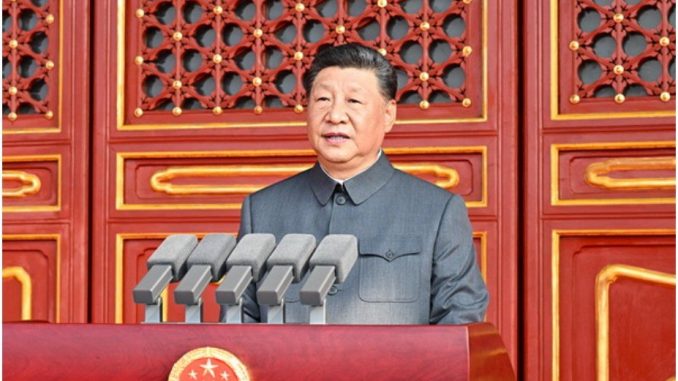
Xi made the remarks Monday during a high-profile ceremony marking the 100th anniversary of the birth of former Chinese leader Jiang Zemin. The event was held at Beijing’s Great Hall of the People and attended by thousands of officials and delegates.
The reference to Tiananmen was notable because discussion of the 1989 crackdown remains highly restricted inside mainland China. Xi’s decision to address the episode publicly at a major political ceremony gives the remarks added significance.
Xi Calls for an “Indomitable Fighting Spirit”
During his speech, Xi said China must be prepared to confront serious challenges and withstand difficult circumstances.
“With an indomitable fighting spirit and exceptional capabilities, we will actively confront major challenges,” Xi said, according to reports of his remarks.
Xi also called for the protection of China’s national sovereignty, security and development interests, portraying the country as facing significant challenges while emphasizing the Communist Party’s ability to maintain stability.
The language reflects Xi’s broader emphasis on national security, political discipline and resistance to external pressure.
Rare Reference to Tiananmen Crackdown
The most politically significant portion of the speech was Xi’s reference to the 1989 pro-democracy demonstrations.
According to reports, Xi praised the Communist Party’s decision to suppress the protests, describing the response as part of the party’s efforts to preserve political stability.
The 1989 demonstrations began as a student-led movement and expanded into a broader protest calling for political reform and other changes. Chinese authorities ultimately sent troops into Beijing to clear the demonstrations in June 1989.
The crackdown remains a deeply sensitive subject in China, where public discussion and commemoration of the events are heavily restricted.
The Jiang Zemin Connection
Xi’s remarks came during a ceremony commemorating Jiang Zemin, who served as China’s Communist Party leader from 1989 to 2002 and as president from 1993 to 2003.
Jiang rose to the top leadership position during the political turmoil surrounding the Tiananmen protests. He subsequently presided over a period of rapid economic growth and China’s eventual accession to the World Trade Organization in 2001.
Jiang died in 2022 at the age of 96.
Xi used the anniversary ceremony to praise Jiang’s political and economic legacy while emphasizing the need for China’s current leadership to continue advancing national development despite today’s challenges.
A Message About Stability and Power
Xi’s invocation of Tiananmen is significant because the Communist Party has long presented the 1989 crackdown as necessary to maintain political stability.
The party’s official treatment of the events contrasts sharply with accounts from protesters, victims’ families and international observers who have described a violent military crackdown.
The subject remains largely absent from China’s publicly available historical discourse.
By praising the party’s response, Xi reinforced the leadership’s longstanding interpretation that maintaining Communist Party rule and political stability takes precedence over demands for political liberalization.
Xi’s Broader Challenge to China
The speech also comes at a time when China’s leadership is confronting economic and geopolitical pressures.
China continues to face challenges involving economic growth, trade tensions, demographics, technological competition and its increasingly complicated relationship with the United States and other Western governments.
Xi has increasingly emphasized technological self-reliance, national security and stronger state control during his leadership.
His latest remarks appear consistent with that approach, linking national resilience with the preservation of political stability and Communist Party authority.
Tiananmen Remains a Political Taboo
More than three decades after the protests, Tiananmen remains one of China’s most sensitive political subjects.
Public commemoration of the crackdown is prohibited on the mainland, while authorities maintain strict controls over information concerning the events.
The anniversary has also remained a focal point for Chinese dissidents and human-rights activists outside mainland China.
Xi’s remarks therefore carry significance beyond the Jiang commemoration itself. They provide a rare glimpse into how China’s current leadership continues to interpret one of the defining political crises of the country’s modern history.
A Signal to China and the World
Xi’s emphasis on an “indomitable fighting spirit” can also be viewed as a broader political message.
Domestically, it reinforces the idea that the Communist Party must remain resilient in the face of internal and external challenges.
Internationally, the language comes amid tensions between Beijing and Western governments over trade, technology, Taiwan, national security and China’s expanding global influence.
Rather than signaling a retreat from the party’s established political position, Xi’s speech appeared to reaffirm the leadership’s commitment to maintaining control and resisting pressure.
What Happens Next?
The immediate significance of Xi’s remarks will likely be measured less by any change in policy and more by how they fit into the Communist Party’s broader political messaging.
The Chinese government continues to place national security, political stability and Communist Party leadership at the center of its governing philosophy.
By connecting Jiang Zemin’s legacy with the party’s response to the 1989 protests, Xi has once again presented the preservation of party rule as a fundamental component of China’s modern political history.
Overall Takeaway
Xi Jinping’s decision to praise the Communist Party’s response to the Tiananmen protests while calling for an “indomitable fighting spirit” represents a striking reaffirmation of Beijing’s longstanding interpretation of the 1989 crackdown.
Delivered during a ceremony honoring Jiang Zemin, whose rise to China’s top leadership followed the Tiananmen crisis, the speech connected China’s past political struggles with the challenges facing the country today.
More than three decades after the demonstrations, Tiananmen remains politically taboo inside China. Xi’s remarks demonstrate that the Communist Party continues to view the preservation of political stability and party authority as central to China’s future.
SOURCES: THE GATEWAY PUNDIT – Xi Jinping Praises “Indomitable Fighting Spirit” and the Tiananmen Square Crackdown
THE UK INDEPENDENT – Xi Jinping praises brutal Tiananmen crackdown and calls for return to Chinese ‘fighting spirit’