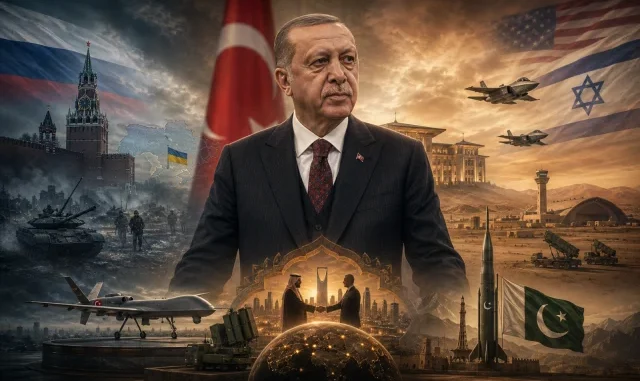
Turkey stands at the center of competing strategic pressures involving Israel, Russia, NATO, Ukraine and the new Makkah defence framework. Illustration created by the author for editorial purposes.
Reported by:

Cherry Meigh Timbol
News Content Editor
Published August 24, 2026
The Middle East has entered a new era of rivalry—not between Israel and Iran, but between two regional heavyweights whose ambitions increasingly collide: Israeli Prime Minister Benjamin Netanyahu and Turkish President Recep Tayyip Erdogan.
Their confrontation is no longer driven solely by ideology or Gaza. It is now fueled by competing visions for Syria, influence over the Eastern Mediterranean, military power, and personal political survival. European diplomats warn that the relationship has deteriorated to its lowest point in decades, raising fears that two of the region’s strongest militaries could stumble into a broader confrontation.
From uneasy partners to bitter adversaries
It wasn’t always this way.
During the 1990s and early 2000s, Turkey and Israel maintained close military cooperation, shared intelligence, and even discussed ambitious energy partnerships. But successive crises—including the Gaza flotilla, the wars in Gaza, and Erdogan’s increasingly vocal support for the Palestinian cause—gradually shattered the alliance.
Today, diplomacy has been replaced by insults.
Netanyahu recently labeled Erdogan an “antisemitic dictator,” while Turkish authorities pursued legal action against the Israeli leader over the 2026 Gaza flotilla incident. The language reflects more than personal animosity—it symbolizes two radically different visions of regional leadership.
Syria: The battlefield neither side wants to surrender


After the fall of Bashar al-Assad, Turkey emerged as the principal military partner of Syria’s new government, providing training, equipment, and logistical support as Damascus attempts to rebuild its armed forces. Israel sees that growing Turkish footprint as a direct security threat.
Last week, Israeli aircraft struck the Abu Duhur airbase shortly after a Turkish delegation visited the site. Israel claimed Syria was preparing to host Turkish forces near Aleppo, violating an informal security understanding. Ankara denied the allegation and condemned the strikes as an attack on Syrian sovereignty.
The message from Jerusalem was unmistakable: Israel will not tolerate Turkish military infrastructure on its northern frontier.
A clash of ambitions, not just personalities
|
Israel |
Preserve military superiority, prevent hostile forces from establishing bases in Syria, and contain Hamas-backed influence. |
|
Turkey |
Expand regional influence, protect Palestinian interests, strengthen Syria’s new government, and project leadership across the Muslim world. |
Both leaders believe they are defending national security.
For Netanyahu, Turkish military expansion in Syria threatens Israel’s strategic depth. For Erdogan, Israel’s repeated airstrikes and operations in Gaza represent an increasingly aggressive regional doctrine that must be challenged politically and diplomatically.
This is why many analysts describe the dispute as a strategic rivalry wrapped in a personal feud.
Would America choose a side?


The answer is complicated.
Israel remains America’s closest Middle Eastern ally, receiving extensive military, intelligence, and diplomatic support. Yet Turkey is a NATO member controlling the Bosporus, hosting critical alliance infrastructure, and occupying one of the most strategic geographic positions in Eurasia.
President Donald Trump maintains working relationships with both Netanyahu and Erdogan, placing Washington in the uncomfortable role of mediator rather than obvious partisan. Recent U.S. officials have criticized Israeli strikes in Syria as an unnecessary escalation while simultaneously reaffirming Israel’s right to defend itself.
In practical terms, America’s priority appears less about choosing a winner than preventing two allies from drifting toward war.
And what about Russia?
Moscow’s position is equally nuanced.
Russia has historically balanced relations with both Israel and Turkey despite backing different actors inside Syria. While Russia cooperates with Ankara economically and strategically, it has also maintained military deconfliction mechanisms with Israel for years. Analysts argue the Kremlin is more likely to exploit divisions between the two than openly back Erdogan against Israel.
For President Vladimir Putin, a fractured NATO and a divided Western alliance may offer greater geopolitical value than taking sides in an Israeli–Turkish confrontation.
Why this matters beyond the Middle East
The rivalry extends far beyond Jerusalem and Ankara.
It influences:
-
NATO cohesion and America’s alliance strategy.
-
Energy routes across the Eastern Mediterranean.
-
Syria’s reconstruction and future government.
-
Palestinian diplomacy and Gaza ceasefire efforts.
-
The regional balance following Iran’s weakening influence.
What appears to be another exchange of hostile rhetoric is actually a contest over who will shape the post-Iran, post-Assad Middle East.
🧩 Bottom Line:
History often remembers wars by the armies that fought them, but many begin with leaders who become convinced that compromise is weakness. Netanyahu and Erdogan are both charismatic, nationalist, and unwilling to appear vulnerable before domestic audiences. That makes this rivalry especially dangerous: every insult raises expectations, every military move demands a response, and every crisis narrows the space for diplomacy.
The world should hope this remains a battle of speeches and strategy—because if two of the Middle East’s most powerful militaries ever turn their rivalry into open conflict, the consequences would reach far beyond Israel, Turkey, or Syria.