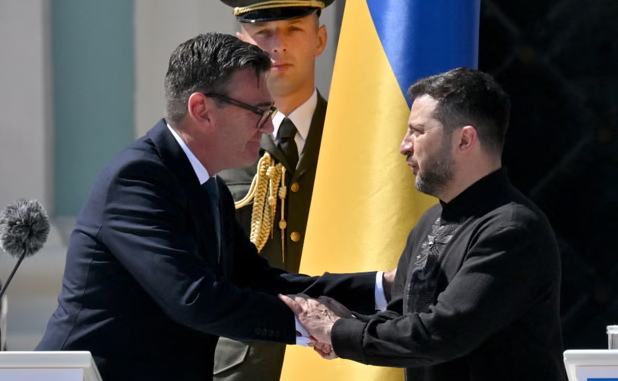
Andy Burnham (L) shakes hands with Volodymyr Zelenskyy at a ceremony marking Independence Day outside St Sofia cathedral in Kyiv. Photograph: Sergei Supinsky/AFP/Getty Images
Reported by:

Cherry Meigh Timbol
News Content Editor
Published August 24, 2026
Britain has intensified its support for Ukraine by agreeing to share previously classified missile technology, allowing Kyiv to manufacture long-range cruise missile components on its own soil—a move that triggered an immediate and furious response from the Kremlin.
The announcement came during Prime Minister Andy Burnham’s first overseas visit since taking office, as he joined Ukrainian President Volodymyr Zelenskyy in Kyiv to mark Ukraine’s 35th Independence Day. Burnham vowed that Britain would continue standing with Ukraine despite what he called Russia’s “outrageous threats.”
Britain hands over classified missile technology
Under the new agreement, the UK will declassify technical information related to British-made Storm Shadow/SCALP long-range cruise missiles. The transfer is designed to help Ukraine develop and manufacture its own missile capabilities with support from British and French defense industries.
The initiative marks one of the most significant technology-sharing agreements since Russia’s full-scale invasion began, shifting support beyond supplying finished weapons toward enabling Ukraine’s domestic defense production.
Kremlin: “Adding fuel to the fire”
Moscow condemned the decision within hours.
Kremlin spokesman Dmitry Peskov accused Britain of deliberately escalating the war, arguing that sharing missile blueprints undermines prospects for peace and deepens London’s direct involvement in the conflict. Russian officials also warned they would seek to identify and destroy any missile production facilities established inside Ukraine.
The diplomatic clash comes amid already deteriorating UK–Russia relations following months of intensified Ukrainian long-range strikes on Russian military and economic infrastructure.
Burnham: “Who started the fire?”
Responding directly to Moscow’s accusations, Burnham rejected the Kremlin’s narrative during a speech in Kyiv.
He compared Ukraine’s struggle against Russian aggression to Britain’s resistance during World War II, declaring that Ukraine now carries “the flame of European freedom.” When Russia claimed Britain was escalating the conflict, Burnham answered with a pointed question: “Who started the fire?”
The British leader insisted that supporting Ukraine is essential not only for Kyiv’s survival but also for Europe’s long-term security.
Ukraine pushes for self-reliance
President Zelenskyy welcomed the expanded military cooperation while reiterating that Ukraine seeks peace—but not surrender.
Ukraine has increasingly focused on building its own defense industry as Western stockpiles face growing pressure. Domestic production of drones, cruise missiles, and air-defense technologies has become a strategic priority as the war enters another prolonged phase.
European leaders attending the Independence Day commemorations also pledged continued financial and military assistance, reinforcing what has become a broader coalition supporting Ukraine’s long-term defense capabilities.
🧩 Bottom Line:
Russia calls it “adding fuel to the fire.” Britain calls it giving a free nation the means to defend itself. The uncomfortable truth is that wars are not won by speeches alone—they are won by industrial strength, technology, and the resolve of allies willing to stand firm. Burnham’s decision signals that London believes the greatest danger is not helping Ukraine too much, but allowing Russian aggression to succeed through hesitation.