
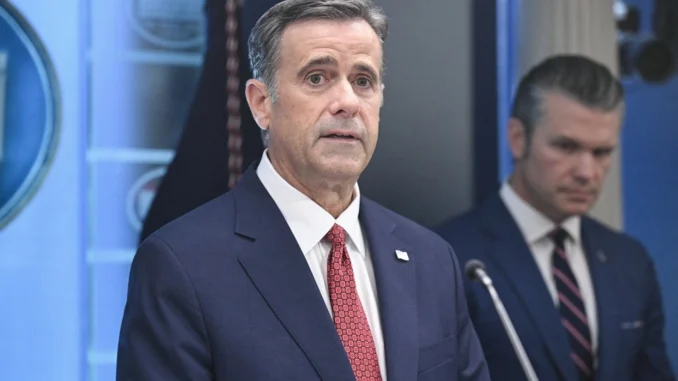
CIA Director John Ratcliffe speaks about the conflict in Iran in the James S. Brady Press Briefing Room of the White House on April 6, 2026, in Washington, DC. (Photo by SAUL LOEB / AFP)
by Diana Zapata • News Writer /Editorial Specialist
Published August 25, 2026
The trip, which took place Tuesday, August 25, was not publicly announced by the White House, Pentagon or CIA. Flight-tracking data showed a U.S. military C-17 transport aircraft traveling to Moscow after a stop in Latvia, where it remained for roughly a day.
The Kremlin subsequently confirmed that Ratcliffe had held discussions with Russian intelligence counterparts. Kremlin spokesman Dmitry Peskov said Russian President Vladimir Putin was briefed on the results, although Ratcliffe did not meet with Putin personally.
The secrecy surrounding the trip has fueled questions in Washington and abroad about what message the Trump administration was delivering to Moscow — and whether the meeting could signal a new phase of U.S.-Russia diplomacy.
A Rare and Highly Sensitive Mission
Ratcliffe’s visit is particularly notable because CIA directors rarely travel openly to Moscow, especially during a major war between Russia and Ukraine.
The last publicly known visit by a CIA director to Moscow came in November 2021, when then-CIA Director William Burns traveled to Russia and warned Putin about the consequences of invading Ukraine. Russia launched its full-scale invasion of Ukraine several months later.
Ratcliffe’s trip therefore carries considerable symbolic weight.
Unlike a conventional diplomatic visit, the CIA director’s involvement points toward discussions involving intelligence, national security, military developments or sensitive negotiations.
The exact agenda remains classified.
What Was Ratcliffe Doing in Moscow?
That remains the biggest unanswered question.
The Kremlin said Ratcliffe had “contacts” with Russian security services, but officials provided few details about what was discussed.
Reuters reported that Putin was informed about the outcome of the talks but did not personally meet with Ratcliffe. The Kremlin also indicated that contacts between intelligence agencies can continue even when broader political relations remain strained.
Several issues could potentially have been on the table:
- The Russia-Ukraine war
- Possible ceasefire or peace negotiations
- Russian military activity
- NATO security concerns
- Intelligence cooperation
- Prisoner or detainee exchanges
- The broader U.S.-Russia relationship
- Russia’s relationship with Iran
None of these possibilities has been publicly confirmed as the purpose of Ratcliffe’s visit.
That distinction is important as speculation surrounding the trip continues.
Washington Asked Ukraine to Hold Fire
Adding another layer of intrigue, multiple reports said Washington asked Ukraine to temporarily refrain from launching strikes against Moscow and St. Petersburg while the U.S. delegation was in Russia.
The Kyiv Independent reported that the request covered the period of Ratcliffe’s visit, while Kyiv Post reported that Ukrainian officials confirmed Washington had asked Kyiv to pause strikes during the sensitive mission.
Ukraine reportedly agreed.
But the pause did not last indefinitely.
According to ABC News, Ukrainian drone attacks on Moscow resumed only hours after Ratcliffe’s departure.
The development illustrates the extraordinary security and diplomatic sensitivities surrounding the CIA director’s presence in the Russian capital.
Russia-Ukraine Peace Efforts Remain Stalled
Ratcliffe’s visit comes at a particularly difficult moment for attempts to end the war.
U.S.-mediated negotiations have struggled to bridge major differences between Moscow and Kyiv, while Russia and Ukraine continue exchanging long-range missile and drone strikes.
The Washington Post reported that the visit occurred as both sides had intensified attacks deep inside each other’s territory, while concerns were growing over the possibility of further Russian pressure against NATO’s eastern flank.
That makes Ratcliffe’s intelligence-level contact with Russian officials potentially significant.
The CIA director is not simply another diplomatic envoy. His position gives him access to sensitive intelligence assessments that could influence how the Trump administration evaluates Russian military intentions.
Iran Adds Another Complication
The Moscow visit also comes against the backdrop of the increasingly complicated U.S.-Russia relationship over Iran.
Russia has maintained close ties with Tehran, while Washington has been applying significant economic and diplomatic pressure against Iran.
The Washington Post reported that Russia has provided Iran with intelligence concerning the location of U.S. military assets in the region.
That means the Trump administration’s dealings with Moscow cannot be viewed exclusively through the lens of Ukraine.
Russia’s relationship with Iran, the war in Ukraine and the broader confrontation between Washington and Moscow are increasingly interconnected.
Why the Military Aircraft Matters
Ratcliffe traveled aboard a U.S. Air Force C-17 Globemaster III, a heavy military transport aircraft commonly used for sensitive government missions.
According to flight-tracking data cited by the Washington Post, the aircraft traveled from Joint Base Andrews to Riga, Latvia, before continuing to Moscow. It later departed Moscow after Ratcliffe’s visit.
The unusual flight immediately attracted attention because the U.S. government had not announced that a senior official was traveling to Russia.
A second U.S. government aircraft also traveled to Latvia, although publicly available flight data did not establish that it continued to Moscow.
Kremlin Keeps the Details Under Wraps
The Kremlin initially offered little information about the American aircraft’s arrival.
Later, Peskov acknowledged the intelligence contacts but rejected speculation that Ratcliffe had met with Putin.
The Kremlin’s decision to confirm the talks while withholding details leaves open the possibility that the discussions were deliberately kept at the intelligence and security-services level.
That would allow Washington and Moscow to communicate on sensitive matters without immediately committing either government to a public diplomatic position.
A Possible Signal to Moscow?
The timing of Ratcliffe’s trip may be as important as the meeting itself.
The Trump administration has repeatedly sought an end to the Russia-Ukraine war while maintaining pressure on Moscow.
A secretive intelligence-level meeting could provide an avenue for delivering messages that would be difficult to communicate through normal diplomatic channels.
It could also give Washington a clearer understanding of Moscow’s intentions.
But there is currently no public evidence that Ratcliffe’s trip produced a breakthrough in peace negotiations.
Any claim that the CIA chief went to Moscow specifically to negotiate a ceasefire, warn Putin about NATO or deliver a particular ultimatum remains speculation unless U.S. officials confirm it.
The Burns Precedent
The historical comparison with William Burns is impossible to ignore.
Burns traveled to Moscow in 2021 to warn Putin about the consequences of invading Ukraine.
That mission failed to prevent the invasion.
Five years later, Ratcliffe has now made another highly unusual Moscow visit — this time after more than four years of war.
The circumstances are dramatically different, but the symbolism is powerful.
The United States is again sending its top intelligence official directly into Moscow at a moment when the future of the Russia-West confrontation remains uncertain.
What Happens Next?
The biggest question now is whether Ratcliffe’s Moscow visit was an isolated intelligence meeting or the beginning of a broader diplomatic effort.
If additional U.S.-Russia meetings follow, the trip could prove to have been an important opening behind the scenes.
If nothing follows, it may ultimately be remembered as a narrowly focused intelligence contact during a particularly tense period.
For now, the Trump administration is keeping its cards close to the vest.
And that secrecy is precisely what is making Ratcliffe’s Moscow mission one of the most closely watched U.S.-Russia developments of the week.
💬 Overall Takeaway:
CIA Director John Ratcliffe’s secretive Moscow trip sends a clear signal that, despite deep disagreements between Washington and Moscow, high-level channels remain open. The Kremlin’s confirmation that Ratcliffe met Russian intelligence officials — combined with the reported U.S. request for Ukraine to temporarily hold strikes on Moscow — makes the mission particularly significant.
But the real story may be what comes next.
If the Trump administration is preparing a new diplomatic push over Ukraine, Iran or broader U.S.-Russia relations, Ratcliffe’s Moscow visit could have been the quiet first step. If not, the mystery surrounding the mission is likely to continue.




