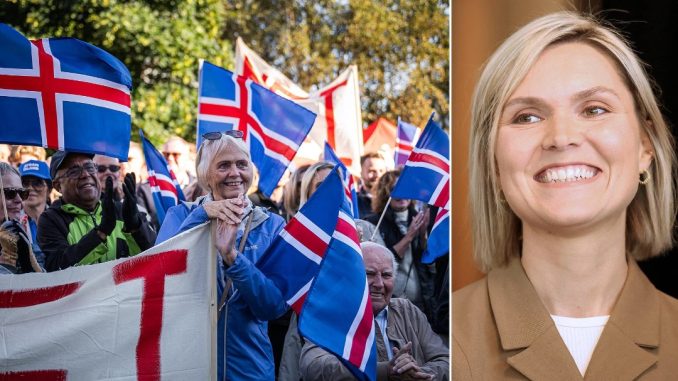
Supporters of the ‘No’ campaign in Reykjavik this morning as the results of the vote came in / Icelandic prime minister Kristrun Frostadottir said the Icelandic population had been waiting years to have a vote
Reported by:

Cherry Meigh Timbol
News Content Editor
Published August 30, 2026
Icelandic voters have rejected a proposal to restart negotiations on European Union membership, delivering a setback to Prime Minister Kristrún Frostadóttir’s government and signaling that many Icelanders remain unwilling to surrender greater control over the country’s fishing industry and national affairs.
The referendum asked voters whether Iceland should resume long-stalled negotiations with Brussels. The proposal was defeated by 52.8% to 47.2%, according to the Associated Press. Turnout was more than 82%.
The result means Iceland will not immediately reopen formal accession negotiations with the 27-member European Union.
 The ‘No’ campaign won 52.8 per cent of the ballot as the country’s population of 400,000 rejected the chance to join the 27-nation bloc
Fishing rights at the center of the debate
For many Icelanders, the EU question was ultimately about control over the country’s waters.
Iceland’s fishing industry remains an important part of its economy and national identity. Opponents of EU membership warned that joining the bloc could expose Iceland to the EU’s common fisheries policy and potentially allow foreign fishing interests greater access to Icelandic waters.
That argument proved particularly powerful outside Reykjavík, where rural communities and fishing interests strongly opposed restarting negotiations.
Supporters of EU membership argued that Iceland could negotiate special arrangements protecting its fishing industry while gaining the economic advantages of membership.
But voters ultimately chose to preserve the country’s existing relationship with Europe rather than risk changes to an industry considered vital to Iceland’s independence.
 The key points of contention ahead of the referendum centred around Iceland’s sovereignty and fishing, over which the country wanted to retain exclusive control
Trump and Greenland tensions added another dimension
The referendum took place against a dramatically changing geopolitical backdrop.
U.S. President Donald Trump’s repeated comments concerning Greenland cast a shadow over Iceland’s debate about its future relationship with Europe. Icelanders have watched developments involving neighboring Greenland and Denmark with increasing concern as tensions over Arctic security have intensified.
Supporters of restarting EU talks argued that closer integration with Europe could provide Iceland with greater economic and geopolitical security at a time when the Arctic is becoming increasingly important strategically.
Prime Minister Frostadóttir had supported reopening negotiations, presenting the European Union as a potential source of greater economic stability and security.
But the geopolitical argument was not enough to overcome concerns about sovereignty and fisheries.
Iceland already has close ties with Europe
One of the strongest arguments made by opponents was that Iceland already enjoys many benefits of European integration without being an EU member.
Iceland is part of the European Economic Area and the Schengen travel zone, giving it access to much of the European single market and allowing citizens to travel freely across much of Europe.
Opponents argued that this arrangement allows Iceland to maintain important economic ties with Europe while retaining greater control over its domestic affairs.
The referendum therefore was not simply a choice between Europe and isolation. Iceland already has extensive economic and political connections with the EU.
A setback for the government
The result represents a political setback for Frostadóttir’s center-left coalition, which had backed the referendum and promoted the possibility of renewed membership negotiations.
The prime minister acknowledged the result and said the government would respect the democratic decision.
The defeat does not mean Iceland is cutting ties with Brussels. Instead, it means the country will continue its existing European arrangements without reopening formal membership negotiations.
The issue could nevertheless remain politically important, particularly if economic or security conditions change.
Iceland previously sought EU membership
Iceland applied for EU membership in 2009 following the country’s financial crisis.
Negotiations subsequently began but were suspended after a change in government. Disagreements over fishing rights became one of the most sensitive issues surrounding the accession process.
The latest referendum was intended to determine whether those negotiations should be restarted.
A “yes” vote would not have automatically made Iceland an EU member. It would have reopened negotiations, with any eventual membership agreement requiring further approval from Icelandic voters.
Reykjavík versus the rest of Iceland
The referendum also exposed a geographic divide within Iceland.
Reykjavík constituencies were generally more supportive of restarting negotiations, while rural and suburban areas were significantly more skeptical.
That divide reflects different economic and political priorities between Iceland’s urban population and communities whose livelihoods are more closely connected to fishing, farming and control of natural resources.
What happens next?
For now, Iceland remains outside the European Union while maintaining its existing economic relationship with the bloc.
The referendum result is unlikely to end the country’s debate over Europe permanently. Economic instability, Arctic security concerns, relations with the United States and future changes within the EU could eventually revive the membership question.
But for the moment, Icelandic voters have chosen independence over deeper integration.
🧩 Bottom Line:
Iceland’s referendum delivered a clear, if relatively narrow, rejection of renewed EU membership negotiations.
With 52.8% voting against and 47.2% supporting the proposal, Icelanders chose to preserve their existing relationship with Europe while maintaining greater national control over fisheries and other key areas of the economy.
The result also demonstrates that concerns over sovereignty remain powerful even as geopolitical pressures increase. Trump’s controversial Greenland ambitions and the growing strategic importance of the Arctic may have encouraged some Icelanders to look more closely at Europe, but they were not enough to overcome fears about losing control of Iceland’s most valuable natural resource.
For Brussels, the message is equally significant: Iceland wants close ties with Europe, but many voters are not prepared to give up national control in exchange for full EU membership.
SOURCE: DAILYMAIL ONLINE – Iceland votes to stay out of European Union as public rejects closer ties with Brussels amid fishing and Trump fears
AP NEWS – Icelandic voters reject a proposal to restart negotiations to join the European Union