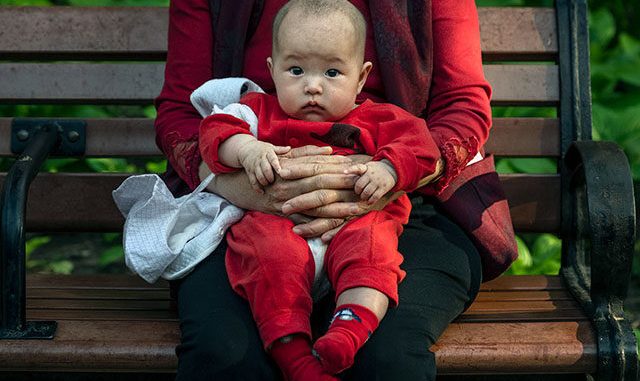
The director of China’s National Health Commission (NHC) announced during a press conference Monday that the Communist Party will be investing heavily in programs intended to raise the birth rate, particularly in expanding access to pediatric care and child care for working families.
Reported by:

Cherry Meigh Timbol
News Content Editor
Published September 17, 2026
BEIJING — China is expanding a nationwide effort to encourage childbirth as the country confronts a sustained decline in births and a shrinking overall population.
The initiative is part of China’s 15th Five-Year Plan and focuses on reducing some of the costs associated with having and raising children. National Health Commission Director Lei Haichao said the government will continue implementing “fertility-friendly” policies, including expanded childcare services and pediatric healthcare.
Childcare at the Center of the Plan
According to China’s State Council Information Office, authorities plan to integrate nursery and kindergarten services and encourage communities and employers to establish childcare facilities.
The government says the objective is to make childcare more convenient and affordable for families while reducing the financial burden associated with childbirth, child-rearing and education.
More than 30 million families have already benefited from a fertility subsidy introduced last year, according to Lei. The government has also expanded maternity-related financial support.
Official figures show that China’s maternity insurance fund spent 78.42 billion yuan, approximately $11.6 billion, during the first seven months of 2026.
Pediatric Healthcare Expansion
Healthcare is another major component of the initiative.
Lei said more than 3,100 pediatricians have already been dispatched to primary-level healthcare institutions. The government expects more than 95 percent of township health centers and community health service centers to offer pediatric services by the end of 2026.
Officials say improving access to pediatric care is intended to make raising children easier for families, particularly those outside China’s largest cities.
Population Has Continued to Decline
China’s demographic challenge has become increasingly visible in recent years.
The country’s population fell for a fourth consecutive year, with the population standing at approximately 1.405 billion, according to Chinese officials. Official statistics cited by Breitbart reported that the population at the end of 2025 had fallen by about 3 million from the previous year.
The decline follows decades of demographic policies that restricted family size. China ended its one-child policy in 2015 and subsequently permitted families to have up to three children. Despite those changes, marriage and childbirth have remained relatively low.
Economic and Social Pressures
Chinese authorities have increasingly linked demographic policy with the country’s long-term economic development.
A smaller working-age population and a growing elderly population could create additional pressure on China’s labor force, healthcare system and pension programs.
Officials have emphasized that China still has a large population and substantial pool of educated workers. Lei said more than 10 million students enter colleges and universities each year, which he cited as evidence of the country’s continuing supply of skilled workers.
At the same time, researchers have pointed to the high cost of raising children as a significant obstacle. Chinese scholars have called for larger childcare subsidies, arguing that existing assistance may not be enough to significantly change family decisions.
From Population Control to Encouraging Births
China’s demographic policy represents a major change from the era of strict birth restrictions.
The one-child policy, introduced nationally in the late 1970s, was gradually relaxed before being replaced by a two-child policy and eventually a three-child policy.
Beijing is now using subsidies, maternity insurance, childcare programs and healthcare expansion to encourage families to have children.
The government has also promoted what officials describe as a more “fertility-friendly society,” making population stabilization a stated objective of the current five-year planning period.
The Challenge Ahead
China’s latest measures come as policymakers attempt to address demographic trends that have developed over many years.
Whether financial assistance and expanded childcare services will substantially change fertility decisions remains uncertain. Demographers have noted that China’s low birth rate is connected to broader factors including marriage patterns, housing and education costs, employment conditions and changing attitudes toward family formation.
For Beijing, the issue extends beyond the number of births. Population trends will influence the size of China’s future workforce, consumer base and demand for social services.
🧩 Bottom Line:
China is putting greater government resources into childcare, maternity support and pediatric healthcare as officials seek to respond to declining births and population contraction. The measures represent a significant shift from China’s earlier population-control policies, but the government faces a long-term demographic challenge shaped by economic, social and generational factors.
SOURCES: BREITBART NEWS – China Launches Ambitious National Plan to Reverse Birth Rate Collapse