Reported by:

Cherry Meigh Timbol
News Content Editor
Published November 17, 2026
China and Canada have agreed to expand tariff relief on a range of goods, marking another step toward improving trade relations between the two countries.
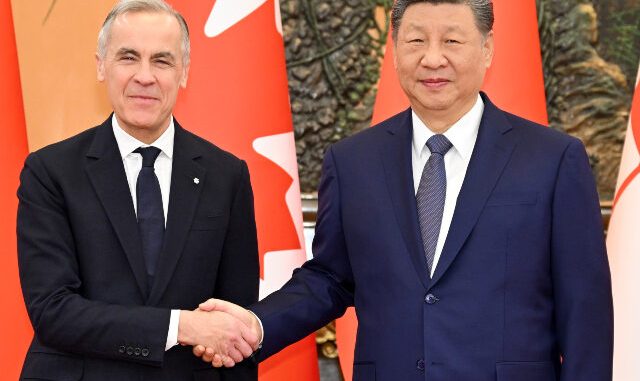
The agreement was reached during a meeting between Chinese President Xi Jinping and Canadian Prime Minister Mark Carney in Shenzhen, China, on November 17, ahead of the Asia-Pacific Economic Cooperation (APEC) summit.
Under the expanded arrangement, China will provide additional tariff relief for approximately C$400 million (US$280 million) worth of Canadian exports, including frozen pork, shrimp, seafood and other marine products. The measures are intended to improve Canadian producers’ access to the Chinese market.
According to Canada’s government, the products covered include frozen pork cuts, certain cold-water shrimp and prawns, geoduck, sea cucumber and Greenland halibut.
The agreement also extends existing trade arrangements between the two countries through December 2028.
In exchange, Canada has agreed to extend existing tariff remission measures for certain Chinese steel and aluminum products by two years, until December 31, 2028. The coverage will also expand to include 32 additional tariff items, consisting of 23 steel products and nine aluminum products for which Canadian supplies are insufficient or unavailable.
China has also agreed to suspend the application of its anti-discrimination tariffs on Canadian products from January 1, 2027, through December 31, 2028, under the expanded arrangement.
Building on an Earlier Trade Agreement
The latest announcement builds on an agreement reached in January 2026, when the two countries began easing trade restrictions following a period of heightened tensions.
Under that earlier arrangement, Canada reduced its 100% tariff on Chinese electric vehicles to 6.1%, initially allowing up to 49,000 Chinese electric vehicles into the Canadian market annually. In return, China agreed to lower tariffs on several Canadian agricultural exports, including canola products.
The countries subsequently expanded tariff relief to include products such as canola meal, peas, lobster and crab.
Efforts to Expand Economic Cooperation
Beyond tariff reductions, Carney and Xi discussed opportunities to strengthen economic cooperation in several sectors, including agriculture, energy, financial services and e-commerce.
Canada also announced plans to organize a major trade mission to China in 2027. Both governments agreed to designate 2027 as the Canada-China Year of E-Commerce, an initiative intended to help small and medium-sized businesses expand their access to consumers in both markets.
The two countries also discussed cooperation in environmental research, education and cultural exchanges.
Canada’s Effort to Diversify Trade
The renewed engagement comes as Canada seeks to broaden its international trading relationships and reduce its dependence on the United States, its largest trading partner.
Carney said Canada was ahead of schedule in achieving its goal of increasing exports to China by 50% by the end of the decade.
According to the Canadian government, bilateral merchandise trade between the two countries reached C$125.6 billion in 2025, representing a 5.6% increase from the previous year.
The latest agreement signals a willingness by both governments to continue addressing trade disputes through negotiations and expanded economic cooperation. However, the long-term impact will depend on implementation and whether the two countries can maintain stable commercial relations.