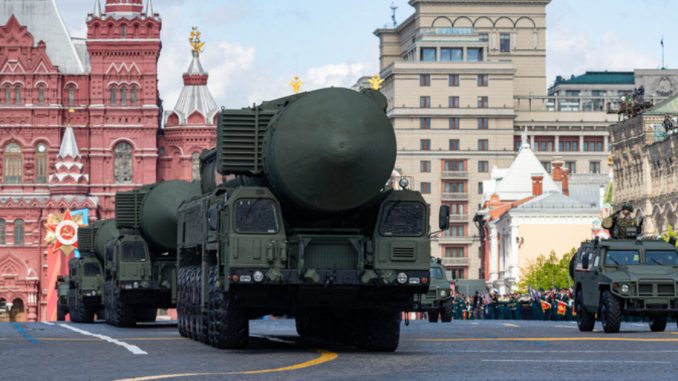
Russian missiles currently ravaging Ukraine also threaten Europe. Despite criticism of the United States from some European leaders, the continent remains dependent on America for its defense. Photo courtesy of Xinhua
Reported by:

Cherry Meigh Timbol
News Content Editor
Published August 24, 2026
he war in Ukraine has transformed Europe’s security landscape, but it has not eliminated one uncomfortable truth: NATO’s European members remain deeply dependent on the United States for military power, strategic deterrence, and advanced defense capabilities.
As Russia continues its campaign against Ukraine and tensions rise across Eastern Europe, leaders in Brussels, Berlin, Paris, and London are accelerating defense spending. Yet analysts warn that money alone cannot quickly replace decades of reliance on American intelligence, airlift, missile defense, and command infrastructure.
Europe is spending more—but still relies on Washington
European nations have dramatically increased defense budgets since Russia’s full-scale invasion of Ukraine. NATO members have committed to ambitious long-term spending targets, while Germany, Poland, and several Baltic states are investing billions into rearmament programs.
Despite those investments, critical military capabilities remain concentrated in U.S. hands, including:
-
Strategic air and sealift for rapid troop deployment
-
Satellite surveillance and battlefield intelligence
-
Patriot and advanced missile defense systems
-
Nuclear deterrence and extended security guarantees
-
Integrated NATO command-and-control infrastructure
Defense researchers say Europe has improved its conventional forces, but replacing American technological and logistical dominance would likely take many years of coordinated industrial expansion.
The Ukraine war exposed industrial weaknesses
The conflict has become more than a battlefield—it has become a stress test for Western defense manufacturing.
European factories have struggled to produce artillery shells, air-defense interceptors, armored vehicles, and precision-guided munitions at the pace demanded by modern warfare. Meanwhile, Ukraine’s enormous consumption of ammunition has revealed how limited Europe’s peacetime production capacity had become.
Military planners argue that rebuilding Europe’s defense industry will require sustained investment in manufacturing, supply chains, and workforce development—not simply larger defense budgets.
Trump’s pressure reshapes NATO’s future
President Donald Trump has renewed longstanding criticism that European allies depend excessively on American taxpayers for their security. His administration has pushed NATO members to assume a greater share of the alliance’s military burden while reviewing the future posture of U.S. forces stationed across Europe.
That pressure has intensified debates over a more “Europeanized NATO,” where European members would lead more operational responsibilities without formally replacing the alliance itself. Analysts emphasize that this differs from abandoning NATO; instead, it seeks to reduce dependence while preserving collective defense.
Can Europe defend itself without the U.S.?
The short answer from most defense experts is: not yet.
While Europe possesses world-class militaries—including those of Britain, France, Germany, Poland, and Italy—the continent still lacks sufficient integrated capabilities in intelligence, strategic mobility, missile defense, and logistics to independently match America’s role inside NATO.
The challenge is particularly acute if multiple crises erupt simultaneously, such as conflict in Eastern Europe alongside instability in the Middle East or the Indo-Pacific, stretching Western resources across several theaters.
🧩 Bottom Line:
Ukraine changed Europe’s perception of security, but it did not erase decades of dependence on American military power. Europe is rearming faster than at any point since the Cold War, yet building the industrial capacity, intelligence networks, and strategic infrastructure needed for genuine autonomy remains a long-term project. For now, NATO’s strength still rests on a partnership in which the United States remains the indispensable pillar—even as Europe works to stand more firmly on its own.