

by Diana Zapata •
News Writer /Editorial Specialist
Published October 26, 2026
Venezuela’s political future has entered a new and uncertain phase following the return of opposition leader María Corina Machado, who reappeared in the country on October 25 after nearly a year abroad.
Her homecoming is more than a personal milestone. It brings one of the country’s most prominent opposition figures back into a political landscape reshaped by the removal of former president Nicolás Maduro by U.S. forces in January 2026. Venezuela is now led by acting President Delcy Rodríguez, a longtime Maduro ally who has maintained the backing of U.S. President Donald Trump.
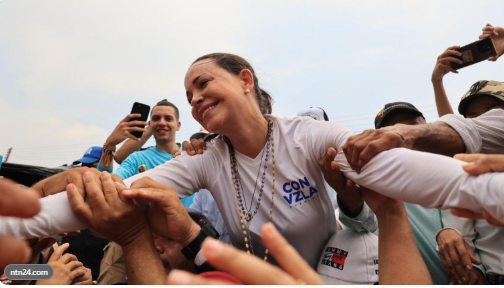
Machado announced her return in a message on social media, writing that she was back with her supporters. Images shared by her team showed her greeting people at a church in Lara state, where supporters welcomed her with chants and displays of national pride.
Yet her return leaves a larger question unanswered: Will Venezuela establish a credible path toward a presidential election, or will the country’s political transition remain under the control of existing power structures?
A Return After Months Away
Machado spent much of the preceding period outside Venezuela after years of political confrontation with Maduro’s government. She emerged publicly in Norway in December 2025 to receive the Nobel Peace Prize, following a period largely spent in hiding.
Her return comes amid renewed demands from opposition supporters for free and transparent elections. The opposition maintains that its candidate, Edmundo González, won the disputed 2024 presidential election, a result challenged by the government’s declaration that Maduro had prevailed.
The dispute remains central to Venezuela’s political crisis. Electoral legitimacy is not merely a question of who holds office; it concerns whether voters can choose their leaders through a process whose results can be independently verified and accepted.
Machado’s physical presence in the country may strengthen the opposition’s ability to organize and communicate with supporters. But returning home does not, by itself, guarantee that opposition candidates will be permitted to compete on equal terms or that a future election will meet international standards.
The practical test will be whether political participation becomes safer, electoral institutions become more credible, and the government establishes a clear and verifiable timetable for voting.
Washington’s Role Complicates the Political Transition
The Trump administration’s approach adds another layer of uncertainty.
Washington has supported Rodríguez as Venezuela’s interim leader while emphasizing economic stabilization and institutional changes before new elections. Trump has previously indicated that he considered it too early to move directly toward a democratic vote.
That position creates a difficult situation for Machado and the wider opposition. Although the United States has considerable influence over Venezuela’s political and economic future, its immediate priorities do not necessarily align with the opposition’s demand for an early election.
Secretary of State Marco Rubio described Machado’s safe return as a result of U.S.-supported reconciliation efforts, which he said had helped secure the release of political prisoners and enabled opposition figures to return from abroad.
Trump, however, told reporters he did not know about Machado’s return and expressed hope that she would be safe.
The contrasting statements illustrate the complexity of Washington’s position. The administration is supporting a transition process while also backing an interim leader closely associated with the former government.
For Machado, the challenge is to turn her return into meaningful political influence without losing the public support that has made her a central figure in the opposition movement.
The Election Question Remains Unresolved
Venezuela’s immediate political challenge is not simply whether Machado can return safely. It is whether the country can establish conditions for a credible national election.
An election requires more than announcing a date. Voters need confidence that candidates can campaign freely, political organizations can operate without intimidation, and electoral authorities can count and report votes transparently.
The country’s institutional arrangements will therefore matter as much as the public response to Machado’s return.
Reuters reported before her homecoming that the opposition was preparing for eventual elections, including efforts to improve voter registration. The report also noted that an election might not take place for a year or more.
That possibility underscores the gap between the opposition’s demand for a democratic mandate and the interim authorities’ current approach.
A prolonged transition could give institutions time to prepare for a credible vote, but it could also leave important questions of political legitimacy unresolved. The outcome will depend on whether the process produces verifiable progress or merely extends the current arrangement.
What Machado’s Return Means for Venezuelans
For Venezuelans who have spent years navigating political instability, economic hardship, and uncertainty about their country’s leadership, Machado’s return offers a visible development in a crisis that has often seemed difficult to resolve.
Her presence may energize opposition supporters and increase pressure on the authorities to clarify their plans. It could also complicate relations between the interim government, the opposition, and Washington.
However, it would be premature to conclude that her return guarantees a democratic transition.
The authorities’ response, the treatment of opposition activists, negotiations over electoral institutions, and the establishment of a credible election timetable will provide more concrete indications of whether Venezuela is moving toward political competition.
The interests of ordinary Venezuelans must remain central to that assessment. A transition should ultimately be judged not by diplomatic announcements or political symbolism alone, but by whether citizens gain meaningful opportunities to choose their leaders and hold them accountable.
💬 Overall Takeaway: A Significant Return, but No Guaranteed Transition
María Corina Machado’s return marks an important development in Venezuela’s political crisis. It brings a prominent opposition leader back into the country at a time when the future of its interim government and the timing of national elections remain uncertain.
Her return could strengthen demands for democratic elections, but the next steps will depend on decisions by the interim authorities, the opposition, and the governments involved in the transition.
For Washington, the challenge is balancing its strategic and economic interests with its stated support for political reconciliation. For Venezuela’s leadership, the challenge is establishing institutions that can command public confidence. For the opposition, the challenge is converting popular support into a credible political process.
The central question is no longer simply whether Machado can return to Venezuela. It is whether her return will help Venezuelans secure a genuine opportunity to decide who governs them.
Until a credible election process is established, the country’s political future will remain unsettled.




