Reported by:

Cherry Meigh Timbol
News Content Editor
Published October 26, 2026
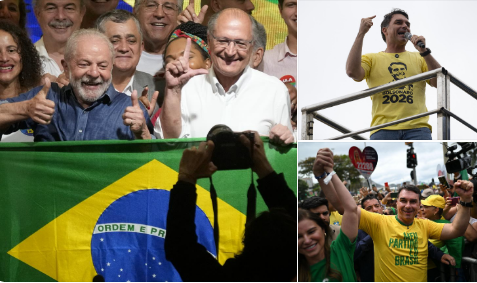
Brazilian President Luiz Inácio Lula da Silva has won reelection, defeating right-wing challenger Flávio Bolsonaro in the October 25 presidential runoff and securing a historic fourth, nonconsecutive term in office. The result defied the final polling trend, which had generally placed Bolsonaro ahead before election day.
According to Brazil’s electoral authorities, Lula received approximately 51.8% of valid votes, compared with 48.2% for Bolsonaro, the eldest son of former president Jair Bolsonaro. The victory gives Lula another four-year mandate beginning in January 2027 and marks a significant setback for Brazil’s conservative opposition.
The outcome raises immediate questions about why polling organizations and election aggregators failed to anticipate the final result, how voters shifted during the closing days of the campaign, and what the result means for Brazil’s political direction.
A surprise result after a polling shift
In the final stretch of the campaign, several prominent polling organizations showed Flávio Bolsonaro holding a narrow advantage over Lula among voters surveyed for the runoff.
An aggregator maintained by Plano Político, based on 45 published polls, placed Bolsonaro at 51.1% and Lula at 48.9% as of October 24. Other published surveys also showed Bolsonaro ahead, although the size of his lead varied between pollsters.
The final result reversed that projected ordering. Lula won by approximately 3.5 percentage points, demonstrating the difficulty of translating late polling snapshots into an accurate election-day outcome.
However, it would be premature to conclude that every polling organization was wrong in every respect. Individual surveys use different sampling methods, field dates, turnout assumptions and statistical adjustments. An aggregator summarizes the available polling evidence; it does not independently count votes or guarantee the eventual winner.
The discrepancy nevertheless leaves pollsters facing questions about whether their methods adequately captured the electorate that ultimately participated in the runoff.
In a shock decision, the Supreme Court extended election hours after complaints by Lula!
Why did the polling aggregators get it wrong?
The available post-election reporting points to several possible explanations, rather than evidence of deliberate manipulation.
1. Polling models underestimated Lula’s eventual support.
A post-election comparison published by Gazeta do Povo found that all seven major polling institutes included in its analysis underestimated Lula’s final vote share while overestimating Bolsonaro’s. That consistent pattern raises questions about how effectively the surveys represented the electorate.
2. Voter turnout and participation mattered.
Reuters reported that stronger-than-expected voter turnout benefited Lula. Polls can misjudge an election when their assumptions about which respondents will actually vote differ from real election-day participation.
3. The race changed after the first round.
Bolsonaro entered the runoff with a first-round advantage, but that did not guarantee that his supporters would maintain the same advantage in the head-to-head contest. Lula’s campaign emphasized social programs and his record on poverty and employment, while Bolsonaro focused on crime, living costs and political change.
4. A polling average is not an election result.
Aggregators combine surveys, but their conclusions depend on which polls they include, how they weight them and how recently the surveys were conducted. When several polls share similar sampling or turnout errors, combining them may not eliminate the underlying problem.
The evidence establishes that the final polling picture missed the result. It does not, by itself, establish that the errors were intentional or that any particular organization manipulated its figures.
Two more hours for Lula…
They call Justice Cristiano Zanin “Lula’s justice” (or “ministro do Lula”) because he was Lula’s personal lawyer who successfully defended him in the Lava Jato cases, and Lula later appointed him to Brazil’s Supreme Federal Court (STF).
A historic victory with significant political consequences
Lula’s reelection represents a major moment for Brazil’s left and a setback for the conservative political movement associated with the Bolsonaro family.
The president will return to office facing persistent concerns over household expenses, public security, corruption and economic growth. His administration will also have to contend with a conservative-leaning Congress that could complicate efforts to advance his legislative agenda.
For Bolsonaro, the defeat leaves questions about the future of Brazil’s right-wing movement and whether its supporters will remain united behind the former president’s family or pursue a broader political realignment.
Internationally, the outcome is also significant for relations with the United States. Lula has emphasized Brazilian sovereignty, while President Donald Trump’s administration has pursued a more conservative regional agenda and imposed tariffs affecting Brazil. The reelection is likely to keep those differences in focus.
What happens next?
The immediate challenge for Lula will be translating his electoral victory into a governing program capable of addressing economic pressures and Brazil’s deep political divisions.
For polling organizations, the result creates a separate challenge: explaining why their final estimates leaned toward Bolsonaro when the electorate ultimately delivered a victory to Lula. A rigorous assessment will require examination of sampling, turnout assumptions, undecided voters, regional patterns and each institute’s published methodology.
The result is a reminder that polls measure reported intentions at a particular time—not votes already cast. Even when several surveys point in the same direction, their collective estimate can miss the final outcome.