Reported by:

Cherry Meigh Timbol
News Content Editor
Published October 26, 2026
France is bracing for another wave of demonstrations after hundreds of thousands of people took to the streets over rising living costs, economic inequality and deteriorating public services, while clashes between protesters and police resulted in more than 1,300 arrests nationwide.
The latest demonstrations, held on Saturday, October 24, exposed growing public frustration with President Emmanuel Macron’s government despite an extensive security operation involving approximately 70,000 police officers and gendarmes. Authorities reported fewer arrests than during the previous weekend’s unrest, but confrontations continued in Paris, Marseille, Lyon and several other cities.
The protests have evolved from student demonstrations over school conditions into a broader movement involving workers, trade unions and anti-government activists, putting additional pressure on a French administration already facing political and economic challenges.
Clashes Erupt in Major Cities Despite Massive Security Deployment
Saturday’s demonstrations drew an estimated 410,000 participants nationwide, according to France’s Interior Ministry. Trade unions disputed the government’s count, estimating turnout at approximately 800,000.
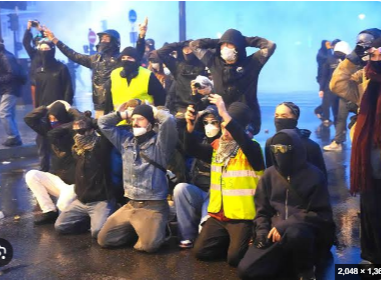
In Paris, police used tear gas, batons and water cannons to disperse groups of demonstrators after the main march. Clashes were also reported in Marseille, Lyon, Lille, Montpellier, Nantes and Toulouse.
The French Interior Ministry reported 1,314 arrests, 53 injured security personnel and 24 businesses looted in its provisional assessment published on Sunday. These figures represented a significant reduction from the October 17 demonstrations, when authorities recorded 2,628 arrests and 1,144 injured security personnel.
The extensive police deployment appears to have limited the scale of destruction, although it did not prevent violence from breaking out in several locations.
Rising Living Costs Fuel Public Anger
The demonstrations reflect growing dissatisfaction over wages, household expenses and the quality of public services. What began with high school students protesting shortages of teachers and deteriorating school conditions has expanded into a wider campaign against economic hardship.
Workers, teachers, trade unions and members of the Yellow Vests movement have joined the protests, arguing that ordinary citizens are struggling to keep pace with rising expenses while receiving inadequate support from the government.
The movement’s expanding base presents a challenge for Macron, whose administration must balance demands for economic relief against strained public finances. His centrist political bloc also lacks a parliamentary majority, limiting his ability to push through major legislation.
Macron Government Faces Pressure Over Protest Restrictions
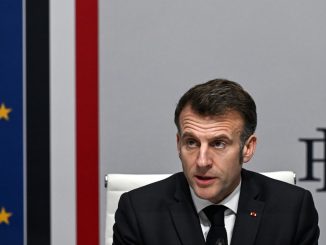
Macron has pledged to restore public order and criticized radical groups accused of exploiting demonstrations to commit acts of vandalism and attacks against police.
The government has also tightened restrictions on demonstrations, with authorities banning some planned rallies and directing authorized marches away from sensitive city-center locations.
However, the restrictions have drawn criticism from union representatives and demonstrators who argue that the measures interfere with their right to protest. The confrontation has intensified a broader debate over public security, civil liberties and the government’s response to economic grievances.
More Protests Planned for October 31 and November 5
Protest organizers are preparing another round of demonstrations for Saturday, October 31, followed by a nationwide strike and mobilization planned for Thursday, November 5.
The Yellow Vests movement has called for rallies and sit-ins outside public buildings, while trade unions are seeking to broaden participation among workers and other groups dissatisfied with the government’s policies.
Union leaders say the movement will continue unless the government offers concrete responses to demands concerning wages, living costs and public services. Discussions between officials, student representatives and labor organizations have so far failed to satisfy protest leaders.
The next demonstrations could become another major test of the government’s ability to maintain order while addressing the concerns driving public anger.
What Happens Next?
France now faces two interconnected challenges: preventing another outbreak of widespread violence and finding a political response to the grievances that have brought hundreds of thousands of people into the streets.
If negotiations fail to produce meaningful concessions, the planned October 31 demonstrations and November 5 strike could extend the unrest into November. A larger labor mobilization could also disrupt transportation, schools and other public services, although the scale of any disruption remains uncertain.
For Macron, the immediate challenge is to restore stability without deepening the perception that his government is ignoring the economic pressures facing ordinary French citizens.