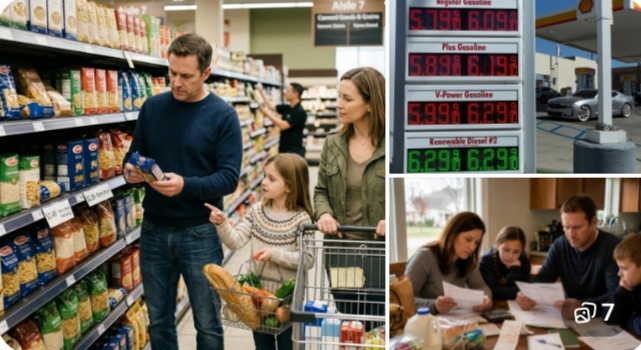
American families face rising grocery prices, higher fuel costs, and mounting household bills, putting pressure on Washington to address the growing cost-of-living crisis.

by Diana Zapata •
News Writer /Editorial Specialist
Published November 10, 2026
WASHINGTON, D.C. — For generations, the American Dream has been associated with the promise that hard work can provide financial security, homeownership, access to healthcare, and a better future for the next generation. However, for millions of Americans, achieving that promise has become increasingly difficult as the cost of everyday necessities continues to put pressure on household budgets.
From rising housing expenses and healthcare costs to grocery bills, transportation, and childcare, the financial challenges facing American households extend beyond any single economic indicator. While national economic statistics can show growth in employment, wages, and business activity, those figures do not always reflect how comfortably ordinary families are managing their daily expenses.
Rising Costs Continue to Pressure Household Budgets
Recent federal data illustrate the scale of household spending. According to the U.S. Bureau of Labor Statistics (BLS), average annual consumer expenditures reached $81,905 in 2025, representing a 4.3 percent increase from the previous year.
Housing accounted for the largest share of household spending, averaging $27,790 annually, or 33.9 percent of total expenditures. Transportation represented 16.5 percent, food 13 percent, and healthcare 7.9 percent. Housing expenditures alone increased 5.8 percent compared with 2024.
More recent figures indicate that some costs continue to rise. The BLS reported that the Consumer Price Index increased 0.4 percent in October 2026, following a 0.6 percent increase in September. Food prices rose 0.5 percent during October, while shelter costs increased 0.3 percent.
The agency also reported that gasoline prices had increased 37.4 percent over the available 12-month comparison period. However, because federal survey data for October 2025 were unavailable following a lapse in government appropriations, the BLS could not calculate the usual year-over-year inflation rate for October 2026 across most categories.
These figures highlight an important distinction: even when inflation slows, household expenses do not necessarily return to previous levels. A slower rate of price increases means prices are rising more slowly, not that groceries, rent, or medical expenses have become cheaper.
Housing Remains a Major Financial Challenge
Housing affordability is among the most significant obstacles facing American households, particularly younger adults and families with limited incomes.
According to the Federal Reserve’s May 2026 report on the economic well-being of U.S. households in 2025, the median monthly mortgage payment among homeowners with mortgages increased from $1,500 in 2024 to $1,600 in 2025. The median rent reported by renters remained at $1,200, compared with $1,100 in 2023.
The report also found a substantial income gap in homeownership. Only 33 percent of adults earning less than $50,000 owned their homes, compared with 86 percent of those earning at least $100,000.
For younger Americans, these financial conditions can make saving for a down payment increasingly difficult. For retirees living on fixed incomes, rising housing, insurance, and utility expenses can place additional pressure on retirement savings.
The consequences extend beyond housing itself. When a significant portion of household income goes toward rent or mortgage payments, less money remains available for food, healthcare, transportation, education, and emergency savings.
Economic Growth Does Not Tell the Entire Story
Despite affordability concerns, national economic indicators also show areas of improvement.
The U.S. Census Bureau reported in September 2026 that real median household income reached $87,460 in 2025, the highest level recorded in its historical series dating back to 1967. The official poverty rate also declined to 10.2 percent, down 0.5 percentage points from 2024.
However, the same report found that 26.7 million Americans, or 7.9 percent of the population, remained uninsured throughout 2025.
These findings present a more complicated picture of the American economy. Household incomes have improved, and the poverty rate has declined, but significant portions of the population continue to face financial and economic insecurity.
The Urban Institute’s American Affordability Tracker, updated in October 2026, also estimated that 49 percent of people in American families lacked sufficient resources to cover the true cost of essential living expenses in their communities. Its assessment includes housing, food, childcare, energy, healthcare, and other necessities.
The findings suggest that income growth alone does not necessarily guarantee financial stability, particularly when essential expenses consume a large share of household earnings.
Working Families, Retirees and Young Adults Face Different Pressures
The affordability challenge affects different groups in different ways.
For working families, higher grocery bills, childcare expenses, transportation costs, and housing payments can make it difficult to maintain savings while meeting everyday responsibilities.
Retirees may face a different set of challenges. Those relying on Social Security, pensions, or personal savings must manage living expenses that can change even when their regular income remains relatively fixed.
Young adults entering the workforce face difficulties of their own. Student debt, housing expenses, and the cost of establishing independent households can delay major financial milestones, including purchasing a home, starting a family, or building long-term savings.
Low-income households are particularly vulnerable because they have fewer financial resources to absorb unexpected expenses. A medical emergency, vehicle repair, rent increase, or temporary loss of employment can quickly disrupt an already limited household budget.
Although these experiences vary across income groups and geographic locations, they illustrate how affordability has become an important measure of economic well-being.
Government Accountability and the Policy Debate
The growing discussion surrounding affordability has placed renewed attention on the responsibilities of federal, state, and local governments.
Housing supply, healthcare costs, energy prices, wages, taxation, childcare availability, and transportation infrastructure all influence how much Americans must spend to maintain a reasonable standard of living.
Addressing these challenges requires policies that consider both economic growth and the everyday financial circumstances of households.
Federal policymakers face questions about how to improve housing affordability, strengthen access to healthcare, support wage growth, and reduce the financial pressures associated with essential services.
State and local governments also play important roles through housing regulations, public transportation investment, infrastructure planning, and assistance programs.
However, there is no single policy solution that can address every component of the affordability problem. Economic conditions differ across communities, and measures intended to reduce costs in one area may create additional challenges elsewhere.
For that reason, assessing policy outcomes requires examining measurable results, including changes in household purchasing power, housing availability, healthcare access, and the cost of essential goods and services.
The Broader Question: What Does Economic Success Mean for Americans?
The debate over the American Dream ultimately raises a broader question about how the country’s economic success should be measured.
Stock market performance, corporate earnings, employment figures, and national income statistics provide important information about economic conditions. However, they cannot independently establish whether ordinary Americans have enough financial resources to maintain a decent quality of life.
An economy may demonstrate growth while some households continue to struggle with rent, medical bills, groceries, and other basic expenses. Conversely, rising household incomes and declining poverty rates are meaningful signs of progress that should also be recognized.
The challenge for policymakers is to understand both sides of this picture.
As economic data continue to reveal differences between national performance and household experiences, the affordability question remains central to discussions about the future of the United States.
For millions of Americans, the American Dream is not necessarily about accumulating wealth or achieving extraordinary success. It is about having a stable job, a safe place to live, access to healthcare, the ability to support a family, and enough money to prepare for the future.
Whether that promise remains attainable for future generations will depend not only on the strength of the national economy but also on whether its benefits translate into greater financial security for ordinary households.