
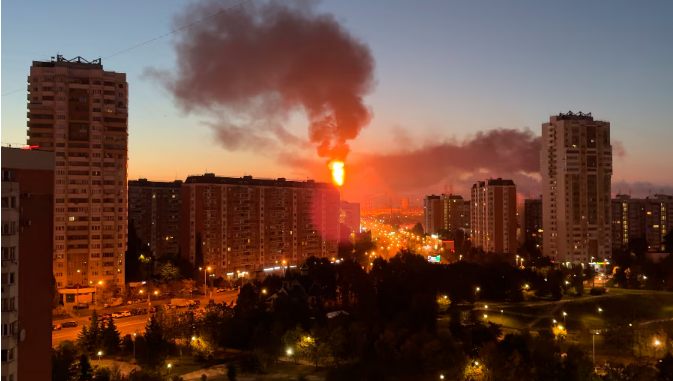
Flames at a Russian refinery light up the sky after the site was struck by a large-scale Ukrainian drone barrage late last month. (AP)
Reported by:

Cherry Meigh Timbol
News Content Editor
Published October 6, 2026
U.S. President Donald Trump is shifting his explanation for America’s rising gasoline and diesel prices, arguing that Ukrainian attacks on Russian oil refineries and refinery closures in the United States are now playing a larger role than the war with Iran and disruption around the Strait of Hormuz.
In a Truth Social post Monday, Trump said record oil shipments were moving through the Strait of Hormuz and argued that the key problem had become a shortage of refining capacity. He specifically pointed to Russian refineries hit by Ukrainian attacks and refineries being closed in Democratic-led states such as California.
The comments come as fuel prices remain politically sensitive in the United States and the Trump administration faces growing pressure to contain the economic effects of the Middle East conflict.
Trump points to refineries rather than Iran
Trump’s argument represents a significant shift in emphasis.
The president has previously acknowledged that the war involving Iran and disruptions around the Strait of Hormuz have contributed to higher energy prices. The strait is one of the world’s most important oil transit routes, normally carrying roughly one-fifth of global oil shipments.
But Trump now says the situation has changed.
He argues that oil is once again moving through the waterway in significant quantities and that the bigger problem is what happens after crude oil reaches refineries.
In his Monday post, Trump blamed Ukrainian attacks on Russian refineries for reducing available fuel supplies while also criticizing refinery closures in California and other Democratic-led states.
Speaking to reporters later Monday, Trump again emphasized refinery capacity, saying Russia’s refineries were being hit particularly hard and that the resulting problems were especially affecting diesel.
Ukraine’s refinery campaign
Ukraine has increasingly targeted Russia’s energy infrastructure as part of its effort to undermine Moscow’s ability to finance and supply its war effort.
Ukraine’s Defense Ministry said Sunday that recent attacks had disabled 51% of Russia’s oil-refining capacity. The claim has not been independently verified.
The strikes have reportedly hit refineries in locations including Moscow, Yaroslavl, Ust-Luga, Perm, Saratov and Syzran.
The impact is increasingly being felt inside Russia. The International Energy Agency has reported that Russian diesel production has fallen by about 30%, while fuel shortages have resulted in restrictions and long waits at some gasoline stations.
Russian President Vladimir Putin has also acknowledged the economic consequences, saying earlier this month that Ukrainian attacks on the country’s oil industry had cost Russia approximately 1% of GDP.
The Kremlin has responded with measures including restrictions on fuel exports, while Russian refiners have attempted to compensate for damaged capacity.
But is Ukraine really the main reason Americans are paying more?
This is where the situation becomes more complicated.
Trump’s explanation is only one part of the broader energy picture.
Reuters reported Monday that the Iran war has disrupted global oil supplies by restricting traffic through the Strait of Hormuz, while Ukrainian attacks on Russian energy infrastructure have added further pressure — particularly on diesel markets.
Al Jazeera likewise reported that the conflicts involving Iran and Russia are reinforcing each other and creating additional stress in global oil-product markets.
The average U.S. gasoline price was reported at about $4.36 per gallon, compared with $4.14 a month earlier and $2.98 on February 28, according to AAA data cited by Al Jazeera.
That suggests consumers are facing a combination of factors rather than one single cause.
California becomes part of the political fight
Trump has also turned his attention toward California’s refining industry.
Two California refineries have closed over the past year, reducing the state’s refining capacity by an estimated 17%, according to analysis cited by Al Jazeera.
California has a particularly important role in the U.S. fuel market because its gasoline supply is relatively isolated from other regions and operates under specialized fuel standards.
Trump has blamed Democratic policies for refinery closures, making California part of a broader political argument over energy policy.
The timing is significant.
With the November midterm elections approaching, energy prices are becoming an increasingly important political issue. Trump and Democrats are likely to use gasoline prices as evidence for competing arguments about energy policy, regulation and the economic consequences of foreign conflicts.
The Iran factor remains significant
Despite Trump’s argument, the Middle East remains central to the global energy crisis.
The Strait of Hormuz connects the Persian Gulf with the Gulf of Oman and is a critical route for crude oil and petroleum products.
The conflict involving Iran has severely disrupted normal shipping patterns, contributing to a global supply shock.
CBS reported that the administration has been pushing allies to release fuel reserves as Washington attempts to ease the pressure on diesel and other energy products. G7 countries have also agreed to release significant emergency stocks.
The Trump administration has additionally pressured European countries to draw down emergency diesel supplies.
That would be difficult to reconcile with the idea that the Iran conflict is no longer an important factor in fuel prices.
Instead, the evidence suggests that the market is being squeezed simultaneously by geopolitical disruptions, refinery damage, reduced refining capacity and restrictions on fuel exports.
What happens next?
The central question for energy markets is whether the various supply disruptions will ease simultaneously.
If shipping through the Strait of Hormuz becomes more reliable, damaged refineries return to production and fuel inventories recover, prices could eventually move lower.
But if the Iran conflict continues while Ukraine maintains its campaign against Russian energy infrastructure, the pressure could persist.
Washington is therefore facing a difficult balancing act: supporting Ukraine and maintaining pressure on Russia while attempting to prevent disruptions from translating into even higher fuel prices for American consumers.
The administration’s efforts to release strategic reserves and encourage allied countries to release emergency stocks suggest that officials recognize the seriousness of the situation.
🧩 Bottom Line:
President Trump is increasingly arguing that refinery disruptions — rather than the Iran war alone — are responsible for America’s elevated fuel prices, pointing specifically to Ukrainian attacks on Russian refineries and refinery closures in California.
There is evidence supporting part of that argument: Ukrainian attacks have significantly disrupted Russia’s refining system, and diesel production has fallen sharply.
But the broader energy picture is more complicated.
The Iran conflict and disruption around the Strait of Hormuz remain major sources of global market instability, while Russian fuel shortages and U.S. refinery capacity problems add further pressure.
For Americans, the immediate issue is straightforward: the geopolitical battles taking place thousands of miles away are increasingly showing up at the gasoline pump.
And with the U.S. midterm elections approaching, the fight over who is responsible for those prices is likely to become almost as intense as the fight over the fuel itself.
SOURCES: NEWSMAX – Trump: Russia, Calif. Refinery Disruptions, Not Iran War, Pushing Gas Price
THE TIMES OF INDIA – Trump says Ukraine strikes on Russia refinery, not Iran war, driving gas prices




