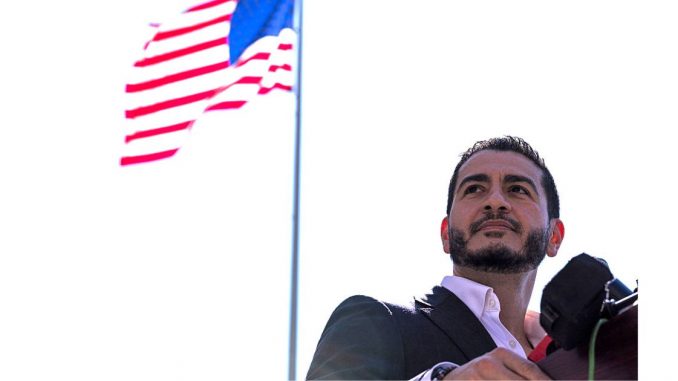
Michigan Democratic Senate primary winner Abdul El-Sayed speaks during an Aug. 5 news conference in Detroit, Michigan. (Finn Gomez / Getty Images)
Reported by:

Cherry Meigh Timbol
News Content Editor
Published August 12, 2026
LANSING, Michigan — A decade-old statement from Abdul El-Sayed has become the latest flashpoint in Michigan’s closely watched 2026 U.S. Senate race, after conservative outlets highlighted comments he made to The New York Times in 2009 about his personal commitment to following Sharia principles.
The remarks resurfaced after El-Sayed won the Democratic nomination for Michigan’s open Senate seat, putting his personal religious beliefs under renewed scrutiny as Republicans prepare to make his views a central issue in the general election.
According to the Washington Free Beacon, El-Sayed made the comments when he was 24 and was purchasing his first home in Ann Arbor. He had chosen a Sharia-compliant mortgage and explained his reasoning in explicitly religious terms.
🕌 The 2009 Statement at the Center of the Controversy
The Washington Free Beacon reported that El-Sayed told The New York Times in 2009 that he wanted his financial decisions to comply with Sharia because he viewed that compliance as a religious obligation.
The remarks were made in the context of his decision to use a Sharia-compliant mortgage rather than a conventional interest-bearing loan. The reported comments concerned his personal religious practice rather than a stated proposal to replace U.S. law with Islamic law.
That distinction is important as the statement enters a highly political campaign environment.
KEY POINT: The newly resurfaced remarks demonstrate that El-Sayed once described following Sharia principles as a personal religious obligation, but the cited 2009 comments alone do not establish that he was advocating the replacement of the U.S. Constitution or American civil law with Sharia.
🇺🇸 Why the Remarks Matter in a Senate Campaign
The controversy comes at a politically significant moment.
El-Sayed has emerged as the Democratic nominee in Michigan’s 2026 Senate race and would become the first Muslim U.S. senator if elected, according to current reporting on his campaign.
His candidacy has already generated intense debate over his progressive politics, foreign-policy views and Muslim faith.
The newly highlighted 2009 remarks give Republican opponents another avenue of attack, particularly as they attempt to portray El-Sayed as outside the political mainstream.
The National Republican Senatorial Committee amplified the Washington Free Beacon report, arguing that voters should examine what El-Sayed’s previous statements reveal about his beliefs.
⚖️ Personal Religious Practice vs. Government Policy
The central question surrounding the controversy is whether El-Sayed’s personal commitment to religious principles should be interpreted as evidence of a political agenda.
The 2009 statement was made while discussing a mortgage. Islamic finance generally includes structures designed to avoid conventional interest payments, and Sharia-compliant financial products are available in the United States.
The statement therefore needs to be considered within its original context.
Critics argue that the language demonstrates a deep personal commitment to Islamic law. Supporters can counter that religious observance by itself does not demonstrate an intention to impose religious law on other Americans.
KEY QUESTION: How should voters distinguish between a candidate’s private religious obligations and the laws and policies he would support as a U.S. senator?
🔎 The Broader Sharia Debate
The controversy is also connected to earlier comments by El-Sayed regarding efforts to restrict the consideration of Sharia or foreign law in American courts.
The Washington Free Beacon previously reported that El-Sayed compared an Oklahoma effort to prohibit courts from considering Islamic and international law with historical injustices including the Trail of Tears. He also criticized what he described as the racial and political forces behind the initiative.
Those earlier remarks have given Republicans additional material for arguing that El-Sayed has held unusually strong views about the role of Islamic law in American political debates.
However, opposition to legislation restricting the consideration of foreign or religious law is not itself proof that a candidate wants religious law to replace the Constitution.
🗳️ Republicans Move to Make Faith a Campaign Issue
Republicans are expected to use the controversy as part of a broader effort to define El-Sayed before the general election.
The NRSC’s decision to highlight the 2009 remarks indicates that the issue is already being incorporated into the Republican campaign narrative.
Conservative publications have gone further, using labels such as “Sharia Senator” and arguing that the remarks raise questions about whether El-Sayed’s religious beliefs are compatible with service in the U.S. Senate.
The political effectiveness of that argument will depend largely on whether Michigan voters view the remarks as evidence of a meaningful policy position or simply as an example of a young man’s personal religious commitment.
🧑⚕️ El-Sayed’s Political Record Is Broader Than the Sharia Controversy
El-Sayed’s political career extends well beyond the newly resurfaced remarks.
He is a physician and public-health specialist who previously served as Detroit’s health director and later headed Wayne County’s Department of Health, Human, and Veterans Services.
He previously ran for governor of Michigan in 2018 and became associated with the progressive wing of the Democratic Party.
His Senate campaign has emphasized issues including health care, workers’ rights and progressive economic policies.
He has also criticized U.S. support for Israel and called for changes to American foreign policy.
These positions, rather than his religious identity alone, are likely to remain major issues in the general election.
🌐 The Role of Religion in the 2026 Race
El-Sayed’s candidacy has already sparked a broader national debate over the role of religion in American politics.
Supporters argue that a Muslim candidate should be evaluated according to the same political standards as any other candidate and that personal religious observance should not automatically be interpreted as a political threat.
Critics argue that voters have a legitimate interest in understanding how candidates’ religious beliefs influence their political judgment.
The resurfaced 2009 comments have therefore become a test of where the line should be drawn between legitimate scrutiny of a candidate’s beliefs and assumptions about what those beliefs necessarily mean for public policy.
⚠️ What the 2009 Remarks Do — and Do Not — Establish
The documented material establishes that El-Sayed spoke positively about following Sharia principles in his personal life and described compliance as a religious obligation.
It does NOT, based on the cited material, establish that he advocated replacing the U.S. Constitution with Sharia law or creating a Sharia-based legal system in the United States.
That distinction is likely to become increasingly important as both parties seek to define El-Sayed ahead of the general election.
🇺🇸 The Bigger Political Question
The controversy ultimately raises a broader question for Michigan voters: should a candidate’s personal religious commitments be treated as relevant evidence about how he would govern, or should voters focus primarily on his explicit policy positions and political record?
For Republicans, the resurfaced statement provides an opportunity to challenge El-Sayed on questions of religious influence, constitutional principles and national identity.
For Democrats and El-Sayed’s supporters, the challenge will be demonstrating that his religious beliefs are compatible with his obligations as an American public official while keeping the campaign focused on policy.
👥 Public / Political Reactions:
🇺🇸 Republican Leaders and Campaign Groups
Republicans have quickly seized on Abdul El-Sayed’s resurfaced 2009 remarks as a potential issue in the Michigan Senate race.
- The National Republican Senatorial Committee highlighted the Washington Free Beacon report about El-Sayed’s comments on following Sharia principles.
- Republican campaign groups are seeking to define El-Sayed early in the general-election campaign.
- The Senate Leadership Fund has also announced additional spending targeting El-Sayed and supporting Republican nominee Mike Rogers.
- The controversy is being presented by Republican critics as part of a broader argument about El-Sayed’s ideology and political judgment.
Position: Republicans are attempting to make El-Sayed’s past statements and political positions central issues in the 2026 Michigan Senate campaign.
🇺🇸 Conservative Media and Commentators
Conservative outlets have given renewed attention to El-Sayed’s 2009 remarks and his previous comments concerning Sharia law.
- The Washington Free Beacon reported that El-Sayed described following Sharia principles as an obligation in his personal life.
- The Western Journal has characterized the remarks as evidence of a longstanding commitment to Sharia.
- RedState has also highlighted the resurfaced comments as part of its scrutiny of El-Sayed.
- Conservative commentators are using the controversy to question how El-Sayed’s religious beliefs could influence his political views.
Position: Conservative critics argue that voters should examine El-Sayed’s previous statements rather than evaluating his candidacy solely on his current campaign messaging.
🕌 El-Sayed and His Campaign
El-Sayed’s campaign has maintained that he continues to follow Sharia in his personal life, according to the Washington Free Beacon report cited by the NRSC. 1
- His campaign has distinguished his personal religious observance from his responsibilities as an American political candidate.
- El-Sayed has presented himself as a progressive candidate focused on healthcare, economic issues and other domestic policies.
- His campaign has also pushed back against attacks that portray his Muslim identity as evidence that he is hostile to American values.
Position: El-Sayed’s campaign is attempting to separate his personal religious beliefs from claims that he would seek to impose Islamic law on the United States.
🟦 Democratic Supporters
Democratic supporters have criticized Republican attacks on El-Sayed as attempts to weaponize his Muslim identity and past statements.
- Critics argue that personal religious observance should not automatically be interpreted as a political program.
- Some Democrats have accused Republicans of using El-Sayed’s name, religion and background to generate fear among voters.
- Supporters have emphasized that El-Sayed should be judged on his stated policies and record rather than assumptions about his faith.
Position: Democratic supporters argue that the campaign should focus on El-Sayed’s policies rather than treating his Muslim faith as evidence of disloyalty or extremism.
🗳️ Michigan Republican Candidate Mike Rogers
Republican Senate nominee Mike Rogers is preparing to face El-Sayed in the November general election.
- The Republican campaign is expected to emphasize El-Sayed’s progressive political positions.
- El-Sayed’s past comments on religion, foreign policy and domestic issues could become part of the Republican effort to define him.
- The race is attracting national attention because control of the Senate could depend on competitive contests such as Michigan.
Position: Republicans are likely to use El-Sayed’s past statements alongside his current policy positions as they attempt to persuade Michigan voters that he is too far left for the Senate.
🌍 Muslim and Arab-American Community
El-Sayed’s candidacy has generated significant interest among Muslim and Arab-American voters, particularly because he could become the first Muslim U.S. senator if elected.
- His primary victory was viewed by many Arab and Muslim Americans as historically significant. 4
- Supporters argue that his faith should be treated as a normal part of his identity rather than as grounds for questioning his patriotism.
- The controversy over Sharia has intensified debate over how Muslim candidates are treated in American elections.
Position: Supporters within the Muslim and Arab-American community see the campaign as an important test of whether a Muslim candidate can compete nationally without having his religious identity turned into a political liability.
📰 Broader Political Debate
The controversy has expanded beyond the original 2009 remarks into a larger debate over religion, constitutional government and political identity.
- Critics argue that voters have a legitimate right to examine how a candidate’s religious beliefs influence his worldview.
- Supporters counter that following religious principles personally does not mean advocating their imposition on other Americans.
- El-Sayed’s previous comments concerning government consideration of Sharia and foreign law have added another layer to the debate.
Position: The central political dispute is increasingly about whether El-Sayed’s religious beliefs should be interpreted as a private matter or as evidence relevant to how he would govern as a U.S. senator.
⚠️ Resulting Effects:
The resurfacing of Abdul El-Sayed’s 2009 remarks about Sharia is likely to intensify an already highly polarized Michigan Senate race. The controversy comes shortly after El-Sayed secured the Democratic nomination and as Republican groups increase efforts to define him before the November election.
1. Sharia Debate Could Become a Major Campaign Issue
El-Sayed’s past comments are likely to receive increased attention from Republican candidates and conservative organizations.
🕌 His statements about personal religious obligations could become a recurring campaign issue.
🗳️ Republicans could use the remarks to question his political philosophy.
⚠️ Democrats could argue that his personal faith is being misrepresented as a political agenda.
➡️ Result: Resurfaced remarks → greater focus on religion and Sharia during the Senate campaign.
2. Republican Attacks on El-Sayed Could Intensify
Republican organizations are already working to define El-Sayed ahead of the general election.
📺 More television and digital advertising could focus on his past statements.
🎯 His progressive positions could be combined with the Sharia controversy.
💰 Additional campaign spending could increase pressure on the Democratic nominee.
➡️ Result: Increased Republican campaigning → stronger efforts to portray El-Sayed as outside the political mainstream.
3. Democratic Counterattacks Could Increase
El-Sayed’s supporters are likely to challenge what they view as attacks based on his Muslim identity.
🕌 Democrats could accuse Republicans of exploiting religious identity.
🇺🇸 Supporters could emphasize that personal religious observance does not automatically determine public policy.
⚖️ The campaign could become a broader debate over religious freedom and political tolerance.
➡️ Result: Republican attacks → stronger Democratic defense of El-Sayed and increased accusations of anti-Muslim campaigning.
4. The Distinction Between Personal Faith and Public Policy Will Become Important
The controversy could force El-Sayed to explain more clearly how his personal religious beliefs relate to his responsibilities as a U.S. senator.
📜 Voters may seek clarification about his views on constitutional law.
⚖️ His opponents could demand specific positions on religious law and government authority.
🗣️ El-Sayed may face additional questions about statements made earlier in his career.
➡️ Result: Religious controversy → greater scrutiny of the candidate’s constitutional and policy positions.
5. The Michigan Senate Race Could Become More Nationalized
The controversy is emerging in a race already attracting significant national attention.
🇺🇸 Republicans see Michigan as an important Senate battleground.
💰 National political organizations are spending heavily to influence the contest.
🗳️ El-Sayed’s nomination has already attracted attention from progressive and conservative groups across the country.
➡️ Result: National political involvement → greater importance of the Michigan Senate race beyond the state.
6. El-Sayed Could Face Greater Pressure to Define His Faith and Politics
The controversy could force the Democratic nominee to spend campaign time responding to questions about his religious beliefs rather than focusing exclusively on healthcare, economic policy and other issues.
🎤 Interviews and debates could include more questions about Islam and Sharia.
📋 Opponents could examine additional statements from his past.
⚠️ Controversies could distract from his primary campaign agenda.
➡️ Result: Increased scrutiny → greater pressure on El-Sayed to clarify his positions.
7. Religious Identity Could Become a Larger Issue in the Election
El-Sayed’s candidacy is already historically significant because he could become the first Muslim elected to the U.S. Senate.
🕌 His faith could attract strong support among some Muslim and Arab-American voters.
⚠️ It could also become a target of political attacks.
🌐 The campaign could become a national debate over the role of religion in American politics. 4
➡️ Result: Historic Muslim candidacy + political controversy → greater national discussion about religion and representation.
8. The Controversy Could Influence Independent and Moderate Voters
The ultimate electoral effect will depend on how Michigan voters interpret the remarks.
🗳️ Some voters could view the comments as evidence of ideological concerns.
🇺🇸 Others could consider them an example of protected personal religious belief.
⚖️ Independent voters may focus on whether El-Sayed supports applying religious principles to government policy.
➡️ Result: Competing interpretations → potential impact on undecided and moderate voters in a closely watched Senate race.
🔮 Future Outlook:
The resurfacing of Abdul El-Sayed’s past comments is likely to become an increasingly important issue as Michigan’s 2026 Senate race moves into the general-election campaign. El-Sayed has already secured the Democratic nomination and will face Republican Mike Rogers in November, in a contest that could have implications for control of the Senate.
1. Republicans Could Intensify Attacks on El-Sayed’s Past Statements
Republican campaigns and outside groups are likely to continue examining El-Sayed’s previous remarks as they attempt to define him before voters make their decision.
🗳️ Past statements could become major campaign talking points.
📺 Television and digital advertisements could highlight controversial comments.
🎯 Republicans could combine the Sharia controversy with El-Sayed’s broader progressive record.
➡️ Outlook: Continued scrutiny of past remarks → greater pressure on El-Sayed to explain his views.
2. El-Sayed Could Face More Questions About Religion and Government
The controversy could force El-Sayed to draw a clearer distinction between personal religious observance and his approach to American constitutional government.
🕌 His religious beliefs could receive increased attention.
⚖️ Voters could demand clearer explanations of his views on religious law and government.
🇺🇸 His campaign could emphasize constitutional principles and separation between personal faith and public policy.
➡️ Outlook: Increased religious scrutiny → greater pressure for policy clarification.
3. The Campaign Could Become Increasingly Polarized
The issue is likely to intensify an already contentious Senate contest.
⚠️ Republicans could portray El-Sayed as too progressive for Michigan.
🟦 Democrats could accuse Republicans of exploiting his Muslim identity.
🗣️ Campaign rhetoric could become increasingly focused on identity, religion and ideology.
➡️ Outlook: Competing narratives → increasingly polarized Senate campaign.
4. National Republican Groups Could Increase Spending
National Republican organizations have already begun increasing their involvement in the Michigan race. The Senate Leadership Fund announced an additional $6 million in television and digital advertising targeting El-Sayed and supporting Republican Mike Rogers. 1
💰 More outside spending could follow.
📺 El-Sayed could face sustained negative advertising.
🎯 Republicans could use the campaign to nationalize the debate over progressive candidates.
➡️ Outlook: Increased national spending → more intense attacks and a more expensive Michigan Senate race.
5. Democrats Could Work to Reunify the Party
El-Sayed narrowly defeated Haley Stevens in a divisive Democratic primary, leaving him with the challenge of consolidating support before November.
🤝 El-Sayed will need to appeal beyond the progressive voters who powered his primary victory.
🗳️ Democratic leaders could work to prevent divisions from weakening the general-election campaign.
🎯 The campaign could shift toward economic, healthcare and other issues with broader voter appeal.
➡️ Outlook: Primary divisions → pressure on El-Sayed to broaden his coalition.
6. Independent and Moderate Voters Could Become Decisive
The controversy could have its greatest electoral impact among voters who are less committed to either party.
🗳️ Some voters could view the remarks as evidence of ideological concerns.
🇺🇸 Others could regard them as expressions of personal religious belief.
⚖️ Independent voters may focus on El-Sayed’s actual policy positions rather than the controversy itself.
➡️ Outlook: Competing interpretations → independent voters could play a critical role in determining the outcome.
7. The Sharia Debate Could Remain a Recurring Issue
Even if El-Sayed attempts to move the campaign toward healthcare and economic issues, opponents could continue returning to the controversy.
🕌 Questions about Sharia could appear in debates and interviews.
📋 Additional statements from El-Sayed’s past could receive renewed attention.
🔎 Opponents could continue examining his previous political positions.
➡️ Outlook: Resurfaced controversy → continued attention throughout the general-election campaign.
8. The Senate Race Could Become a National Test for Progressive Politics
El-Sayed’s primary victory has already attracted national attention because he defeated a more establishment-backed candidate in a competitive state. His November race against Rogers could provide another test of whether a progressive candidate can win statewide in Michigan.
🇺🇸 A Democratic victory could strengthen the case for progressive candidates in other swing states.
🇷🇺 Republicans could use a victory by Mike Rogers as evidence that progressive candidates face limits in competitive states.
🗳️ The outcome could influence Democratic strategy heading into future elections.
➡️ Outlook: Michigan contest → potential national implications for the future direction of both parties.
🧩 Bottom Line:
The resurfacing of Abdul El-Sayed’s 2009 remarks about Sharia has created a new political vulnerability for the Democratic Senate nominee as he prepares for the November general election against Republican Mike Rogers.
🇺🇸 For Republicans, the controversy provides another opportunity to define El-Sayed as a progressive candidate whose past statements and religious views deserve greater scrutiny.
🕌 For El-Sayed, the central challenge will be explaining the distinction between his personal religious obligations and his responsibilities as a potential U.S. senator operating under the Constitution.
🟦 For Democrats, the issue creates a delicate political balance between defending El-Sayed against what they view as attacks on his Muslim identity while also addressing legitimate questions about his stated beliefs and policy positions.
🗳️ For Michigan voters, the controversy adds another dimension to an already highly competitive Senate race, with voters likely to weigh El-Sayed’s religious views alongside healthcare, economic policy, foreign policy and other campaign issues.
🇺🇸 For the broader national debate, the controversy highlights continuing tensions over religious freedom, political identity and the role of personal faith in American public office.
⚠️ Bottom Line: El-Sayed’s 2009 remarks are likely to remain a campaign issue, but the political impact will depend on whether voters interpret them as evidence of a broader governing philosophy or as an expression of personal religious observance. With national Republican groups already increasing spending to define him, the controversy could become one component of a much larger battle over El-Sayed’s political identity and fitness for the Senate.
SOURCES: THE WESTERN JOURNAL – Sharia Senator: In 2009, Abdul El-Sayed Declared He Will Follow Sharia in ‘Everything’ He Does Until the Day He Dies
NRSC – Washington Free Beacon: El-Sayed Proclaimed ‘Obligation’ To Follow Sharia Law Until the Day He Dies
REDSTATE – El-Sayed’s Alarming ‘Sharia ‘Til I Die’ Comment Comes Back to Haunt Him