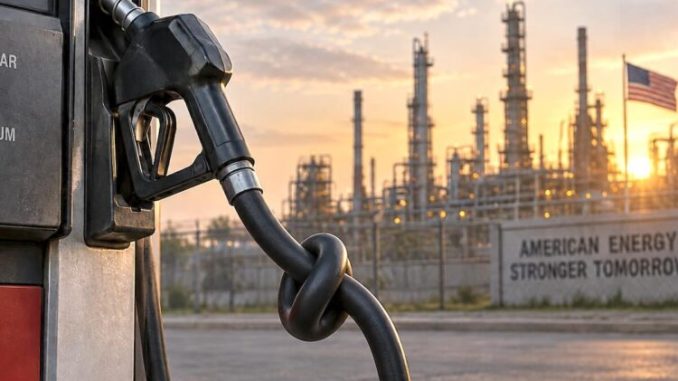
Image: Climate Lawsuits Are Driving Up Energy Costs—And Consumers Pay The Price
Related: We must use the remaining fossil fuels to build nuclear
Video: States 2050 og Williamson
The Marcellus Shale, stretching roughly 95,000 square miles beneath Pennsylvania, West Virginia, Ohio, and New York, is the largest single natural gas deposit ever discovered in America — and it spent 120 years being drilled straight through and dismissed as worthless. In 2002, the United States Geological Survey assessed the formation and concluded it held about 1.9 trillion cubic feet of undiscovered gas, a rounding error by national standards. By 2019, the same agency revised that estimate to 96.5 trillion cubic feet, after horizontal drilling and hydraulic fracturing proved that this black source rock could produce commercial quantities of gas. The turning point came in 2004, when geologist Bill Zagorski made the connection between the Barnett Shale in Texas and the Marcellus, convincing Range Resources to fracture-stimulate a dead well called the Renns Number 1 in Mount Pleasant Township, Washington County. That single well produced about 300,000 cubic feet of gas per day and proved the concept worked.
The Marcellus is a Middle Devonian-age source rock laid down about 390 million years ago in a stagnant foreland basin during the Acadian Orogeny. Its total organic carbon runs between 3 and 12 percent, and its burial history placed it squarely in the gas window, converting kerogen into dry methane in the northeast and wet gas with ethane and propane in the southwest. Its permeability is measured in nanodarcies, meaning gas never migrated out of the rock under its own power. Stiff limestone layers above and below the Marcellus act as fracture barriers, keeping induced cracks within the target zone, while the formation’s silica-rich, low-clay mineralogy makes it brittle enough to crack in branching networks that link into natural joint sets. Today the Marcellus delivers more than 25 billion cubic feet of gas per day, supplying roughly a third of all natural gas produced in the lower 48 states, and surpassing the historic Hugoton field by nearly ninefold. Within 15 years of the Renns well, the United States went from building LNG import terminals to becoming the world’s largest exporter of liquefied natural gas
Who Pays For What Solar Owners Don’t?
Video: The Heartland Institute
Rooftop solar sounds like the reasonable version of solar power. Panels on your own roof, no farmland paved over, lower bills for everyone. Heartland Institute’s Linnea Lueken explains why the grid-connected version doesn’t work that way.
Under net metering, utilities are typically required to buy rooftop solar power at retail rates instead of wholesale, so that electricity costs far more than power from an existing plant. Everyone else on the grid covers the difference. Solar owners also skip much of the grid maintenance cost and the expense of the backup generation that has to stay available for when the sun goes down.
Then there’s the federal tax credit covering about a third of the install. Add it up and you get a subsidy flowing from people who can’t afford solar panels to people who can.
Going fully off grid with your own batteries is a different conversation. Asking your neighbors to fund your roof is not
Wind and solar scammers and their enablers run on “double-think”, the Orwellian concept of comfortably holding mutually inconsistent ideas, simultaneously.
Whenever the sun sets and/or calm weather sets in, they blame coal-fired power plants for the ensuing power rationing and blackouts and the fact we have a grid on the brink of collapse. It’s “unreliable” coal power that’s to blame, don’t you see?
Same with power prices.
Infect the grid with massively subsidised and chaotically intermittent wind and solar – mandate both unreliable sources and penalise anyone who won’t accept third-rate electricity when it is sometimes available – and when power prices go through the roof, blame the same coal-fired power plants that have been chugging away for more than a century provided electricity for a snip, around-the-clock, whatever the weather
Full article ..