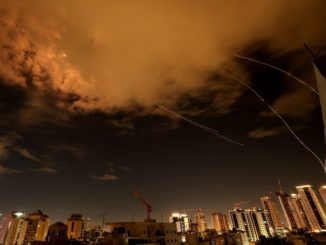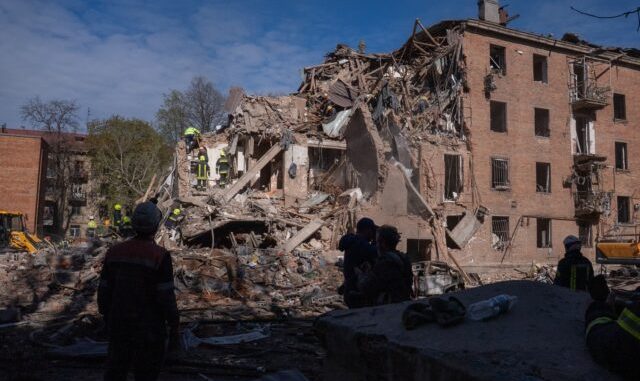
At least 16 people have been killed in strikes over the weekend across Ukraine, Russian-occupied territory and Russia, local authorities said, as the 40th anniversary of the Chernobyl nuclear disaster prompted fresh warnings about the risks posed by attacks near the plant during Russia’s more than four-year invasion of its neighbor.
Published April 26, 2026
KYIV, Ukraine — A new wave of drone and missile strikes across Ukraine and Russian-held territories has left at least 16 people dead, officials and local reports said, intensifying an already volatile conflict at a moment when Ukraine is marking the anniversary of the 1986 Chernobyl nuclear disaster.
The violence stretched across multiple regions, including Dnipro, Crimea, and Russia’s interior, underscoring how the war has increasingly expanded beyond traditional front lines into a wide-ranging aerial and cross-border campaign.
Coordinated Strikes Hit Multiple Regions
Ukrainian officials reported that the city of Dnipro was among the hardest hit, where a Russian missile and drone barrage reportedly killed at least nine people and damaged residential buildings and infrastructure. Emergency crews spent hours searching through rubble as fires burned in several impacted sites.
In addition to Dnipro, strikes were reported in other Ukrainian regions, though full casualty assessments are still ongoing as authorities continue to recover victims and assess structural damage.
At the same time, Russian-installed officials in occupied Crimea said a Ukrainian drone strike killed a civilian in Sevastopol. In eastern Ukraine’s Luhansk region, additional fatalities were reported following overnight drone attacks, though independent verification remains limited due to restricted access in occupied areas.
Russia and Ukraine have increasingly relied on long-range drones and missiles, allowing both sides to strike far beyond the immediate battlefield.
Cross-Border Attacks Deep Inside Russia
The conflict also spilled deeper into Russian territory, with Ukrainian forces reportedly targeting an oil refinery in the Yaroslavl region. Ukrainian military sources said the strike caused fires and disrupted fuel production tied to Russia’s military supply chain.
These long-range strikes reflect a shift in Ukraine’s strategy toward targeting energy and logistics infrastructure inside Russia, aiming to disrupt military operations and supply routes.
Russian officials have frequently condemned such attacks as escalatory, while Ukraine argues they are necessary to counter ongoing bombardments of Ukrainian cities and infrastructure.
Chernobyl Anniversary Reignites Nuclear Safety Concerns
The latest escalation coincides with the anniversary of the 1986 Chernobyl nuclear disaster, when a reactor explosion released radioactive material across much of Europe.
Ukraine’s leadership used the occasion to renew warnings about the risks posed by military activity near nuclear facilities, particularly after Russian forces previously occupied the Chernobyl exclusion zone during the early stages of the 2022 invasion.
President Volodymyr Zelensky has repeatedly warned that continued fighting near nuclear infrastructure creates “serious and unacceptable risks,” particularly if protective systems or monitoring operations are disrupted.
While no nuclear sites were directly hit in the latest wave of strikes, the proximity of ongoing military operations to sensitive infrastructure continues to worry international observers.
Civilian Toll Continues to Rise
The latest attacks highlight the continued human cost of the conflict, with civilians bearing the brunt of strikes on residential areas and infrastructure.
In Dnipro, emergency responders described chaotic scenes as buildings collapsed and residents were evacuated from damaged neighborhoods. Power outages and transportation disruptions were also reported in several affected areas.
Humanitarian groups have warned that repeated strikes on urban centers are straining emergency response systems and leaving civilians increasingly vulnerable as the war drags on.
Escalation With No Clear End in Sight
Despite ongoing diplomatic efforts and international calls for de-escalation, both sides continue to intensify long-range attacks.
Ukraine has focused on targeting Russian energy and military infrastructure, while Russia continues large-scale strikes on Ukrainian cities and industrial facilities.
With neither side showing signs of backing down, the conflict is increasingly defined by drone warfare, missile exchanges, and cross-border strikes that extend far beyond the original battlefield.
As Ukraine marks another year since Chernobyl, the renewed focus on nuclear safety serves as a reminder of how quickly modern warfare can intersect with high-risk infrastructure — and how fragile regional stability remains.
🔍 Critical View: A War Growing More Dangerous as Civilian Deaths Rise and Nuclear Fears Return
The latest reports from Ukraine paint a grim picture: more strikes, more civilian deaths, and a conflict that keeps spreading in both scale and risk. At least 16 people were reportedly killed in a wave of attacks across Ukraine and Russian-controlled areas, while cities like Dnipro once again found themselves under heavy bombardment.
What stands out is not just the destruction itself, but the direction the war is heading.
Civilian Areas Are Still Taking the Hit
One of the most concerning patterns is how often residential areas are being struck. Apartment buildings, urban neighborhoods, and civilian infrastructure continue to be caught in the crossfire.
In plain terms, this means ordinary people—not soldiers—are the ones waking up to explosions, losing homes, and dealing with power outages and emergency evacuations.
From a critical standpoint, this raises a difficult question: if the conflict keeps expanding into cities, what does “military target” even mean anymore?
The War Is Spreading Beyond Borders
Another major shift is how the fighting is no longer confined to the main battlefield. Ukraine has reportedly carried out strikes inside Russia, including energy infrastructure like oil refineries. Russia continues its own long-range attacks on Ukrainian cities and critical systems.
This back-and-forth creates a widening circle of retaliation. Instead of slowing the conflict down, each side’s deeper strikes appear to push the other side to respond in kind.
The risk here is escalation without a clear off-ramp.
Chernobyl Anniversary Highlights a Deeper Fear
The timing of these attacks—on the 40th anniversary of the Chernobyl disaster—adds a symbolic layer that is hard to ignore.
Chernobyl remains a global reminder of how quickly nuclear safety can turn into a humanitarian catastrophe. Ukrainian leadership has warned that military activity near nuclear infrastructure amounts to “nuclear terrorism,” especially given past concerns about fighting near sensitive zones.
Even if nuclear sites are not directly hit, the fact that a war is taking place in a country still dealing with the legacy of Chernobyl raises serious concerns about risk management in wartime conditions.
A War With No Clear Boundaries
What is increasingly clear is that this is not a traditional battlefield war anymore. It is a long-distance conflict involving drones, missiles, and infrastructure strikes stretching across hundreds of miles.
That creates three major problems:
- Civilians are increasingly exposed to sudden attacks
- Infrastructure like power and fuel systems becomes a target
- The line between battlefield and home front is disappearing
For many observers, this raises concern that the conflict is becoming harder to control as it expands in both geography and intensity.
The Bigger Concern: Escalation Without Resolution
The pattern emerging from recent events is straightforward but troubling: attacks lead to retaliation, retaliation leads to further escalation, and civilians remain in the middle of it.
At the same time, the symbolic weight of Chernobyl serves as a reminder of what uncontrolled risk looks like when safety systems fail or are put under stress during conflict.
From a practical standpoint, the central issue is not just who is striking whom—but how long this cycle can continue before the consequences become even harder to contain.
👥 On the Ground:Civilians Caught in the Middle as Strikes Continue and Daily Life Becomes More Uncertain
In Ukraine, daily life in many areas now moves around air raid warnings, explosions in the distance, and the constant uncertainty of when the next strike might come. Recent reports of at least 16 deaths in fresh attacks across different regions show that the conflict is still very active—and still very close to ordinary people’s homes.
What is happening on the ground is not just military movement. It is a steady pressure on everyday life that never fully goes away.
Life in Cities Under Threat
In places like Dnipro and other affected cities, residents are dealing with repeated disruptions. When strikes hit, it is often apartment blocks, roads, and basic infrastructure that take the damage.
That means power cuts, damaged housing, and emergency evacuations become part of normal life. Even when people are not directly injured, they are still affected by the aftermath—broken windows, destroyed buildings, and disrupted services.
For many families, the biggest concern is no longer just safety during an attack, but what remains afterward.
Cross-Border Strikes Are Expanding the Risk Area
One noticeable change is how the conflict is no longer limited to front-line zones. Long-range drones and missiles are now reaching deeper into both Ukraine and Russian-controlled territory.
Ukraine has targeted infrastructure such as fuel facilities inside Russia, while Russian forces continue strikes on Ukrainian cities and power systems.
On the ground, this creates a wider sense of insecurity. People far from the front lines are now also having to prepare for the possibility of sudden strikes.
Chernobyl Anniversary Adds Emotional Weight
The timing of the recent attacks—around the anniversary of the Chernobyl disaster—has added a deeper emotional layer for Ukrainians.
Even decades later, Chernobyl is still associated with fear, displacement, and long-term consequences that stretched far beyond Ukraine. Many families remember it as a warning about how quickly a crisis can spiral into something much larger than expected.
Now, with war taking place in the same country, those memories are resurfacing in public conversation, especially as officials warn about risks near sensitive infrastructure.
Civilians Continue to Absorb the Impact
What stands out most from reports on the ground is that civilians remain the ones absorbing the impact of the conflict.
- Homes are being damaged or destroyed
- Emergency services are stretched thin
- Power and fuel systems are repeatedly disrupted
- Families are forced to move or take shelter repeatedly
Even when strikes are aimed at military or infrastructure targets, the effects often spill over into civilian life.
A War That Feels Closer Every Day
For many people inside Ukraine, the conflict no longer feels distant or limited to specific regions. With drones and missiles reaching deeper areas, the sense of safety has narrowed significantly.
What used to be considered “safer cities” are now also dealing with alerts and occasional strikes. That shift is changing how people plan their days, where they sleep, and how they move around.
🎯 The Final Word:
The situation in Ukraine shows a conflict that is not slowing down and is increasingly spilling into civilian life, with strikes hitting cities, homes, and key infrastructure far from the front lines. What stands out is that the impact is no longer limited to soldiers or battle zones—ordinary families are the ones dealing with destroyed apartments, power cuts, disrupted transport, and constant emergency alerts. Life in many areas has shifted into a routine of reacting to danger instead of living normally.
On top of that, the timing around the Chernobyl anniversary brings back serious concerns about how fragile things can become when conflict takes place near sites tied to nuclear risk. Even if no nuclear facilities are directly hit, the memory of past disaster adds weight to current warnings about safety, miscalculation, or unintended consequences in a war environment that already feels unpredictable.
From a practical standpoint, the biggest issue now is the ongoing cycle of attack and retaliation. Each strike tends to lead to another response, and over time this pattern spreads the damage wider instead of containing it. Civilians end up stuck in the middle of decisions they have no control over, while essential services like energy, water, and transportation remain vulnerable to disruption.
At this stage, the concern is not just about individual incidents, but about how long this pattern can continue before the human, economic, and safety costs become even harder to manage.