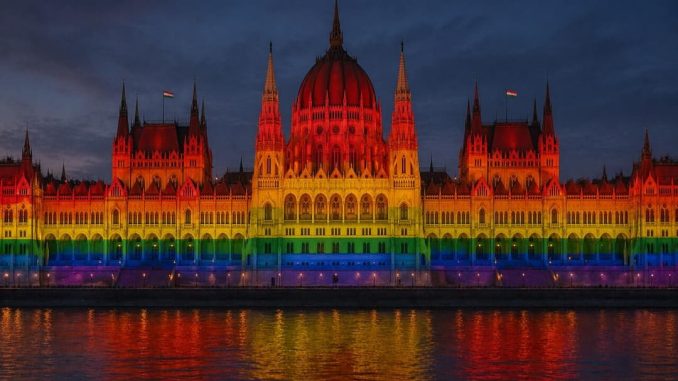
Hungary will soon be getting a new government under Tisza’s Péter Magyar, but the landscape is already shifting, with a new LGBTQ-themed online television channel called “Rainbow” (“Szivárvány”) TV in the works to broadcast programs targeting the LGBTQI community 24 hours a day.
Published April 26, 2026
BUDAPEST, Hungary — A reported plan to launch a 24-hour television channel focused on LGBTQ programming in Hungary is drawing attention across political and media circles, coming at a sensitive moment in the country’s ongoing disputes with the European Union over media and child protection laws.
According to multiple reports, a proposed channel—referred to in some outlets as “Rainbow TV”—is being developed as a dedicated broadcast and streaming platform featuring LGBTQ-themed content around the clock. Programming is expected to include cultural segments, talk shows, entertainment features, and community-focused storytelling.
The initiative has not yet been approved by Hungary’s media regulator, and licensing decisions remain pending.
Timing follows EU legal pressure
The proposal comes shortly after a ruling by the European Court of Justice found that aspects of Hungary’s 2021 child protection law conflict with EU law. The court ruled that restrictions tied to LGBTQ content in media and education violate EU anti-discrimination principles.
The decision has intensified tensions between Budapest and Brussels, with Hungary maintaining that its laws are designed to safeguard children from inappropriate material, while EU officials argue the measures unfairly restrict expression and representation.
Supporters and critics divided
Supporters of the planned channel describe it as a modern media project aimed at expanding representation and providing specialized programming for a specific audience. They point to growing fragmentation in digital media consumption, where niche channels and streaming platforms are increasingly common.
Critics, however, say the timing and nature of the proposal raise broader cultural and political questions, especially given Hungary’s ongoing legal disputes with the EU over LGBTQ-related media content regulations.
Regulatory decision still ahead
Hungary’s National Media and Infocommunications Authority is expected to review the application under existing broadcasting and classification rules. Officials have not yet announced a timeline for a decision.
The outcome could become another flashpoint in the wider debate over media regulation, national sovereignty, and cultural policy in Hungary.
🔍 Critical View: Hungary’s Proposed 24/7 LGBTQ TV Channel Raises Questions About Media Direction and Cultural Priorities
A plan to launch a 24-hour television channel dedicated to LGBTQ-themed programming in Hungary is now sparking debate—not just about media choices, but about where public attention and broadcasting priorities are heading.
At first glance, supporters describe it as just another niche channel in a modern media landscape. But critics argue the issue is not simply about entertainment—it’s about what kind of content becomes normalized and promoted through constant, around-the-clock exposure.
1. One-sided programming focus
A full-time channel dedicated to one specific social or identity-based theme naturally raises questions about balance.
In a media environment where families and children can easily access content, critics worry that constant emphasis on one perspective may crowd out more general, neutral, or traditional programming that reflects a broader audience.
2. Influence on younger viewers
Even if some programs are labeled for adults, television content often flows across platforms, clips, and online streaming. Critics argue that once a 24/7 channel exists, its content can easily reach younger audiences indirectly. This raises concerns about how early exposure to complex identity topics should be handled, and who gets to decide what is appropriate for children.
3. Timing alongside legal and cultural disputes
The proposal is also emerging during ongoing tensions between Hungary and European institutions over media laws and child protection rules. Critics see the timing as significant, arguing that media changes like this do not happen in isolation—they are part of a larger cultural and legal debate over how far regulation should go in shaping public messaging.
4. Public media space and priorities
Another concern raised is whether public attention and broadcast resources should focus on highly specialized programming when many viewers still rely on television for general news, education, and family-oriented content. Critics say media space is limited, and prioritizing niche identity-based channels may shift attention away from shared cultural programming.
5. Broader cultural direction
At the center of the debate is a simple question: should national media systems increasingly segment audiences into identity-based channels, or should they prioritize more common-ground content that appeals broadly across society?
Supporters see diversity and representation. Critics see fragmentation and a gradual shift in what is considered “mainstream” culture.
👥 On the Ground:What a 24/7 LGBTQ TV Channel in Hungary Really Means for Everyday Viewers
In Hungary, talk of a planned 24-hour TV channel focused on LGBTQ-themed content is now moving from policy circles into everyday conversation. On paper, it sounds like just another channel joining a crowded media space. But for many people, the bigger question is simpler: what will actually be on TV all day, and who is it really for?
A very narrow focus on one topic
Unlike regular channels that mix news, entertainment, cooking, sports, and family shows, this proposed channel is built around one central theme. Critics say that already makes it very different from what most families are used to watching.
The concern is not about a single program or documentary—it’s about nonstop content centered on one specific social topic, repeated all day, every day.
What viewers in ordinary households are thinking
On the ground, many parents and everyday viewers tend to think in practical terms: what will their children accidentally see while flipping channels? What kind of ideas or messages will be shown repeatedly in the background of daily life?
Even if a channel is meant for a specific audience, TV does not stay neatly separated in real households. One remote control can expose everyone in the home to the same content.
The question of “normal TV space”
Some people are also asking whether it makes sense to dedicate a full channel slot—24 hours a day—to one identity-focused topic when most viewers expect general programming.
To them, television has always been a shared space: news for everyone, shows for families, sports for fans, and entertainment that doesn’t require explanation or labels. A highly specialized channel changes that balance.
Timing that adds tension
The discussion is happening at the same time as ongoing disputes between Hungary and European institutions over media rules and child protection standards. That context makes the proposal feel more political than purely cultural.
For critics, it raises a broader concern: whether media is slowly shifting from shared national content toward more segmented, interest-based broadcasting.
🎯 The Final Word:
From a critical, everyday perspective, the main worry here is about how realistic it is for parents to fully control what children are exposed to in a home where TV and streaming are always accessible. Even if a channel says certain programs are restricted or intended for adults, in real life supervision is not perfect. Parents are busy, phones ring, chores happen, and kids can change channels or come across content when no one is actively watching over them.
That’s where the concern comes in. Critics feel that once a 24-hour channel is available in a household, especially one focused heavily on sensitive social topics, it becomes part of the normal viewing environment. And when something is always present on TV, even in the background, children can still see clips, hear conversations, or get curious and start asking questions that parents may not be ready to explain at that moment.
In simple terms, the argument is about real-life limits, not theory. On paper, restrictions and labeling may exist—but in everyday family life, control is never 100%. So the concern is whether it is wise to add more highly specific or sensitive programming into a space that children can easily access at any time, especially when parents cannot be there every single moment to filter what comes through the screen.