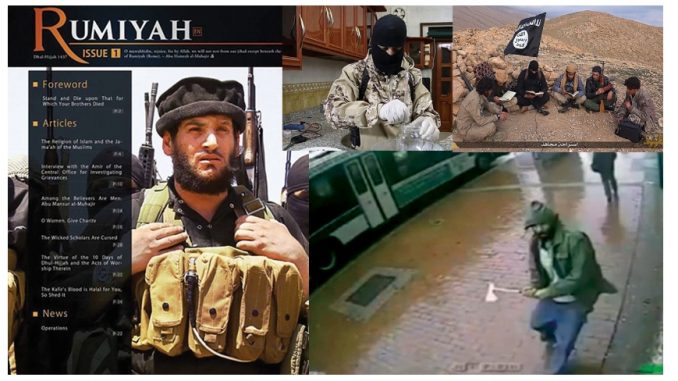
Rumiyah (Arabic: رومية, meaning “Rome”) was an online propaganda and recruitment magazine published by ISIS, first released in September 2016 in multiple languages. The magazine and various videos released by ISIS taught tactics such as knife attacks, vehicle ramming, arson, and bomb-making. No similar right-wing extremist magazine or propaganda campaign exists. Photo courtesy of U.S. Army University Press.
Published April 26, 2026
Western governments are facing renewed scrutiny over how they characterize and prioritize global terrorism threats, as analysts and political commentators argue there is growing inconsistency in how extremist violence is framed in public discourse.
Recent reporting from international monitoring bodies, including United Nations counterterrorism assessments, has highlighted that groups such as ISIS and al-Qaeda remain active in multiple regions, particularly across parts of Africa and the Middle East, where affiliates continue to carry out attacks, recruit fighters, and expand local influence networks.
At the same time, security agencies in the United States and Europe have warned that the nature of the threat has shifted significantly in recent years, with a rising share of incidents involving self-radicalized individuals acting independently rather than as part of organized foreign-directed cells.
Debate Over “Framing” of the Threat
Critics of Western policy argue that political leaders and institutions often avoid explicitly linking certain extremist ideologies to terrorism in public messaging, instead emphasizing broader categories such as “domestic extremism” or “lone actor violence.”
Supporters of that approach say it reflects operational realities: modern terrorism investigations frequently show overlapping influences, including online radicalization, mental health factors, geopolitical conflicts, and hybrid ideological ecosystems that are not easily categorized.
Security analysts caution that focusing too narrowly on any single ideological category risks overlooking other emerging threats, including politically motivated violence across the ideological spectrum.
Rising Global Complexity
Counterterrorism reports have consistently noted that extremist networks today are more decentralized, with smaller cells, encrypted communication tools, and greater reliance on digital propaganda rather than territorial control.
According to recent assessments, ISIS-linked and al-Qaeda-affiliated groups continue to operate in regions where governance is weak, particularly in parts of the Sahel, Yemen, and Somalia, though their operational strength varies widely by region.
Political Sensitivity in Western Discourse
The way governments and media describe these threats has become increasingly politically sensitive, particularly as public debates intensify over immigration, integration, and national security policy.
Some lawmakers argue that avoiding direct language about ideological motivation can hinder public understanding, while others warn that overly broad labeling can stigmatize entire communities and undermine counterterrorism cooperation.
🔍 Critical View:
👥 On the Ground:Growing Debate Over How Security Threats Are Handled and Talked About
Across many Western cities, the conversation around safety and terrorism is not just happening in government offices—it’s happening in everyday life. From commuters to small business owners, there’s a sense that something has changed in how threats are handled, and how openly they are talked about.
What People Notice in Daily Life
For many residents, concern isn’t about abstract policy—it’s about visible reality. News of attacks, arrests, or disrupted plots often spreads quickly online, and people pay attention to patterns they think they see over time.
Some say they feel that certain types of threats, especially those linked to Islamist extremist groups, are treated more cautiously in public discussion. They notice that official statements often use broad language, which they feel can make it harder to understand exactly who or what is being warned about.
At the same time, authorities continue to emphasize that threats come from multiple directions, including individuals influenced by different ideologies or personal grievances.
Law Enforcement Focus vs Public Messaging
Security agencies generally say they are tracking a wide range of risks, from organized extremist networks to isolated individuals acting alone.
But critics argue there is a gap between what agencies are monitoring internally and what is clearly communicated to the public. They feel announcements are sometimes softened or generalized, which can leave people unsure about what the main risks actually are.
Supporters of current communication practices say this approach helps avoid panic, reduces community tension, and protects ongoing investigations.
The Question of Priorities
Another concern often raised is whether all threats are treated equally in terms of urgency and public attention.
Some believe that certain ideological threats—especially those tied to international extremist groups—still deserve more direct and consistent focus in public messaging. Others argue that domestic and politically motivated violence has become just as important, and that security agencies are right to broaden their focus.
This disagreement has become part of a wider public debate about how governments define “the main threat” in a changing security landscape.
Trust and Clarity Are Key Issues
At the center of the discussion is trust. People want to feel that they are getting a clear and honest picture of risks in their communities.
When language feels too vague or inconsistent, it can lead to frustration and skepticism. On the other hand, officials argue that communication must be carefully managed so it does not inflame tensions or unfairly label entire groups.
🎯 The Final Word:
At the end of the day, a lot of people just want clear, plain answers when it comes to safety and terrorism. The concern raised by critics is that Western leaders sometimes use very broad or careful language that can make it harder for ordinary people to understand what the real threats are. Instead of clearly naming the groups or ideologies involved in certain attacks or plots, officials often use general terms that cover many different situations at once.
For critics, the issue is not about ignoring other forms of violence or pretending there is only one kind of threat. They acknowledge that danger can come from different directions, including lone individuals and politically motivated attackers. But they believe that when specific extremist groups are repeatedly involved in global attacks, that should be stated more directly and consistently in public messaging.
They also argue that being too careful with words can sometimes create confusion or even distrust. When people feel like important details are being softened or not fully explained, they may start to think information is being filtered for political or social reasons rather than presented as it is. That can lead to frustration, especially when people are trying to understand what is actually happening in their communities.
In simple terms, the view is that security communication should be more straightforward. People want to hear clear explanations of who is responsible for what kinds of threats, instead of overly general labels that feel vague. The belief is that better clarity does not create fear—it creates awareness. And with awareness, people feel more prepared, more informed, and more confident that leaders are addressing the real issues directly instead of avoiding difficult language.