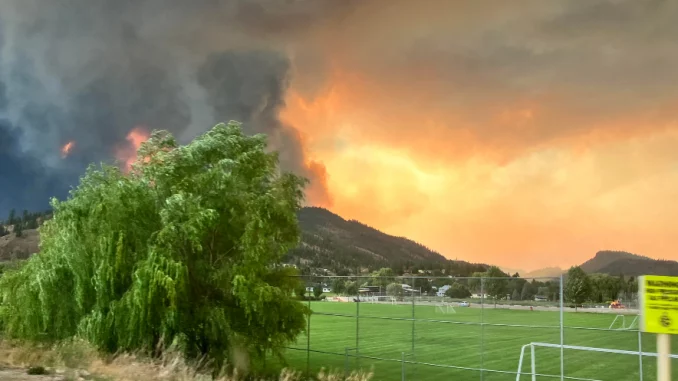
Flames from the Bald Range wildfire west of Summerland, B.C. light up the Okanagan sky. (Tracy Sherlock/Submitted)
Published August 9, 2026
A fast-moving wildfire crisis has erupted across British Columbia, forcing more than 20,000 people from their homes as flames rapidly spread through communities around Okanagan Lake, prompting provincial authorities to declare a state of emergency.
The Bald Range wildfire exploded in size amid hot, windy and exceptionally dry conditions, destroying homes and other property while sending residents scrambling to evacuate. British Columbia Premier David Eby described the situation as extremely dangerous and rapidly changing.
The emergency declaration, announced Saturday, gives provincial authorities additional powers to coordinate evacuations, restrict travel and secure accommodations and other resources for evacuees and emergency personnel.
A Fire that exploded overnight
The Bald Range fire grew dramatically in a matter of hours, expanding to roughly 9,500 hectares (23,500 acres) and threatening communities including Summerland and Peachland.
Officials said the fire’s behavior was particularly dangerous because of strong winds, dry vegetation and prolonged drought conditions.
The blaze became so intense that it generated its own weather system, including lightning, further complicating firefighting operations.
Premier Eby said homes had been lost and properties destroyed, while some residents became trapped when conditions shifted rapidly and had to be rescued.
20,000 People forced to evacuate
More than 20,000 residents have been forced to flee areas affected by evacuation orders, making the incident one of the largest wildfire evacuations in British Columbia this summer.
Summerland, a community of roughly 12,000 people, was placed under evacuation orders, while thousands more residents around Peachland and surrounding areas were also ordered to leave.
The speed of the fire’s advance created a chaotic evacuation environment, with authorities warning residents not to delay leaving when orders are issued.
Highway 97 Closed as Emergency response intensifies
The wildfire crisis has also disrupted transportation through the region.
Highway 97, a major transportation route through British Columbia’s Interior, has been closed because of the fire danger, creating additional challenges for residents attempting to evacuate and emergency crews trying to move personnel and equipment.
Search-and-rescue teams have been deployed, with aircraft also assisting emergency operations. Officials said dozens of people have already required rescue as the fire moved through threatened areas.
Homes destroyed as fire creates its own weather
The most alarming aspect of the Bald Range fire has been its explosive behavior.
Officials have described the conditions as exceptionally dangerous, with towering flames consuming trees and rapidly changing winds pushing the fire into new areas.
The fire’s ability to generate lightning and its own weather system demonstrates how intense the blaze has become, making traditional firefighting operations considerably more difficult.
Authorities are also investigating a possible wildfire-related fatality near Summerland, although hazardous conditions have complicated access to the area.
More than 100 Fires Burning across B.C.
The Bald Range wildfire is only one part of a much larger wildfire emergency.
More than 100 wildfires are burning across British Columbia, with hot and dry weather creating dangerous conditions for firefighters and communities throughout the province.
International assistance has also been mobilized, with firefighters and other support coming from countries including Mexico, Australia and France, according to Reuters.
Canada has already seen approximately 4 million hectares burned this year, underscoring the scale of the country’s ongoing wildfire crisis.
Emergency Powers Activated
The declaration of a provincial state of emergency allows British Columbia officials to take extraordinary measures as the wildfire situation develops.
Those powers can assist authorities with evacuation management, travel restrictions, accommodations and the movement of resources needed to protect communities and fight the fires.
For residents in threatened communities, officials are emphasizing the importance of following evacuation orders immediately rather than waiting until flames approach.
The rapidly changing conditions around Summerland and Peachland have demonstrated how quickly escape routes and safety conditions can deteriorate.
A Warning for Communities across Western Canada
The crisis in British Columbia is unfolding during another severe wildfire season across western Canada and the broader Pacific Northwest.
Extreme heat, drought, dry vegetation and powerful winds are combining to create conditions in which fires can spread rapidly and overwhelm communities.
For British Columbia, the immediate priority remains protecting lives, evacuating threatened residents and preventing the Bald Range fire from advancing into additional populated areas.
With dozens of communities and thousands of residents potentially exposed to continuing wildfire danger, authorities are warning that the situation remains dynamic and potentially dangerous.
The coming days will be critical as firefighters battle to contain the blaze while officials monitor weather conditions that could either help slow the fire or trigger another explosive expansion.
⚠️ Implications:
The escalating wildfire crisis in British Columbia highlights the growing threat posed by extreme wildfire conditions to communities, infrastructure, emergency services, and regional economies. With tens of thousands of residents forced to evacuate and a provincial state of emergency declared, the latest fires demonstrate how quickly dangerous conditions can overwhelm local response capabilities and disrupt daily life.
1. Mass Evacuations Are Increasing Pressure on Emergency Services
- More than 20,000 people have been forced to flee their homes as wildfires spread across parts of British Columbia.
- Communities including Summerland and Peachland have faced evacuation orders.
- Emergency agencies are being required to coordinate evacuations, rescues, shelters, transportation, and firefighting operations simultaneously.
Implication: Large-scale evacuations are likely to continue placing significant pressure on emergency personnel, shelters, transportation networks, and local governments.
2. Wildfires Are Increasingly Threatening Populated Communities
- The rapid spread of the Bald Range wildfire has placed residential areas directly in the path of advancing flames.
- Homes and other properties have reportedly been destroyed as the fire moved through threatened areas.
- Strong winds, dry vegetation, and extreme heat can cause fires to change direction and spread rapidly.
Implication: Communities located near forests and other fire-prone areas may face increasingly frequent evacuation threats during periods of extreme wildfire danger.
3. Critical Transportation Infrastructure Remains Vulnerable
- Highway closures have complicated evacuation efforts and disrupted transportation through affected areas.
- Major roads are essential for moving residents away from danger while allowing firefighters and emergency equipment to enter affected communities.
- Extended closures can also interfere with commercial transportation and regional supply chains.
Implication: Future wildfire emergencies could produce broader economic disruptions if major highways and transportation corridors remain closed for extended periods.
4. Firefighting Resources Face Growing Pressure
- More than 100 wildfires have been reported burning across British Columbia.
- Fire crews, aircraft, emergency responders, and other resources must be distributed across multiple active fires.
- International assistance from countries including Mexico, Australia, and France underscores the scale of the firefighting challenge.
Implication: Severe wildfire seasons could require increasing reliance on national and international firefighting assistance as local resources become stretched.
5. Extreme Fire Behavior Creates Additional Risks
- The Bald Range fire has demonstrated extremely aggressive behavior, including the development of its own weather conditions.
- Fire-generated winds and lightning can make fires more difficult to predict and contain.
- Rapidly changing conditions can leave residents and emergency crews with limited time to respond.
Implication: Firefighters and authorities may increasingly have to plan for rapidly changing wildfire conditions rather than relying on predictable fire behavior.
6. Economic and Property Losses Could Mount
- Destroyed homes and damaged infrastructure can create significant financial costs for residents, businesses, insurers, and governments.
- Evacuations can disrupt tourism, retail activity, transportation, agriculture, and other local industries.
- Recovery and rebuilding efforts may continue long after the fires are contained.
Implication: Prolonged wildfire seasons could generate substantial economic costs while increasing demand for emergency assistance, insurance coverage, and rebuilding programs.
7. The Crisis Highlights the Need for Stronger Wildfire Preparedness
- The scale and speed of the latest fires demonstrate the importance of evacuation planning and early-warning systems.
- Communities in wildfire-prone regions may need additional emergency shelters, evacuation routes, firefighting equipment, and trained personnel.
- Authorities are likely to face increased pressure to strengthen prevention and preparedness measures.
Implication: British Columbia and other wildfire-prone regions may increasingly prioritize investments in fire prevention, emergency infrastructure, forest management, and community preparedness.
8. The Wildfire Crisis Could Remain a Major Regional Threat
- Hot and dry conditions can continue creating favorable conditions for new fires and rapid fire growth.
- The presence of numerous active wildfires means that emergency resources may remain under pressure even if individual fires are contained.
- Continued evacuations could affect thousands of residents and prolong disruptions to communities across the province.
Implication: The wildfire emergency is likely to remain a major concern in the near term, with weather conditions and fire behavior determining whether additional communities face evacuation orders.
💬 Overall Takeaway:
The British Columbia wildfire crisis demonstrates how rapidly extreme fire conditions can escalate into a large-scale humanitarian and infrastructure emergency. With more than 20,000 people forced to evacuate, homes destroyed, major transportation routes disrupted, and firefighting resources stretched across numerous active fires, the situation highlights the growing vulnerability of communities across wildfire-prone regions. The provincial state of emergency underscores the seriousness of the crisis, while the scale and unpredictability of the fires suggest that emergency preparedness, evacuation planning, firefighting capacity, and long-term wildfire prevention will remain critical priorities as British Columbia confronts an increasingly dangerous fire season.
SOURCES: BREITBART – Wildfires force 20,000 to flee as British Columbia declares state of emergency
FOX 5 NEWS – Wildfires force 20,000 to flee as British Columbia declares state of emergency
REUTERS – British Columbia declares state of emergency, 20,000 flee wildfires
FRANCE 24 – Wildfires: British Columbia declares state of emergency, thousands forced to flee homes