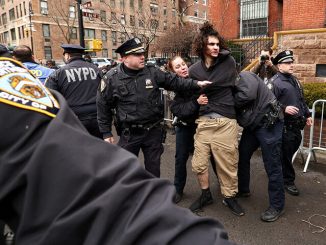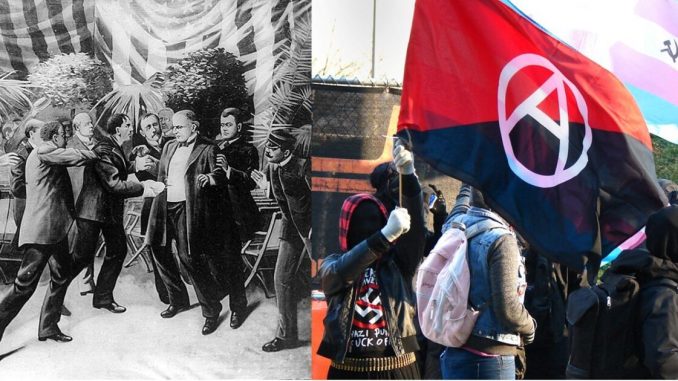
Both President Lincoln and President McKinley were assassinated. Lincoln was assassinated by a Democrat, while McKinley was assassinated by an anarchist. The trend of left-wing violence continued through the 1970s and continues today with Antifa and allied left-wing movements.
Published August 9, 2026
Political violence in the United States has taken many forms across more than a century and a half. Assassinations, conspiracies, militant organizations, street clashes and attacks on property have emerged from radically different political movements and historical circumstances.
A recent feature published by The Gateway Pundit, titled “From John Wilkes Booth to Antifa: The Evolution of Left-Wing Terrorism,” attempts to trace a line between one of the most notorious political assassinations in American history and contemporary militant anti-fascist activism. The Gateway Pundit feature
The comparison is provocative. It also raises a larger historical question: How should Americans understand the evolution of political violence, and how much does ideology matter in determining whether violent actors should be considered part of the same historical tradition?
The Booth Assassination: Political Violence at a Moment of National Crisis
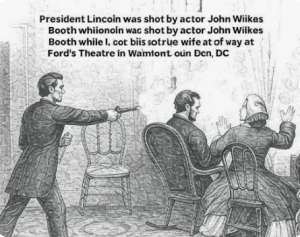
On April 14, 1865, actor John Wilkes Booth entered the presidential box at Ford’s Theatre in Washington, D.C., and shot President Abraham Lincoln.
Lincoln died the following morning.
Booth was a Southern sympathizer who opposed Lincoln and the abolition of slavery. His assassination was not simply an isolated act of personal violence. It formed part of a broader conspiracy aimed at destabilizing the U.S. government during the final days of the Civil War. The conspirators also targeted Vice President Andrew Johnson and Secretary of State William Seward.
The historical record therefore makes one point particularly clear: Booth used political violence to achieve a political objective.
He believed that killing national leaders could revive the Confederate cause and plunge the country into sufficient chaos to alter the outcome of the war. The Smithsonian notes that Booth hoped assassinations would create conditions favorable to Southern independence.
But labeling Booth simply as a representative of the modern political “left” would be historically problematic.
The political categories of 1865 were fundamentally different from those of the 20th and 21st centuries. Booth’s worldview was rooted in Southern nationalism, Confederate sympathies and opposition to abolition—not in the contemporary left-wing political movements to which the term “left-wing terrorism” is normally applied.
That distinction matters.
The Long History of Ideological Violence
Political violence rarely belongs exclusively to one ideology or one period.
American history has witnessed violence associated with movements ranging from revolutionary anarchism and militant labor radicalism to white supremacist organizations, anti-government militias, Islamist extremists and other ideological causes.
What these movements share is not necessarily their political philosophy. Rather, it is the belief that violence can accomplish political objectives that ordinary political institutions cannot—or will not—deliver.
That is one of the most important themes raised by attempts to construct a historical genealogy of terrorism.
The form of political violence changes as society changes.
In the 19th century, assassination could be directed against a president or other political leader. In later decades, revolutionary organizations sometimes targeted government institutions, businesses or police. Modern extremist movements can combine street confrontation, property destruction, online radicalization and decentralized organizing.
The technology has changed.
The underlying political calculation—use coercion or violence to force political change—has appeared repeatedly.
From Revolutionary Movements to Modern Extremism
The American experience with politically motivated violence expanded dramatically during the late 19th and early 20th centuries.
Anarchist movements, for example, became associated with political violence in several countries, including the United States. The assassination of President William McKinley in 1901 by Leon Czolgosz, an anarchist, became one of the most consequential examples.
Later generations saw political violence emerge from radically different ideological camps.
The 1960s and 1970s witnessed militant organizations associated with revolutionary left-wing politics, including groups that embraced bombings, kidnappings and armed attacks.
The broader lesson is that extremism is not static.
Movements adapt their rhetoric to contemporary political conditions, recruit through new technologies and reorganize when governments respond to them.
That makes comparisons between historical figures and modern movements both potentially illuminating and potentially misleading.
Enter Antifa

The contemporary term Antifa is short for “anti-fascist.” Unlike a conventional political party or centralized organization, however, Antifa has generally been described as a loose collection of activists, groups and networks rather than a single hierarchical organization.
The Anti-Defamation League describes the movement as a decentralized collection of groups and individuals, many of whom come from anarchist or far-left political backgrounds. It also notes that Antifa became significantly more visible in the United States following the 2017 Charlottesville demonstrations.
That decentralized structure is critical to understanding the modern movement.
There is no simple membership card that determines who is or is not “Antifa.” Individuals can participate in anti-fascist demonstrations without supporting violence, while some militants associated with the broader movement have engaged in violent confrontations.
Consequently, political opposition to fascism should not automatically be equated with terrorism or violent extremism.
At the same time, the existence of a decentralized structure does not mean that individual acts of political violence should be ignored.
The Politics of Street Confrontation
Antifa became particularly visible during periods of intense political polarization in the United States.
Confrontations between activists on the far left and far right became common at demonstrations, particularly in cities such as Portland and during protests involving white supremacist or other extremist groups.
Some encounters escalated into assaults, vandalism and property destruction. The ADL has documented violent clashes between Antifa activists and far-right groups while also emphasizing that many people attending counter-protests are nonviolent.
This distinction is essential.
A protest movement can contain thousands of peaceful participants while a smaller number of militants engage in violence.
The same analytical standard should be applied across the political spectrum.
Terrorism, Extremism and Political Violence Are Not Synonyms
One of the most important challenges in discussing political violence is the tendency to treat several different concepts as interchangeable.
They are not.
Extremism generally describes ideological positions far outside a society’s political mainstream.
Political violence refers broadly to violence committed for political purposes.
Terrorism is a more specific concept involving violence—or threats of violence—intended to intimidate or coerce populations or governments for political or ideological purposes.
And ordinary political protest, even when highly confrontational or controversial, is not automatically terrorism.
This distinction becomes especially important when discussing Antifa.
Calling the entire movement “terrorist” can obscure the difference between peaceful anti-fascist activists and individuals who commit politically motivated violence.
Conversely, dismissing violent acts simply because their perpetrators identify with an anti-fascist cause can create a different analytical problem.
The appropriate standard should be the conduct itself.
The Numbers Complicate the Political Narrative
There is another reason caution is necessary when discussing the evolution of American political extremism.
Available data do not support the simplistic idea that contemporary left-wing extremism is responsible for most extremist killings in the United States.
For example, the Anti-Defamation League’s review of extremist-related killings from 2014 through 2023 found that right-wing extremists accounted for the overwhelming majority of such deaths during that period, while left-wing extremists—including anarchists and Black nationalists—accounted for a much smaller proportion.
That does not mean left-wing political violence is nonexistent or unimportant.
It means that a serious feature about political extremism should distinguish between ideological rhetoric, street violence, property destruction, terrorism and lethal violence rather than treating them as one phenomenon.
Historical analysis becomes stronger—not weaker—when it acknowledges evidence that complicates its central thesis.
What Actually Connects Booth and Modern Extremism?
The strongest connection between Booth and contemporary political militants is not necessarily their political ideology.
It is the idea that political objectives can justify extraordinary violence.
Booth believed the political system had reached a point at which assassination could accomplish what conventional politics could not. His conspiracy sought to disrupt the government and alter the political consequences of the Civil War.
Modern extremists can reach similarly radical conclusions for entirely different ideological reasons.
Some believe elections are illegitimate.
Others believe government institutions are fundamentally oppressive.
Others believe an opposing political movement represents an existential threat that must be physically confronted.
The ideology varies.
The dangerous psychological leap is similar: the belief that political opponents have become enemies who may legitimately be attacked rather than citizens with whom one disagrees.
The Evolution Is Also Technological
The biggest difference between Booth’s era and the present may not be ideology.
It may be technology.
Booth needed physical access to the president.
Modern extremists can reach millions of people through social media before ever appearing at a demonstration. Propaganda, ideological literature and recruitment can spread across borders almost instantly.
Political polarization can therefore be amplified at a speed unimaginable in the 19th century.
Online communities can create ideological echo chambers, reinforce increasingly extreme beliefs and connect individuals who previously would have remained isolated from one another.
The internet has not invented political extremism.
But it has dramatically changed the speed, scale and visibility with which extremist ideas can circulate.
The Danger of Historical Simplification
Booth was a Confederate sympathizer operating in the aftermath of a catastrophic civil war. Antifa is a modern decentralized movement whose activists generally organize around opposition to fascism and far-right extremism.
Their political contexts are radically different.
Their organizational structures are different.
Their ideologies are different.
Their methods and historical circumstances are different.
A responsible historical analysis should therefore avoid suggesting that contemporary Antifa activists are simply the ideological descendants of Booth.
A more defensible conclusion is that American political violence has repeatedly emerged when individuals or movements become convinced that ordinary political institutions are incapable of resolving what they consider existential conflicts.
The Larger American Lesson
The story of political violence is ultimately bigger than the left-versus-right debate.
America has experienced political violence from multiple ideological directions. The identities of the perpetrators have changed, but the consequences have remained remarkably consistent: death, fear, polarization, repression and deeper political division.
Lincoln’s assassination demonstrated how a single act of political violence could traumatize an already divided nation. The Smithsonian records that Lincoln’s death occurred only days after the effective end of the Civil War, making the assassination an especially consequential moment in American history.
The modern United States faces a different political environment, but the fundamental warning remains relevant.
When political opponents are portrayed as enemies rather than fellow citizens, violence becomes easier to rationalize.
And once violence becomes politically acceptable, it can spread beyond the original cause.
A History That Should Not Be Repeated
The debate over political extremism should not be reduced to determining which side is more dangerous.
A healthier historical question is why political movements reach the point at which violence becomes acceptable to their most radical members.
John Wilkes Booth provides one of America’s most consequential examples of that transformation. His assassination plot emerged from a political worldview in which the destruction of national leadership was seen as a means of achieving a political objective.
Modern political extremism operates in a vastly different environment, but the warning remains recognizable.
Democratic societies depend on the principle that political disputes can be settled without violence.
When that principle collapses, the consequences can extend far beyond the original confrontation.
The historical record therefore offers a warning not only about the evolution of left-wing or right-wing extremism, but about the evolution of political hatred itself.
The central lesson is perhaps simpler than the title suggests:
Political violence does not belong to one era, one movement or one side of the political spectrum. Its most dangerous feature is the moment when ideology convinces people that violence is no longer a line they must refuse to cross.
💬 Conclusion:
From John Wilkes Booth’s assassination of Abraham Lincoln to the emergence of modern militant political movements, American history demonstrates that political violence can arise when ideological convictions become more powerful than respect for democratic institutions and human life. While Booth and contemporary Antifa activists belong to vastly different historical and ideological contexts, the broader lesson is the same: political violence becomes dangerous when individuals begin to believe that their cause justifies coercion, intimidation, or physical force.
The history of extremism should therefore be examined without selective standards. Violence committed in the name of the left, the right, or any other ideology deserves the same scrutiny. Understanding how political movements become radicalized—and how political disagreement can turn into hatred and violence—is essential to preventing America’s past from becoming a blueprint for its future.
SOURCES: THE GATEWAY PUNDIT – From John Wilkes Booth to Antifa: The Evolution of Left-Wing Terrorism
SMITHSONIAN – The Conspirators Behind the Plot to Kill President Lincoln
CSIS – Left-Wing Terrorism and Political Violence in the United States: What the Data Tells Us