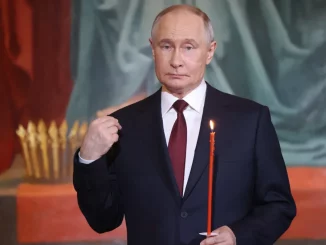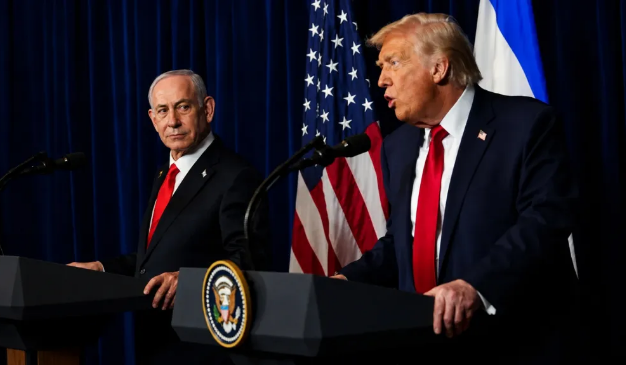
Prime Minister Benjamin Netanyahu of Israel, and US President Donald Trump during a press conference. (File Photo/ enhanced via AI)
Published August 9, 2026
Israeli Prime Minister Benjamin Netanyahu has rejected U.S. President Donald Trump’s 15-point Gaza peace plan, declaring that Israeli forces will not withdraw from the territory unless Hamas completely gives up its weapons.
The rejection represents a major setback for Washington-backed efforts to consolidate the Gaza ceasefire and move toward a broader political settlement. Reuters reported Sunday that Netanyahu said Israel does not accept the draft framework presented by the United States and will not pull its troops out until Hamas is fully disarmed.
Trump had previously described his Gaza initiative as a breakthrough, saying Hamas had agreed to surrender its weapons under the proposed framework. But Netanyahu’s latest declaration exposes a fundamental disagreement between Washington and Jerusalem over one of the central conditions for ending the conflict.
Netanyahu draws a hard line on Hamas disarmament
Netanyahu’s position is centered on a demand that Hamas surrender its entire weapons arsenal before Israel accepts a full military withdrawal.
According to Reuters, the Israeli prime minister said Sunday that Israel “will not withdraw until Hamas fully disarms.” CGTN likewise reported that Netanyahu said Israeli troops would not pull out until Hamas completely surrendered its weapons.
The demand places Hamas disarmament at the heart of the dispute over the future of Gaza.
For Israel, allowing Hamas to retain its military capabilities could leave the group positioned to rebuild and potentially launch another attack. For any ceasefire framework to succeed, however, the parties would need to agree on how disarmament would be implemented and verified.
Trump’s Peace initiative hits major obstacle
Trump announced last month that his Board of Peace plan had achieved a breakthrough in efforts to end the Gaza war.
The 15-point proposal is part of broader U.S.-backed efforts to implement the Gaza ceasefire agreement reached between Israel and Hamas last year. Trump has said Hamas agreed to lay down its weapons under the proposed framework.
Netanyahu’s rejection now puts the future of that initiative under serious pressure.
The disagreement is particularly significant because the United States has been attempting to transform the ceasefire into a more durable political and security arrangement.
Israel’s Military presence remains a Central issue
The Israeli government’s refusal to withdraw without Hamas disarmament means that the question of Israeli military presence in Gaza remains unresolved.
Israel has continued military strikes in Gaza despite the ceasefire agreement, according to Reuters and CGTN.
The disagreement over troop withdrawal could therefore become one of the most difficult issues facing negotiators.
Any arrangement requiring Israel to leave territory would likely need to address Israel’s security concerns, while Palestinian and international actors could demand an end to Israeli military operations and a clear framework for Gaza’s future governance.
Hamas disarmament becomes the Key test
The latest development places the spotlight squarely on Hamas and whether it is prepared to surrender its military capabilities.
Trump has said Hamas agreed to lay down its weapons under the proposed plan, but Netanyahu’s rejection indicates that Israel does not believe the existing framework provides sufficient guarantees.
The issue is more than symbolic.
Hamas has been the dominant armed organization in Gaza for years, and its military infrastructure was a central factor behind Israel’s campaign following the October 7, 2023, attack.
For Israel, preventing Hamas from retaining the ability to conduct another large-scale attack remains a fundamental security objective.
A New test for U.S.-Israel relations
Netanyahu’s rejection also creates a potentially difficult moment for the Trump administration.
Washington has invested significant political capital in its Gaza peace initiative, while Israel remains one of America’s closest partners in the Middle East.
Trump now faces the challenge of reconciling his administration’s proposed framework with Netanyahu’s insistence that Israel will not accept a withdrawal before Hamas is fully disarmed.
The disagreement does not necessarily mean U.S.-Israeli cooperation has broken down, but it demonstrates that Washington and Jerusalem may have different assessments of what conditions are necessary to end the war.
Ceasefire prospects face renewed uncertainty
The rejection raises fresh questions about whether the current ceasefire framework can evolve into a lasting peace agreement.
A durable settlement would require agreement on several interconnected issues, including Hamas’s weapons, Israeli troop withdrawals, Gaza’s security arrangements, governance, reconstruction and the protection of civilians.
With Netanyahu now explicitly rejecting the U.S. proposal, negotiators may have to revisit key elements of the plan before further progress can be achieved.
The immediate question is whether Washington can persuade Israel to accept a modified framework while simultaneously securing meaningful commitments from Hamas.
⚠️ Implications:
💬 Overall Takeaway:
Israel’s rejection of President Donald Trump’s 15-point Gaza peace plan underscores the enormous difficulty of achieving a lasting settlement. Netanyahu’s insistence that Hamas must fully disarm before Israel withdraws places security concerns at the center of the negotiations and creates a major obstacle to the proposed framework. While the rejection does not necessarily end diplomatic efforts, it leaves the ceasefire, Israeli troop withdrawal, Gaza’s future governance, and reconstruction plans uncertain. The next phase of negotiations will largely depend on whether Washington can bridge the gap between Israel’s security demands and the broader conditions required for a durable peace.
SOURCES: NEWSMAX – Israel Rejects Trump’s 15-point Plan for Gaza, PM Netanyahu Says
REUTERS – Israel rejects Trump’s 15-point plan for Gaza, PM Netanyahu says
CGTN – Israel rejects Trump’s 15-point plan for Gaza, Netanyahu says
THE INDIAN EXPRESS – Israel PM Netanyahu rejects Trump’s 15-point plan for Gaza