Reported by:

Cherry Meigh Timbol
News Content Editor
Published August 31, 2026
CEUTA, Spain — Tensions in Spain’s North African enclave of Ceuta have intensified following a series of incidents involving Moroccan migrants and Spanish military personnel, including arrests over alleged attacks using stones and, in a separate incident, bottles containing corrosive liquids.
Spanish authorities detained three Moroccan migrants accused of throwing bottles filled with corrosive substances at military personnel, according to Breitbart’s report. The arrests came amid a broader security crisis in Ceuta following the mass arrival of migrants from Morocco in late July.
The latest incident has added to concerns among Spanish authorities and residents about deteriorating security conditions in the enclave.
Soldiers targeted in separate attack
The corrosive-liquid incident followed another confrontation involving a Spanish military patrol in the Benzú area of Ceuta.
Spanish police arrested four Moroccan nationals who were allegedly involved in throwing stones at soldiers patrolling the area, according to Yabiladi’s report.
The incident reportedly involved a larger group of migrants. One soldier was injured after being struck by a stone and falling, according to reports.
The confrontation prompted police intervention and the detention of several people.
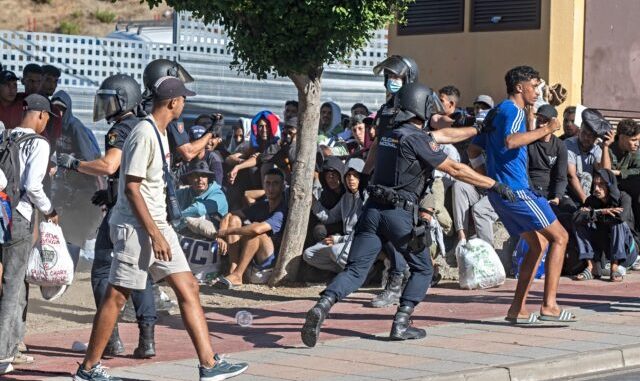
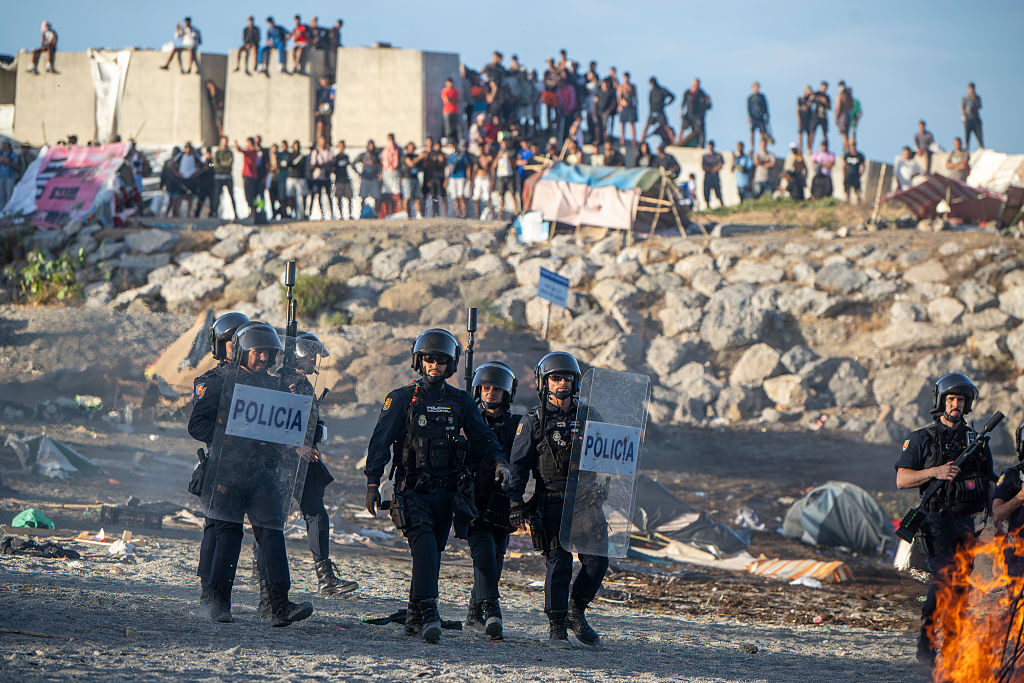 Police officers and illegal migrants clash at a demonstration to protest against the situation caused by their mass arrival, on 27 August, 2026 in Ceuta, Spain. (Marcos Moreno/Europa Press via Getty)
11 Moroccans ordered expelled from Spain
The legal consequences have already extended beyond the initial arrests.
A criminal court in Ceuta ordered the deportation of 11 Moroccan nationals following their conviction in connection with the attack on a military patrol. The men were also barred from returning to Spain for five years, according to Hespress’s report.
Morocco World News reported that 12 migrants had initially been detained following the Benzú incident and that four soldiers were injured. The court’s expulsion order applied to 11 of those detained, while the case involving the remaining migrant was not included in the decision.
The same five-year prohibition was reported by Yabiladi in its follow-up report.
Violence adds pressure to an already volatile migrant crisis
The attacks come against the backdrop of an extraordinary migration crisis in Ceuta.
More than 70,000 people reportedly entered the enclave during the mass border crossing from Morocco at the end of July, with most subsequently returning to Morocco. Thousands nevertheless remained in Ceuta, creating severe pressure on local accommodation, public services and security resources.
The continuing tensions have also produced clashes between police, protesters and migrants. Authorities have faced growing demands to restore order while humanitarian organizations have raised concerns about conditions for migrants.
Spain has now asked the European Union for additional assistance to process migrants remaining in the enclave, including support from European border authorities.
 Spanish police in the city of Ceuta arrested four Moroccan nationals in an irregular situation on Saturday, on suspicion of involvement in an attack in which a group of Spanish soldiers were pelted with stones in the early hours of the same day
Madrid faces mounting political pressure
The security incidents are adding another layer to the political controversy surrounding the Ceuta crisis.
Prime Minister Pedro Sánchez has rejected accusations that Morocco’s government was responsible for the mass border crossing, saying there is no evidence that Rabat orchestrated the episode.
At the same time, Sánchez has faced criticism from opposition politicians over the government’s handling of the unprecedented influx and the continuing presence of migrants in Ceuta.
The government has also become embroiled in a separate dispute over claims that foreign actors helped spread misinformation encouraging migrants to cross into Ceuta. Sánchez has accused Russia and Israel of involvement, allegations that Israel has rejected.
🧩 Bottom Line:
The Ceuta crisis is a clear reminder that border security and public safety cannot be treated as separate from the broader migration debate. People fleeing hardship deserve to be treated with dignity, but that principle cannot excuse violence against soldiers, police officers or civilians.
The arrests and deportations reported in these cases show that Spain is prepared to respond when migrants cross the line from seeking entry into the country to allegedly attacking those responsible for maintaining order. At the same time, authorities must ensure that every case is handled through due process and that responsibility is established individually.
What concerns me most is the possibility that continued disorder could deepen tensions between local communities and migrants and make an already difficult situation even harder to resolve. Ceuta needs firm, lawful enforcement, effective border management and a clear European response—while maintaining the standards of justice and human dignity expected from a democratic society.