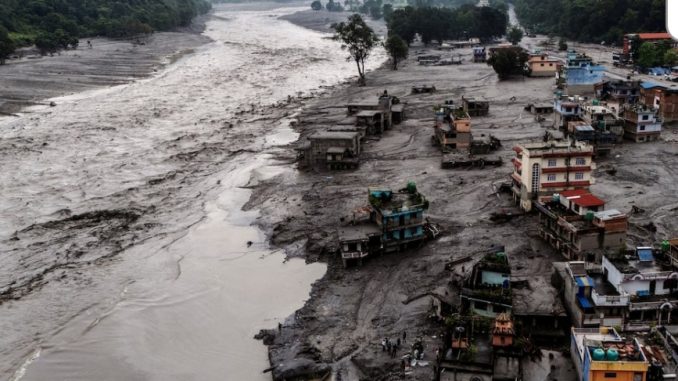
A drone view shows damaged buildings and houses covered in mud next to the Likhu River following deadly flash floods and mudslides in Devighat, Nuwakot District, Nepal
Reported by:

Cherry Meigh Timbol
News Content Editor
Published August 30, 2026
A catastrophic glacier collapse and flash flood along the Nepal-China border has left a devastating trail of death and destruction across the Himalayas, with the combined death toll approaching 800 and thousands of people still reported missing.
The disaster struck on August 26 after a glacier and rock collapse sent enormous amounts of ice, mud, water and debris through mountain valleys in Nepal and China’s Tibet region. Communities, roads, bridges and infrastructure were swept away in minutes.
Rescue teams are now working around the clock in extremely difficult terrain, while authorities warn that additional flooding could threaten survivors and rescuers.
Death toll approaches 800
According to the latest reports, Nepal has recorded 781 deaths, while China has confirmed 16 deaths on the Tibetan side of the border. Thousands of people remain missing across the two countries.
The number of missing includes foreign nationals who were in the affected region for work, tourism or religious pilgrimages.
China said 261 foreign nationals from 23 countries were among those missing on the Tibetan side of the disaster zone.
The figures are expected to change as rescue teams reach areas that remain inaccessible.
China sends more than 2,100 rescuers
Beijing has mobilized more than 2,100 rescue workers as the search continues around Gyirong Port and other devastated areas in Tibet.
Chinese military transport aircraft and helicopters have been used to move personnel and supplies, while rescue crews have attempted to reopen roads damaged by mudslides and floodwaters.
Operations have been complicated by unstable mountain slopes, heavy debris and the threat of additional flooding.
A large barrier lake formed after debris blocked a river near the border. Authorities have been closely monitoring the lake because a sudden breach could send another wall of water downstream.
Thousands remain missing in Nepal
The situation is particularly desperate in Nepal, where thousands remain unaccounted for.
Rescue teams are focusing on damaged hydropower facilities, where hundreds of workers may still be trapped inside tunnels.
At one site, rescuers have been drilling into tunnels in an effort to reach people believed to be trapped underground. The Nepalese military has also used helicopters and heavy equipment to reach isolated areas.
The destruction has severely damaged roads and bridges, making traditional ground-based rescue operations extremely difficult.
New threat from a barrier lake
The disaster has not ended.
A lake formed by debris blocking a river has created concerns about another potential flood. The reservoir reportedly grew to more than 2.5 million cubic meters of water during the early stages of monitoring.
Earlier warnings indicated that continued rainfall could increase the danger.
Chinese and Nepalese authorities have therefore had to balance two competing priorities: searching for survivors while keeping rescuers away from areas that could suddenly flood.
Questions over early warnings
The disaster has also raised questions about whether Nepal could have received earlier warnings about the growing danger.
Reports indicate that Nepal had asked China for information about risks in the region months before the catastrophe. The issue has sparked debate over whether improved cross-border monitoring and communication could have provided communities with more time to evacuate.
China has rejected suggestions that it could simply have issued an earlier warning, pointing to the extreme difficulty of monitoring the Himalayan terrain and the complexity of predicting sudden geological failures.
The question is likely to remain controversial as investigators examine what happened before the flood.
Nepal and China confront an enormous recovery effort
Beyond the immediate search for survivors, both countries face a potentially enormous reconstruction challenge.
Homes, roads, bridges, businesses and hydropower facilities have been damaged or destroyed.
Nepal’s economy is particularly exposed because hydropower plays an increasingly important role in the country’s development. Damage to major projects could affect electricity generation, transportation and economic activity for months or even years.
China has allocated approximately $32.7 million for emergency relief, according to reports.
International teams are also assisting with rescue and recovery operations.
The bigger picture
The Himalayan disaster is now one of the region’s worst natural catastrophes in years.
The combination of a glacier collapse, extreme flooding, unstable terrain and damaged infrastructure has created an exceptionally difficult rescue environment.
For families across Nepal and Tibet, the most urgent question remains whether loved ones listed as missing can still be found alive.
For governments, the disaster raises a much broader question about whether emergency preparedness and cross-border coordination are sufficient to respond to catastrophic events in the remote Himalayan region.
The tragedy has also highlighted how quickly a disaster in a remote mountain region can cross national borders and affect tourists, workers, pilgrims and communities from dozens of countries.
🧩 Bottom Line:
The Himalayan disaster has developed into a humanitarian catastrophe stretching across the Nepal-China border.
With the death toll approaching 800 and thousands still missing, rescuers are racing against time while facing dangerous terrain, unstable slopes and the possibility of additional flooding.
China’s deployment of thousands of rescue personnel demonstrates the scale of the emergency, while Nepal continues to struggle to reach communities cut off by destroyed roads and bridges.
The disaster is also raising difficult questions about preparedness and emergency coordination. For the families waiting for news of missing relatives, however, the immediate priority remains the search for survivors.
SOURCE: REUTERS – Rescuers battle floods and debris as Himalayan disaster death toll nears 800
REUTERS – Before flood catastrophe, Nepal asked China for early warnings as risks mounted
AP NEWS – Catastrophic floods kill over 390 in Nepal and Tibet, with more than 1,400 missing
AL JAZEERA – Death toll nears 800 after Himalayan glacier collapse