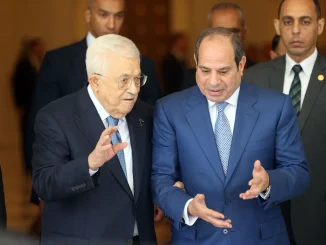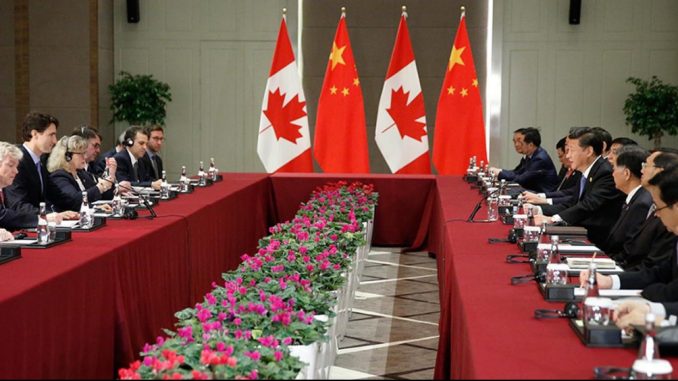
The Chinese and Canadian flags displayed during a diplomatic engagement, symbolizing the renewed military and diplomatic dialogue between Beijing and Ottawa after an eight-year pause.
Reported by:

Cherry Meigh Timbol
News Content Editor
Published September 8, 2026
OTTAWA/BEIJING — China and Canada have resumed formal military-to-military dialogue for the first time in eight years, marking one of the clearest signs yet that relations between Ottawa and Beijing are undergoing a strategic reset.
The China-Canada Defense Coordination Dialogue was revived on September 4 in Canada, according to reports published this week. The talks represent the return of a communication channel that had been suspended amid years of diplomatic tensions between the two countries.
The timing is particularly significant. Canada is simultaneously facing a major deterioration in its trade relationship with the United States, with Ottawa’s retaliatory tariffs on U.S. goods taking effect on September 8. Reuters reported that the measures cover roughly $20 billion in American imports, with tariffs ranging from 15% to 50%.
That combination raises a larger geopolitical question: Is Canada accelerating its effort to diversify away from overwhelming dependence on the United States—and is China becoming an increasingly important part of that strategy?
From Diplomatic Freeze to Strategic Reset
Canada-China relations have undergone a remarkable transformation this year.
In January, Canadian Prime Minister Mark Carney traveled to Beijing for the first visit by a Canadian prime minister since 2017. Carney and Chinese President Xi Jinping announced a new strategic partnership covering energy, trade, security, multilateral cooperation and people-to-people ties.
The January agreement did not erase longstanding disagreements between Ottawa and Beijing. But it established a framework for renewed engagement.
The reopening of military dialogue now takes that relationship into a more sensitive area: national security and defense communication.
Military-to-military channels are particularly important because they can reduce the risk of miscalculation even when countries remain strategic competitors.
Why the Military Talks Matter
Canada is a member of NATO and remains deeply integrated with the U.S.-led security architecture.
At the same time, Ottawa operates in the Indo-Pacific, where China’s military power is increasingly central to regional security calculations.
Restoring direct communication with the People’s Liberation Army does not necessarily mean Canada is aligning itself with Beijing. Rather, it could represent an attempt to establish guardrails between two countries that have serious differences but also increasingly recognize the need to communicate.
The resumption is therefore significant precisely because Canada and China have not resolved their strategic disagreements.
The U.S. Factor
The development comes as Canada’s relationship with Washington enters another difficult phase.
Canada’s new retaliatory tariffs took effect Tuesday after trade negotiations with the Trump administration stalled. Ottawa says the measures are intended to protect Canadian industries from U.S. tariffs.
Prime Minister Carney has simultaneously emphasized the need for Canada to diversify its economic relationships.
That strategy was already visible during his January visit to China. The Canadian government described China as presenting major opportunities for Canadian energy, agriculture, trade and investment as Ottawa seeks a more resilient economy.
The latest developments therefore suggest that Canada’s China policy is not occurring in isolation. It is part of a broader attempt to give Ottawa more economic and diplomatic options in an increasingly fragmented world.
China Also Has an Interest
Beijing has strong reasons to cultivate closer relations with Canada.
Canada possesses enormous natural resources, including energy, agricultural products and critical minerals. China, meanwhile, remains one of the world’s largest economies and a major industrial and manufacturing power.
Reuters reported today that Asia—primarily China—is expected to account for as much as 70% of Canada’s crude oil exports by the end of 2028, following an expansion of Canada’s pipeline access to Asian markets.
That development could make China increasingly important to Canada’s energy strategy.
For Beijing, stronger economic ties with Canada could also provide greater access to North American resources while strengthening China’s relationships with another major Western country.
A Delicate Balancing Act
However, Ottawa is unlikely to abandon its Western alliances.
Canada remains a NATO member and continues security cooperation with the United States and other Indo-Pacific partners. Canadian officials have also emphasized that diversification does not mean replacing one dependency with another.
The challenge will be maintaining economic engagement with China while managing disagreements over security, Taiwan, human rights, technology and foreign interference.
That balancing act could become increasingly difficult if competition between Washington and Beijing intensifies.
🧩 Bottom Line:
Canada is not choosing China over the United States—at least not at this stage. What Ottawa appears to be doing is building alternatives.
The restoration of military dialogue after eight years is particularly noteworthy because it moves the relationship beyond trade and diplomacy and into the national-security sphere. Combined with Canada’s efforts to expand Asian energy exports and its worsening trade confrontation with Washington, the development suggests that Prime Minister Carney is pursuing a more independent Canadian foreign-policy posture.
For China, the opportunity is equally significant. Beijing can present itself as an alternative economic partner at a moment when some traditional U.S. allies are questioning the reliability of their relationship with Washington.
The bigger story may therefore not simply be China and Canada getting closer.
It may be the emergence of a world in which middle powers such as Canada increasingly seek room to maneuver between competing major powers.
And that could have consequences far beyond Ottawa and Beijing.
SOURCES: ASIA NEWS NETWORK – China and Canada resume military talks after eight years
SOUTH CHINA MORNING POST – Canada and China thaw continues as militaries hold first talks in 8 years amid US pressure
REUTERS – Canada’s retaliatory tariffs take effect as US trade talks stall