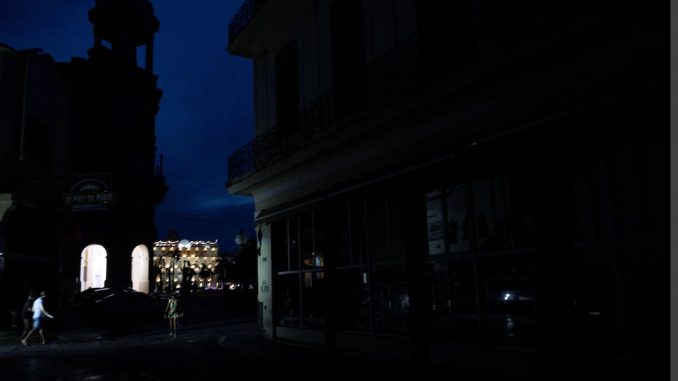
People walk along a darkened street during a power outage as a hotel remains illuminated in the background in Havana, Cuba, September 16, 2026. REUTERS/Ricardo Arduengo
Reported by:

Cherry Meigh Timbol
News Content Editor
Published September 19, 2026
Cuba was plunged into another nationwide blackout on Friday after the country’s electrical grid suffered a total collapse, leaving millions of people without power amid an escalating energy crisis.
The collapse occurred at about 2 p.m. local time after a failure in high-voltage transmission lines in central Cuba, according to authorities. The eastern part of the island was subsequently disconnected from the western system.
Cuba’s Ministry of Energy and Mines said restoration protocols had been activated, while the state utility Union Eléctrica worked to gradually rebuild the electrical system.
Millions Left in Darkness
By Friday evening, only about 5% of Havana’s electricity users had reportedly regained power. Authorities were establishing smaller “micro-islands” of electricity in several provinces and restoring power to hospitals and other critical facilities.
The blackout affected more than electricity. Residents faced disruptions to transportation, communications, water supplies, cooking and other basic services.
For many Cubans, the latest collapse came after already enduring prolonged rolling blackouts. Reuters reported that outages lasting more than 30 hours have become common in parts of the country.
Aging Infrastructure and Fuel Shortages
Cuba’s electrical system has been under severe strain for years. The country relies heavily on aging thermoelectric power plants, while shortages of fuel and replacement parts have made it increasingly difficult to maintain electricity generation.
Reuters reported that Friday’s collapse was the latest in at least six major partial or total grid collapses since January. The grid also suffered three collapses in July.
Cuban officials have pointed to fuel shortages and infrastructure problems as major factors behind the worsening crisis.
U.S. Pressure Adds to the Crisis
The blackout comes amid an increasingly tense relationship between Havana and Washington.
The United States imposed sweeping restrictions on fuel supplies to Cuba earlier this year as part of the Trump administration’s pressure campaign against the Cuban government. Cuban authorities and other critics of the measures have blamed the restrictions for worsening the island’s fuel shortage.
The Associated Press reported that the restrictions have limited Cuba’s ability to obtain fuel needed to operate thermoelectric plants as well as replacement parts for aging infrastructure.
Washington, meanwhile, has argued that Cuba’s economic problems are substantially rooted in the policies and management of its own government.
Humanitarian Consequences
The continuing power crisis is affecting everyday life across the island.
Without reliable electricity, residents have struggled to obtain water, prepare food, maintain communications and travel. Hospitals and other essential facilities have had to rely on emergency power systems.
The latest blackout has also intensified frustration among residents who had already experienced lengthy outages before Friday’s nationwide collapse.
AFP reported that some Havana residents had already been without electricity for more than a day when the national grid failed, while outages in some provinces have lasted even longer.
Restoration Efforts Underway
Cuban authorities have begun gradually reconnecting portions of the electrical system, but the timetable for a full restoration remains uncertain.
The immediate priority is restoring electricity to hospitals and other critical infrastructure before reconnecting broader areas of the country.
The latest collapse demonstrates the vulnerability of Cuba’s aging power system and the difficulty of maintaining a stable national grid while the country faces severe fuel shortages and economic pressures.
For millions of Cubans, however, the issue is more immediate: keeping homes supplied with electricity, water and basic services as the island waits for its power system to recover.
🧩 Bottom Line:
Cuba’s nationwide power-grid collapse is more than a temporary blackout—it highlights the mounting pressure on an aging electricity system already struggling with fuel shortages, maintenance problems and repeated outages. The immediate priority is restoring power to hospitals and essential services, but the broader challenge is rebuilding a grid capable of providing reliable electricity.
The competing explanations over the role of U.S. sanctions and Cuba’s own economic and infrastructure policies also remain part of the wider debate. What is clear is that millions of Cubans are once again dealing with the direct consequences of an increasingly fragile power system.
SOURCES: REDSTATE – Cuba’s Power Grid Completely Collapses
AP NEWS – Cuba hit with another blackout as millions across the island are left without electricity
REUTERS – Cuba’s electrical grid collapses again, plunging island into darkness