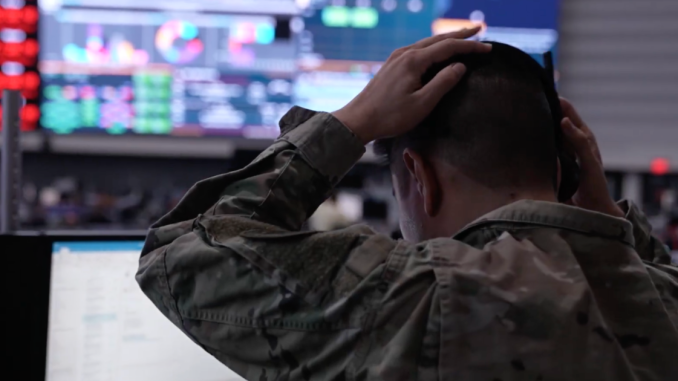
Screenshot of U.S. Cyber Command personnel via U.S. Cyber Command YouTube Channel
Reported by:

Cherry Meigh Timbol
News Content Editor
Published September 29, 2026
FORT MEADE, Maryland — Five people working with or closely affiliated with U.S. Cyber Command and the National Security Agency died by suicide over roughly five weeks this summer, prompting congressional scrutiny over the mental-health resources available to personnel at one of the nation’s most important national-security installations.
The deaths occurred between early June and early July 2026, according to reporting based on military communications, public records and sources cited by Bloomberg. The cluster has since prompted lawmakers from Maryland and members of congressional intelligence and defense committees to seek briefings and additional support for the workforce at Fort George G. Meade.
The situation has drawn particular attention because Cyber Command personnel operate under demanding conditions involving classified missions, extended work hours and continuous cyber operations. Recent reporting has also raised concerns about whether existing military mental-health programs are designed to address personnel who effectively remain in an operational environment without traditional deployment and recovery cycles.
Five Deaths in a Five-Week Period
The deaths occurred during a period when U.S. Cyber Command was engaged in an expanding range of operations.
According to Tech Times, five personnel associated with Cyber Command died by suicide between early June and early July. Army Gen. Joshua Rudd, who leads Cyber Command and the NSA in a dual role, acknowledged three of the deaths in an internal communication, while public records subsequently confirmed two additional deaths.
The Banner reported that the five deaths involved civilians and others working in or supporting Cyber Command and NSA missions at Fort Meade.
The deaths have raised questions about whether the circumstances represent an isolated series of tragedies or evidence of broader problems affecting the workforce.
The Defense Department’s formal definition of a suicide cluster applies to military personnel, creating an additional issue because the Fort Meade workforce includes military personnel, civilian employees and contractors. Lawmakers are now examining whether that framework adequately captures the circumstances surrounding the deaths.
A Workforce Under Increasing Operational Pressure
Fort Meade is home to some of America’s most sensitive intelligence and cyber operations.
The Banner reported that Cyber Command personnel can work long hours in secure, windowless facilities known as Sensitive Compartmented Information Facilities, or SCIFs. The work can involve identifying cyberattacks, defending government networks and supporting offensive cyber operations.
Tech Times reported that Cyber Command conducted approximately 8,000 missions in 2025, representing a 25% increase from the previous year, according to remarks attributed to Gen. Rudd before the House Armed Services Committee.
The command has also taken on additional responsibilities during 2026, including cyber operations connected to U.S. military activities overseas and other national-security missions.
That workload has fueled concerns about burnout and operational fatigue.
The “Deployed-in-Place” Problem
One of the central issues emerging from the congressional and industry discussion is the concept of “deployed-in-place.”
Traditional military deployments generally involve a defined period away from home followed by a period of rest, commonly known as dwell time.
Cyber operators can experience many of the pressures associated with combat operations without physically leaving Fort Meade.
They may conduct highly sensitive operations from a secure facility, return home at the end of the workday and then report back to the same operational environment the following morning.
Tech Times reported that experts and former Cyber Command personnel believe this creates a structural problem because existing deployment policies may not provide the same mandatory rest cycles for cyber personnel.
The issue is particularly significant because cyber operations can continue around the clock, regardless of whether personnel are physically stationed in a traditional combat zone.
Mental-Health Resources Face a Clearance Barrier
Another challenge is the shortage of mental-health professionals who can work directly with personnel handling classified information.
Therapists working with Cyber Command personnel may need appropriate security clearances because patients can potentially discuss classified aspects of their work.
Tech Times reported that Cyber Command had begun working with the Kimbrough Ambulatory Care Center to place cleared mental-health providers closer to cyber personnel.
The program initially involved two embedded providers and could eventually expand to five.
But Cyber Command’s Cyber Mission Force alone includes roughly 6,000 personnel, in addition to civilian and contractor employees. That disparity has prompted questions about whether the available mental-health infrastructure can meet demand.
The Banner reported that Rep. Sarah Elfreth, whose district includes the area surrounding Fort Meade, has been pushing for faster security-clearance processes for mental-health providers serving the Cyber Command workforce.
Congress Had Already Identified Problems
The current controversy is significant because concerns about Cyber Command’s workforce did not begin with the five deaths.
A study commissioned under the FY2024 National Defense Authorization Act examined occupational resilience within the Cyber Mission Force.
According to Tech Times, the study concluded that existing resources were inadequate and could jeopardize long-term personnel readiness and mission effectiveness.
The report’s findings have become particularly relevant following the 2026 deaths.
Lawmakers are now examining whether recommendations from the earlier study were adequately implemented.
New Funding Is Being Considered
Congress is considering additional measures through the FY2027 National Defense Authorization Act and defense appropriations process.
Tech Times reported that an $11 million “High Performance Team Training” request has been included in the House defense appropriations process. Cyber Command reportedly identified the program as an unfunded priority.
The proposed program would focus on cognitive, psychological, physiological and other forms of support intended to help personnel operating at a high tempo.
However, congressional discussions have also highlighted a distinction between authorizing a program and actually providing the money needed to implement it.
Maryland Lawmakers Demand Answers
The deaths have prompted bipartisan attention from Maryland lawmakers.
Rep. Sarah Elfreth has called for additional resources and has discussed changing the Pentagon’s definition of a suicide cluster so that civilian personnel could be included.
Sen. Chris Van Hollen has supported an $11 million funding request for psychological support for cyber operators, according to The Banner.
Sen. Angela Alsobrooks has also sought a briefing from U.S. Cyber Command concerning the deaths.
Meanwhile, Senate Armed Services Committee members held a September 23 briefing concerning cyber operations and readiness. The hearing included senior Defense Department and Cyber Command officials.
The NSA Is Also Facing Questions
The issue extends beyond Cyber Command because the NSA operates from the same Fort Meade complex and many personnel work in closely connected missions.
The Banner reported that congressional intelligence leaders have also sought information regarding mental-health resources available to NSA personnel.
The broader concern is whether the pressures associated with highly classified national-security work are being adequately addressed across the Fort Meade workforce rather than within a single military organization.
A Larger Question About Cyber Warfare
The situation is raising a difficult question for the U.S. military: How should the armed forces protect the mental health of personnel who perform combat-related or national-security missions without physically deploying?
The traditional model of military deployment was developed around geographic separation from home.
Cyber warfare changes that equation.
An operator can participate in operations against foreign targets while remaining physically inside Maryland. The psychological effects of that arrangement may therefore be different from those experienced by conventional forces, while still involving sustained operational pressure.
Researchers studying drone operators have previously examined similar issues involving personnel who conduct remote warfare from domestic military installations. Tech Times cited research identifying burnout, sleep disruption and other psychological effects among remote-warfare personnel.
Whether Cyber Command requires a substantially different personnel-management model remains a subject of debate.
What Happens Next
Congress is expected to continue examining the situation as lawmakers work toward completing the FY2027 defense authorization legislation.
Potential measures include expanding access to cleared mental-health professionals, requiring additional reporting from Cyber Command and strengthening implementation of previous workforce-resilience recommendations.
The larger issue, however, is whether additional counseling resources alone will address concerns about workload, staffing and operational tempo.
The Banner reported that some former personnel and lawmakers believe structural changes may be necessary alongside expanded mental-health services.
🧩 Bottom Line:
The deaths of five people associated with Cyber Command and the NSA within approximately five weeks have triggered renewed scrutiny of mental-health support at Fort Meade.
The episode comes after earlier congressional research had already identified shortcomings in the resources available to the Cyber Mission Force. Lawmakers are now considering additional funding, cleared mental-health providers and changes to how suicide clusters involving civilian personnel are handled.
At the same time, the circumstances have opened a broader discussion about the unique pressures of cyber warfare, where personnel can perform sensitive and potentially combat-related missions from U.S. facilities without the traditional deployment and recovery cycles associated with conventional military operations.
The investigation and congressional response will determine whether the current episode results primarily in expanded counseling resources or leads to broader changes in how America’s cyber workforce is staffed, scheduled and supported.
If you or someone you know is in immediate danger or experiencing suicidal thoughts, in the U.S. call or text 988 for the Suicide & Crisis Lifeline.
SOURCES: THE GATEWAY PUNDIT – WHAT’S HAPPENING: 5 Suicides Reported in 5 Weeks at U.S. Cyber Command in Fort Meade
TECH TIMES – Five Suicides in Five Weeks: Cyber Command Had Prior NDAA Fix; Funding May Not Follow
TIMES NOW – Fort Meade Suicides: 5 Cyber Command, NSA Workers Die Within One Month, Senators Seek Answers
WROP NEWS – 5 suicides in 5 weeks. What’s going on at Cyber Command at Fort Meade?