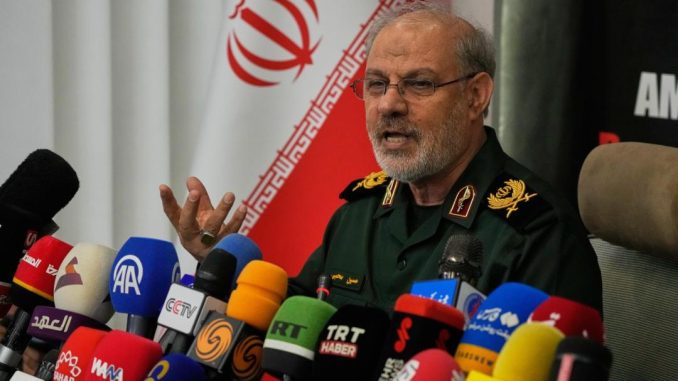
Iran’s Revolutionary Guard spokesman Gen. Hossein Mohebbi speaks during a news conference in Tehran, Iran, Tuesday, Sept. 29, 2026. (AP Photo/Vahid Salemi)
Reported by:

Cherry Meigh Timbol
News Content Editor
Published September 29, 2026
TEHRAN — Iran’s Revolutionary Guard has appealed directly to the American public, urging people to protest President Donald Trump’s Middle East policies and declaring that the U.S. campaign against Iran has failed.
The message, delivered Tuesday by Revolutionary Guard spokesman Gen. Hossein Mohebbi, comes as Washington and Tehran continue indirect diplomatic contacts aimed at ending the conflict. At the same time, violence continues in Gaza, the West Bank and Yemen, while disruption around the region’s major shipping routes continues to affect global energy markets.
Iran’s assertion that the war has failed is Tehran’s characterization of the conflict, not an independently established assessment. President Trump has publicly maintained that the United States will prevail.
Iran Appeals Directly to the American Public
Speaking at a news conference in Tehran, Mohebbi read what he described as a “letter to the American people.”
He said the war could end only if Washington acknowledged defeat and withdrew, while accusing the United States of using Iran’s nuclear program as a justification for broader pressure on Tehran.
Mohebbi also urged Americans to protest Trump’s policies ahead of the November midterm elections.
The timing of the message is significant because the U.S. midterms are approaching, with control of Congress at stake. Iran’s appeal therefore puts the conflict directly into the political conversation inside the United States.
Iran has continued to reject pressure to surrender its position, while the Trump administration has maintained that Tehran must address concerns surrounding its nuclear program as part of any agreement.
Washington and Tehran Continue Indirect Talks
Despite the increasingly confrontational rhetoric, diplomatic efforts have continued.
Iranian Foreign Minister Abbas Araghchi has met with Qatari mediators in New York as part of efforts to advance a proposal involving the reopening of the Strait of Hormuz, a crucial global energy corridor.
U.S. officials have indicated that Washington is open to negotiations but wants Iran’s nuclear program addressed as part of any agreement. According to reporting on the diplomatic discussions, the United States could consider sanctions relief and the release of some frozen Iranian funds in exchange for concrete progress on nuclear issues.
The two sides remain divided over the timing of commitments and which steps should come first.
Trump has rejected an Iranian proposal that would have involved reopening the Strait of Hormuz under specified conditions, while continuing to say publicly that the United States will win the conflict.
Strait of Hormuz Remains Central to the Conflict
The Strait of Hormuz has become one of the most important pressure points in the war.
The narrow waterway connects the Persian Gulf with the Gulf of Oman and is critical to international energy shipments.
Iran maintains that the strait remains closed to hostile forces, while Washington and its allies have sought to maintain or restore commercial shipping.
The disruption has had consequences far beyond the Middle East.
Reuters reported Tuesday that crude exports from major Middle Eastern producers rose to approximately 12.8 million barrels per day in September, the highest level since February, as Saudi Arabia and the United Arab Emirates increased shipments. However, much of the recovery has depended on alternative transportation arrangements, including ship-to-ship transfers, which remain more expensive and less efficient.
Brent crude was trading above $100 per barrel Tuesday, although prices declined during the session as investors focused on improving export flows.
Iran’s Currency Hits Another Record Low
While Tehran projects defiance, Iran’s economy continues to experience severe pressure.
The Iranian rial fell to more than 2.5 million rials per U.S. dollar, according to AP reporting, setting another record low.
The currency had previously fallen to approximately 2.2 million rials per dollar on September 2 and has repeatedly weakened since the war began in February.
The economic deterioration has become one of the central pressures facing Iran as sanctions, military disruption and restrictions on oil exports continue.
For Washington, economic pressure remains one of the tools being used to force Tehran toward negotiations.
Violence Continues in the West Bank
The diplomatic efforts are unfolding while violence continues elsewhere in the region.
In the West Bank village of Jalud, more than 100 Israeli settlers reportedly confronted Israeli soldiers attempting to escort a Palestinian man back to his home.
According to AP, settlers threw rocks, blocked roads and set Palestinian property on fire. Three Israeli officers were injured, while Israeli police arrested three settlers suspected of participating in the violence.
Israeli leaders, including Prime Minister Benjamin Netanyahu, Foreign Minister Gidon Saar and President Isaac Herzog, condemned the violence.
The incident adds another layer of instability to a region already dealing with multiple simultaneous conflicts.
Israeli Strike Kills Hamas Commander in Gaza
In Gaza, an Israeli strike on an apartment west of Gaza City killed two people, including Hamas commander Izz al-Din Bik, according to Israeli officials and Palestinian medical authorities.
The Israeli military said Bik was involved in planning attacks and recruiting members for Hamas.
Hamas confirmed his death and described him as one of the commanders involved in the October 7, 2023, attacks on southern Israel.
The continuing violence comes despite a ceasefire that took effect nearly a year ago.
AP reported that more than 1,400 Palestinians have been killed since that ceasefire began, according to Gaza’s Health Ministry, while the ministry puts the total Palestinian death toll since the beginning of the war at more than 74,000. The ministry’s figures do not distinguish between civilians and combatants.
Nearly 50 Bodies Recovered in Gaza
A separate humanitarian development emerged in the Nuseirat refugee camp, where mourners gathered for the funeral of nearly 50 people whose remains were recovered from destroyed buildings.
The remains had been buried beneath rubble for years.
The United Nations estimated earlier this month that more than 8,000 bodies remained under debris across Gaza.
The recovery effort has been complicated by the lack of heavy equipment needed to remove the enormous quantities of rubble left by the conflict.
Yemen Adds Another Pressure Point
The conflict has also expanded the strategic pressure around the Red Sea.
Iran-backed Houthi forces in Yemen have emerged as another factor in the security of the Bab el-Mandeb Strait, the maritime passage connecting the Red Sea with the Gulf of Aden.
The development has raised concerns about another major shipping corridor being affected at the same time that the Strait of Hormuz remains heavily contested.
Iran has argued that the Houthis have their own objectives and that their confrontation with Saudi Arabia is separate from the U.S.-Iran conflict. Iranian officials have nevertheless indicated they are willing to assist efforts to find a settlement between the Houthis and Riyadh.
The Diplomatic Stakes
The current situation presents Washington and Tehran with competing pressures.
Iran is facing substantial economic damage, including a rapidly weakening currency and restrictions on its ability to sell oil.
The United States and other countries are simultaneously dealing with elevated energy costs and disruptions to major shipping routes.
Reuters reported that Brent crude remained on track for a monthly gain of roughly 14%, while U.S. West Texas Intermediate was also higher for the month despite Tuesday’s decline.
That economic pressure provides an incentive for both sides to explore a negotiated settlement, but the nuclear issue and the question of control over regional shipping routes remain major obstacles.
What Happens Next
The immediate focus will be on whether the indirect talks involving Qatar and other mediators can produce a framework acceptable to both Washington and Tehran.
Iran wants the conflict and economic restrictions brought to an end, while U.S. officials have indicated that any agreement must address Iran’s nuclear program.
The Strait of Hormuz is likely to remain a major bargaining issue because reopening the waterway could reduce pressure on global oil markets while providing Iran with an important negotiating objective.
At the same time, fighting and instability in Gaza, the West Bank and Yemen mean that even a breakthrough between Washington and Tehran would not automatically resolve the wider Middle East crisis.
🧩 Bottom Line:
Iran is publicly portraying the conflict as a failure for the Trump administration and is appealing directly to Americans to oppose the president’s policies. That is Tehran’s political message, rather than an independently verified conclusion about the war’s outcome.
Behind the rhetoric, however, the situation is more complicated. Washington and Tehran are still engaged through intermediaries, with the Strait of Hormuz and Iran’s nuclear program at the center of negotiations.
Meanwhile, Iran’s currency has reached another record low, oil markets remain volatile and violence continues across several parts of the region.
The coming days could therefore prove important: diplomacy is advancing in parallel with continued military and economic pressure, leaving the future of the conflict uncertain.
SOURCES: BOSTON HERALD – Iran tells the US public that Trump’s war has failed, and other Mideast developments
THE HILL – Iran tells the US public that Trump’s war has failed, and other Mideast developments