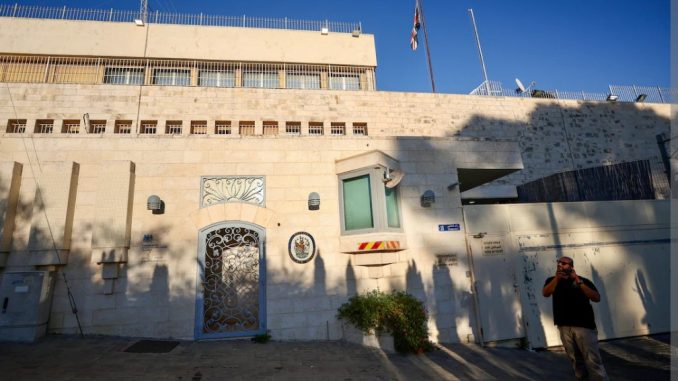
A person stands outside the British Consulate, on the day Israeli Foreign Minister Gideon Saar said he would close it in response to trade sanctions imposed by British Prime Minister Andy Burnham against Israeli settlements in the occupied West…
Reported by:

Cherry Meigh Timbol
News Content Editor
Published September 9, 2026
Jerusalem/London — Israel has ordered Britain to close its consulate in East Jerusalem within 30 days, escalating a rapidly deteriorating diplomatic dispute after the United Kingdom joined France and Canada in imposing new measures against Israeli settlements in the West Bank.
The Israeli response goes beyond the consulate closure. British diplomats assigned to the consulate are expected to lose their diplomatic status, while British officials involved in Gaza coordination and personnel stationed in Ramallah are being ordered to leave within seven days, according to Israeli officials and sources familiar with the decision.
The move represents one of the sharpest diplomatic confrontations between Israel and Britain in years and comes as European governments increasingly pressure Israel over settlement expansion, settler violence and the future of the West Bank.
 A flag waves on the British Consulate, on the day Israeli Foreign Minister Gideon Saar said he would close it in response to trade sanctions imposed by British Prime Minister Andy Burnham against Israeli settlements in the occupied West Bank, in Jerusalem, September 8, 2026. REUTERS/Jamal Awad
Britain Targets Israeli Settlement Trade
The confrontation began with Britain’s announcement on September 8 that it would introduce an import ban on goods originating from Israeli settlements in the occupied West Bank.
British Foreign Secretary Ed Miliband told Parliament that the new sanctions regime would also target companies and individuals involved in construction, infrastructure, financing and real estate connected to settlement expansion.
The British government said the measures are directed at the settlements and their expansion rather than trade with Israel generally. London also said it would continue supporting trade with Israel within the Green Line.
Britain, France and Canada announced the settlement-related trade restrictions together, while Denmark, Finland, Iceland, Ireland, Norway, Poland, Portugal, Spain and Sweden backed or indicated support for further measures aimed at protecting a two-state solution.
The British government specifically cited the expansion of settlements and violence against Palestinians as reasons for its action.
London has also focused criticism on Israel’s planned E1 settlement project, which the UK says could further undermine the territorial continuity required for a future Palestinian state.
 A person enters the British Consulate, on the day Israeli Foreign Minister Gideon Saar said he would close it in response to trade sanctions imposed by British Prime Minister Andy Burnham against Israeli settlements in the occupied West Bank, in Jerusalem, September 8, 2026. REUTERS/Jamal Awad
Israel Calls British Action Interference
Israel’s Foreign Minister Gideon Sa’ar condemned London’s measures, characterizing Britain’s actions as unacceptable interference in Israeli affairs.
Israel has also imposed additional measures against Britain, including restrictions on British personnel and a ban on entry for several British politicians and officials. Former Labour leader Jeremy Corbyn is among the British figures affected, according to Israeli and international reports.
Israel has also decided to end British participation in a U.S.-led coordination mechanism connected to Gaza and to terminate British training of Palestinian security forces in Ramallah.
The consequences therefore extend beyond diplomatic symbolism. British involvement in Palestinian security coordination and Gaza-related activities could be affected as the two governments move further apart.
The Consulate Is Not Britain’s Embassy
The Israeli decision does not mean Britain is closing its diplomatic mission to Israel entirely.
The British Embassy is located in Tel Aviv and is responsible for Britain’s diplomatic relationship with Israel.
The consulate in East Jerusalem has a different role. It deals extensively with Palestinian affairs involving East Jerusalem, the West Bank and Gaza.
The distinction is important because the British government does not recognize Israeli sovereignty over East Jerusalem and maintains its embassy in Tel Aviv.
The consulate’s status reflects Britain’s longstanding position that Jerusalem’s final status should be resolved through negotiations.
Britain Defends Its Decision
Miliband defended the British measures in Parliament, saying the government could not remain passive while settlement expansion continued.
He also stressed that Britain recognizes Israel’s security concerns and continues to support the two-state solution.
The UK government has simultaneously maintained sanctions against individuals accused of extremist settler violence and said its new measures will target settlement expansion rather than Israeli society as a whole.
The British government has also previously warned Israel over the E1 settlement project, saying development there could separate parts of the West Bank from East Jerusalem and threaten the viability of a Palestinian state.
Israel’s Growing Diplomatic Dispute With Europe
Britain’s action is part of a broader European backlash against Israeli settlement policy.
The joint statement signed by 12 Western governments said Israel’s actions in the West Bank were undermining the possibility of a two-state solution and called for an immediate halt to settlement expansion and greater accountability for settler violence.
For Israel, however, the measures represent a growing effort by foreign governments to impose political and economic pressure over territory that Israeli officials regard as central to the country’s security and historical claims.
The economic consequences of the settlement trade bans may initially be limited because settlement exports represent only a small portion of overall Israeli trade. Their larger impact is political: they demonstrate that several Western governments are prepared to use trade restrictions and sanctions to pressure Jerusalem.
🧩 Bottom Line:
Israel’s decision to shut Britain’s East Jerusalem consulate is far more significant than a dispute over one diplomatic building. It is a visible escalation in a widening argument between Israel and an increasingly critical European bloc over the future of the West Bank.
Britain is attempting to use economic and diplomatic pressure to discourage settlement expansion and preserve the possibility of a Palestinian state. Israel, meanwhile, views the campaign as unacceptable foreign intervention and has responded by targeting British diplomatic and security activities.
The most important question now is whether this remains a UK-Israel confrontation or becomes a much larger Israel-Europe diplomatic rupture. If additional countries follow Britain, France and Canada with sanctions, Jerusalem could face increasing economic and political isolation in Europe. If Israel responds with further retaliatory measures, the dispute could expand well beyond settlements and begin affecting security cooperation, trade and broader Western relations with Israel.
SOURCES: REUTERS – Israel tells Britain to close East Jerusalem consulate within 30 days, sources say
AP NEWS – UK government bans goods from Israeli settlements and accuses settlers of ‘ethnic cleansing’
THE JERUSALEM POST – FM Sa’ar: Israel to close UK consulate in east Jerusalem, expel reps. from CMCC over sanctions