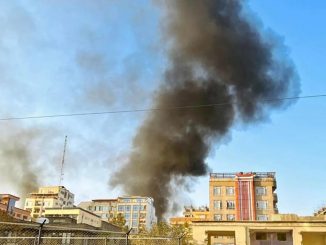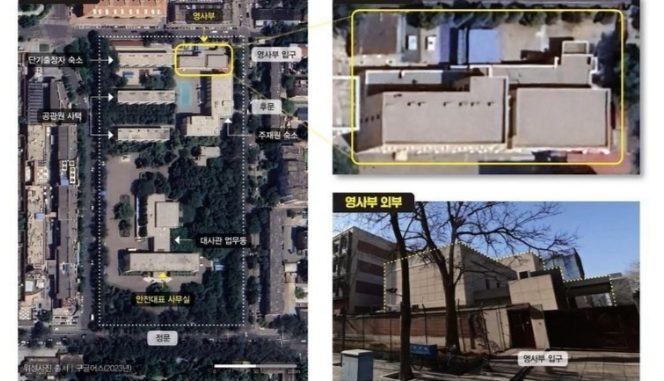
This photo compilation, provided by the Transitional Justice Working Group (TJWG) on Tuesday, shows the suspected location of North Korea’s secret detention facility inside its embassy in Beijing. Yonhap
Reported by:

Cherry Meigh Timbol
News Content Editor
Published September 30, 2026
North Korea allegedly operates a secret detention facility beneath its embassy in Beijing where suspected defectors and other sensitive personnel are detained, interrogated and prepared for forced return to North Korea, according to a new report from the Seoul-based Transitional Justice Working Group (TJWG).
The report, titled “North Korea’s Transnational Repression: China,” was released September 29 and is based on interviews with more than 10 current and former North Korean officials, including a former diplomat, as well as other sources concerning North Korea’s activities in China.
The allegations, if accurate, would indicate that North Korean security operations extend into Chinese territory and raise questions about China’s knowledge of or possible cooperation with Pyongyang’s efforts to prevent defections.
Alleged Prison Beneath North Korean Embassy
According to TJWG, the suspected detention facility is located in the basement of the consular section of the North Korean Embassy in Beijing’s Chaoyang District.
The organization said the site is allegedly used to hold North Koreans who are suspected of preparing to defect, particularly people working overseas who have access to sensitive information.
Targets reportedly include diplomats, students, party officials, weapons and scientific specialists, hackers, overseas workers and managers, and people with knowledge of the Kim family’s activities or sanctioned businesses.
TJWG described the alleged system as part of North Korea’s broader campaign of transnational repression—efforts by a government to track, intimidate, detain or otherwise suppress people outside its own borders.
Former Diplomat Describes Alleged Operation
A former North Korean diplomat interviewed for the report allegedly identified the basement of the consular building as a prison.
According to the report, North Korean security representatives stationed overseas monitor personnel for signs that they may be considering defection.
When someone is suspected of preparing to flee, the person may allegedly be lured to Beijing under false pretenses or apprehended and transferred to the embassy.
The detainee is then reportedly interrogated before being returned to North Korea.
The report says the operation is overseen by a security representative who officially holds a consular position but is allegedly an intelligence officer temporarily assigned to the diplomatic mission.
According to TJWG’s findings, information about suspected defectors can be sent to Pyongyang within 12 to 24 hours.
The Case of a North Korean Hacker
One of the most detailed cases in the report involves a North Korean hacker identified as Pae Yong-ju.
According to TJWG, Pae had been working in China and attempted to defect to South Korea by traveling toward Mongolia. Chinese authorities allegedly arrested him in Inner Mongolia.
The report says he was questioned by Chinese authorities for approximately six months before being transferred into North Korean custody through the North Korean consulate in Shenyang.
He was subsequently allegedly taken to the North Korean Embassy in Beijing, where TJWG says he remained for approximately a year.
The report says Pae was eventually returned to North Korea in August 2023.
Allegedly Disguised as a Patient
The circumstances surrounding Pae’s reported repatriation are among the most disturbing allegations in the report.
TJWG says North Korean officials placed him in a wheelchair and encased his body in a full-body plaster cast to make it appear that he was a medical patient being transported.
The organization said the measures were intended to prevent him from resisting or escaping during the flight from Beijing to Pyongyang.
According to TJWG, information received three years after his repatriation indicated that Pae had died in North Korea.
The allegations could not be independently verified, and North Korean authorities have not publicly acknowledged the reported detention facility.
Forced Repatriation Remains a Major Concern
The report comes amid continuing international concern over the treatment of North Koreans who attempt to escape the country.
China has historically detained and repatriated North Koreans who cross its border without authorization. Human rights organizations have repeatedly argued that people returned to North Korea can face imprisonment, interrogation and other serious abuses.
TJWG argues that the alleged embassy operation represents an additional layer of repression because North Korean authorities would be conducting detention and interrogation operations inside another country’s territory.
The group said the activities could constitute serious human rights violations while also interfering with China’s judicial sovereignty and due-process system.
Questions Over China’s Role
One of the most important questions raised by the report concerns the role of Chinese authorities.
TJWG categorized North Korea’s alleged activities in China into three broad situations: operations conducted independently by North Korean agents; cases in which Chinese authorities allegedly tolerate the activities; and cases in which Chinese authorities allegedly assist in tracking, arresting, investigating or transferring individuals.
The organization said the extent of Chinese involvement varies from case to case and called for greater international scrutiny.
The allegations therefore do not establish that Beijing authorized or participated in every operation described by the report.
Rather, the report raises the question of how much Chinese authorities know about North Korean security activities occurring within China and whether they intervene.
Alleged Violations of China-North Korea Agreements
The report also raises a legal issue involving agreements between Beijing and Pyongyang.
Breitbart, citing the TJWG report, said a 1998 revised agreement between China and North Korea includes provisions under which neither country is supposed to conduct investigations or arrests on the other’s territory and instead must request the other government to conduct such actions.
If North Korean agents are indeed operating an unauthorized detention facility and conducting arrests or interrogations inside China, the activities could therefore conflict with the agreement described in the report.
That conclusion, however, depends on the allegations being substantiated and on the precise legal status of the facility and operations.
A North Korean Version of Transnational Repression?
TJWG compared the alleged North Korean system with China’s own efforts to pursue people overseas.
The report described North Korea’s activities as a form of transnational repression designed to prevent defections and suppress people who possess sensitive information.
The alleged targets are not limited to ordinary defectors. The report identifies people with access to military, technological, diplomatic and financial information as particularly important targets.
This would potentially explain why hackers, scientists, diplomats and overseas workers feature prominently in the allegations.
Why Hackers Are Particularly Sensitive
North Korea’s overseas hackers have become an important source of revenue and intelligence for the regime.
North Korean cyber operators have been accused by governments and cybersecurity organizations of stealing cryptocurrency and conducting cyberattacks against financial institutions and other targets around the world.
A defection by a North Korean hacker could therefore expose information about the country’s cyber operations, personnel or financial networks.
The reported case of Pae illustrates why individuals working in sensitive overseas positions could be considered especially important by Pyongyang.
North Korea and China Remain Close, Despite Changes
The allegations emerge against the background of a complicated relationship between Beijing and Pyongyang.
China has historically been North Korea’s most important economic and diplomatic partner, while the two countries share a long border.
More recently, North Korea has strengthened its relationship with Russia, particularly through military cooperation connected to the war in Ukraine.
Despite those changes, China remains central to North Korea’s ability to conduct economic and diplomatic activity abroad.
The alleged existence of a detention site inside the North Korean Embassy in Beijing therefore carries significance beyond the individual cases described by the human rights organization.
Beijing Has Not Publicly Addressed the Allegations
Neither the Chinese nor North Korean government had publicly responded to the allegations at the time of the reports.
The Korea Herald reported that TJWG called on the international community to monitor China’s handling of North Korean human rights abuses and to examine whether Chinese authorities tolerate or facilitate the alleged activities.
The absence of an official response means that several central questions remain unresolved, including whether the alleged underground detention facility is currently operational and what role, if any, Chinese authorities play in the reported cases.
🧩 Bottom Line:
A new human rights investigation alleges that North Korea operates a secret detention facility beneath its embassy in Beijing, where suspected defectors and other sensitive personnel are allegedly interrogated before being forcibly returned to North Korea.
The report from the Transitional Justice Working Group is based on testimony from multiple sources, including a former North Korean diplomat, and highlights the reported case of hacker Pae Yong-ju, who was allegedly detained in Beijing before being repatriated in 2023.
The allegations have not been independently established by the governments involved, and neither Pyongyang nor Beijing had publicly responded at the time of reporting.
If substantiated, the allegations would raise serious questions about North Korea’s overseas security operations, the treatment of defectors and China’s responsibility for activities conducted by a foreign government on Chinese territory.
SOURCES: BREITBART NEWS – Report: North Korea Operating Extra-Legal Underground Prison in Beijing
THE KOREA HERALD – N. Korea operates secret detention facility beneath Beijing embassy: report
THE KOREA TIMES – N. Korea runs alleged secret prison at Beijing embassy: report