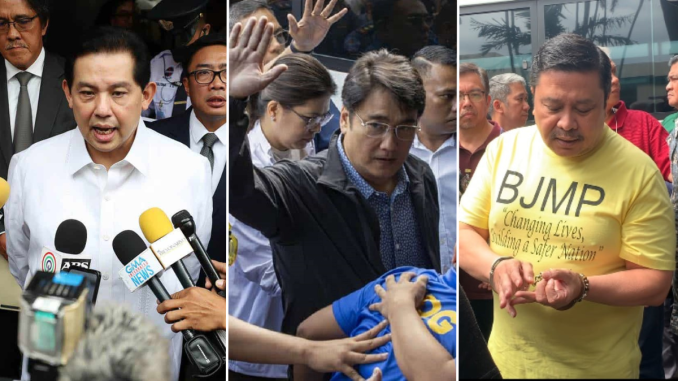
Former House Speaker Martin Romualdez (left), former Sen. Bong Revilla (middle), and Sen. Jinggoy Estrada (right) INQUIRER FILE
Reported by:

Cherry Meigh Timbol
News Content Editor
Published September 8, 2026
MANILA — The Philippines’ long-running flood-control corruption scandal has reached one of its most consequential moments after former House Speaker Martin Romualdez was arrested over allegations that he received billions of pesos in kickbacks from government flood-control projects.
Romualdez, a cousin and former political ally of President Ferdinand Marcos Jr., was arrested on September 7 after the anti-graft court Sandiganbayan issued a warrant in connection with a P7.4-billion ($118 million) plunder case. He and three others are facing charges over alleged misuse of public funds intended for flood-control infrastructure.
The arrest represents a major escalation in a scandal that has already implicated politicians, government officials, engineers and construction companies.
Billions Allegedly Diverted From Flood Protection
According to the allegations outlined by the Office of the Ombudsman, the case involves billions of pesos allegedly diverted from flood-control projects. Investigators say the projects formed part of a much larger government infrastructure program involving nearly 10,000 projects worth more than P545 billion.
Authorities have alleged that numerous projects were overpriced, poorly constructed, or never built at all. The issue is particularly serious in a country regularly struck by powerful typhoons and severe flooding, where flood-control infrastructure can mean the difference between protected communities and devastating losses.
Romualdez has denied the allegations. His legal team has said he is prepared to face the charges and is seeking the same due process afforded to other defendants.
From Political Power to an Arrest Warrant
Romualdez previously served as speaker of the House of Representatives and remains a prominent political figure.
His arrest is significant because the investigation is no longer focused only on contractors and lower-level government personnel. The case has moved directly into the upper levels of Philippine political power.
Other individuals have also been arrested or charged in connection with the broader flood-control investigation. Former lawmakers, government engineers and construction executives have been implicated, while former congressman Zaldy Co remains among the most prominent figures associated with the scandal.
The investigation is continuing, with authorities examining how projects were selected, funded, awarded and implemented.
The Davao Connection
The corruption probe is also reaching other powerful political circles.
The National Bureau of Investigation is examining P1.9 billion worth of flood-control projects in Davao City, including projects in the congressional district represented by Paolo “Pulong” Duterte. Investigators are examining why multiple projects were awarded to a single contractor.
The Davao investigation demonstrates that the flood-control controversy extends well beyond a single politician or political faction.
A Scandal With Real-World Consequences
The controversy is not simply about accounting irregularities or questionable government contracts.
Flood-control projects are intended to protect communities from flooding, particularly in a country repeatedly exposed to typhoons, monsoon rains and extreme weather.
When a project is allegedly never built, built below specifications or substantially overpriced, the consequences can extend far beyond the government budget. Communities may remain vulnerable while billions of pesos intended for protection are allegedly siphoned away.
That has made the scandal especially explosive among Filipinos, with public anger increasingly focused on whether government infrastructure spending actually reaches the communities it is supposed to protect. The country’s recent corruption concerns have also been reflected in international corruption rankings, with the Philippines falling to 120th out of 182 countries and territories in Transparency International’s 2025 Corruption Perceptions Index.
Investigation Continues
The Romualdez case is only one part of a much larger investigation.
Authorities continue to examine allegedly anomalous flood-control contracts, the role of contractors and government officials, and the movement of money allegedly obtained through the projects.
The Office of the Ombudsman has indicated that additional individuals could face legal consequences as investigators follow the money and examine the network surrounding the projects.
For the Philippine government, the challenge now is not merely determining who may have participated in the alleged scheme, but establishing whether the country’s public-works system allowed corruption to become institutionalized.
The case against Romualdez and the other accused will ultimately be decided in court. An arrest or criminal charge is not a conviction, and all defendants remain entitled to due process and the presumption of innocence.
But politically and institutionally, the arrest marks a dramatic development: the Philippines’ flood-control corruption investigation has moved from allegations surrounding questionable projects to criminal proceedings involving one of the country’s most powerful former political figures.
🧩 Bottom Line:
The arrest of former House Speaker Martin Romualdez marks a major turning point in the Philippines’ sprawling flood-control corruption scandal. The case is particularly significant because it reaches one of the country’s most powerful political figures and involves allegations tied to billions of pesos in public funds.
For Filipinos, however, the central issue goes beyond Romualdez or any individual politician. The allegations concern money that was supposed to finance infrastructure protecting communities from flooding. Authorities have said the broader investigation involves thousands of projects, including projects alleged to have been overpriced, substandard, or never constructed.
The legal process must now determine whether the allegations can be proven in court. Romualdez remains entitled to due process and the presumption of innocence. But the case has already placed a much bigger question before the Philippine government: Can it finally demonstrate that billions in public infrastructure spending are being protected from corruption—and that no political connection is strong enough to place anyone above the law?
SOURCES: AP NEWS – Former Philippine House speaker arrested for alleged kickbacks
INQUIRER.NET – LIST: Big names, others arrested in flood control scandal