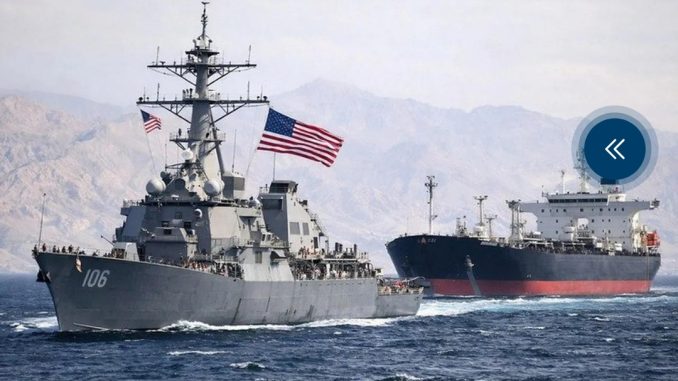
A large oil tanker moving through the Strait of Hormuz with a U.S. Navy destroyer nearby, ideally photographed from an elevated or aerial perspective.
Reported by:

Cherry Meigh Timbol
News Content Editor
Published September 8, 2026
The confrontation between the United States and Iran is entering a potentially more dangerous phase, with the Persian Gulf and the Strait of Hormuz emerging as the latest center of tension.
Iran has threatened to establish a new maritime exclusion zone in the Gulf and introduce a new shipping corridor through the Strait of Hormuz. Senior Iranian security official Mohsen Rezaei said the proposed zone would extend from the area where Tehran says the U.S. naval blockade begins into parts of the Gulf, with vessels entering the area potentially placed on an Iranian sanctions list.
The threat comes as commercial shipping through Hormuz has already fallen sharply. Reuters reported that the average number of commodity ships passing through the waterway dropped to about 10 per day over a recent 10-day period, its lowest level since May.
The significance extends far beyond the immediate U.S.–Iran confrontation. Hormuz is one of the world’s most strategically important energy chokepoints, meaning prolonged disruption could place additional pressure on oil supplies, shipping costs and economies dependent on Gulf energy.
Saudi Arabia Becomes a New Battlefield
The crisis is also spreading beyond the Gulf.
On Tuesday, Iran-backed Houthi forces in Yemen launched attacks against four southern Saudi Arabian cities — Abha, Khamis Mushait, Najran and Jazan. The attacks reportedly involved missiles and drones and injured at least 73 people. Energy facilities were also hit, with fires reported at sites in the region.
The attacks represent a significant escalation because Saudi Arabia is not merely a regional neighbor. It is one of the world’s largest oil producers and a crucial part of the global energy system.
The Saudi-led coalition has vowed to respond, raising the possibility of another cycle of attacks between Saudi forces and the Houthis. AP reported that the renewed fighting also creates additional risks around the Bab al-Mandeb Strait, another strategic maritime route connecting the Red Sea with global shipping lanes.
In effect, the conflict is developing multiple pressure points: Hormuz in the Gulf, Bab al-Mandeb near Yemen, and Saudi Arabia’s energy infrastructure in between.
Oil Markets Are Feeling the Pressure
Energy markets have reacted quickly to the latest escalation.
Brent crude approached the $100-per-barrel level following the attacks on Saudi energy facilities, although it remained below that threshold in recent trading. Reuters reported that alternative export routes, increased production outside OPEC and weaker global demand have helped prevent an even sharper price surge.
But the relatively restrained headline oil price should not obscure the underlying risk.
Physical energy markets are already showing signs of strain, while disruptions to shipping and insurance can increase the cost of moving crude even when global supplies have not completely disappeared.
For American consumers, a prolonged escalation could eventually translate into higher gasoline and transportation costs, adding another economic dimension to the military confrontation.
Washington Faces a Difficult Calculation
For the United States, the challenge is no longer limited to protecting American forces from Iranian attacks.
Washington must also consider the security of international shipping, Gulf allies and global energy infrastructure.
Any attempt to force open or secure the Strait of Hormuz could itself become a major military confrontation with Iran. At the same time, allowing Tehran to impose increasingly restrictive conditions on commercial shipping could undermine freedom of navigation and encourage further escalation.
That leaves Washington facing a difficult strategic choice: increase pressure on Iran and risk a wider conflict, or pursue negotiations while Tehran continues using maritime pressure as leverage.
The Conflict Is Becoming Regional
The Houthi attacks demonstrate why the U.S.–Iran confrontation cannot be viewed solely as a bilateral conflict.
Iran has longstanding relationships with armed groups across the Middle East, while the United States maintains military partnerships with Saudi Arabia and other Gulf states. As those networks become increasingly involved, an attack in one theater can quickly produce consequences in another.
A strike in Iran can trigger retaliation against shipping. Pressure in the Gulf can coincide with attacks from Yemen. Those attacks can then threaten Saudi energy infrastructure, prompting another military response.
That creates the possibility of a self-reinforcing regional escalation in which each side responds to the previous move while making the next round more difficult to control.
What Happens Next?
The immediate question is whether Iran actually implements its threatened maritime exclusion zone and how the United States responds.
A further reduction in shipping through Hormuz would put additional pressure on energy markets. Another major attack against Gulf infrastructure could push oil prices higher and increase pressure on Washington and its allies to respond.
At the same time, diplomatic channels remain important. Qatar has been among the regional states attempting to facilitate dialogue between Washington and Tehran, according to current reporting.
The longer the confrontation continues without a political off-ramp, the greater the danger that a single incident involving a tanker, warship, refinery or civilian population could trigger a much larger escalation.
🧩 Bottom Line:
The Strait of Hormuz is rapidly becoming the central pressure point of the U.S.–Iran conflict.
Iran’s threat to impose new restrictions on Gulf shipping, declining commercial traffic through Hormuz and the latest Houthi attacks on Saudi cities and energy facilities show that the conflict is no longer confined to missiles exchanged between Washington and Tehran. It is increasingly affecting the international shipping system and global energy security.
For the United States, the stakes are therefore much larger than another round of military strikes. Washington must protect its forces and allies without allowing the confrontation to spiral into a regional war that could disrupt the world’s energy lifelines.
For Iran, control or disruption of maritime routes provides powerful economic and strategic leverage—but it also risks bringing stronger military and economic pressure from the United States and its allies.
And for the rest of the world, the message is increasingly clear: what happens around the Strait of Hormuz will not stay in the Middle East. A prolonged confrontation there could reach oil prices, shipping costs, inflation and household budgets far beyond the Persian Gulf.
The next major escalation may therefore not come from another missile strike on Iran or a U.S. base. It could come from a ship trying to pass through the world’s most strategically important waterway.
SOURCES: REUTERS – Iran warns US energy assets in Gulf are vulnerable after latest clashes
SKY NEWS – Middle East latest: Oil prices spike after attacks on Saudi Arabian cities by Houthis