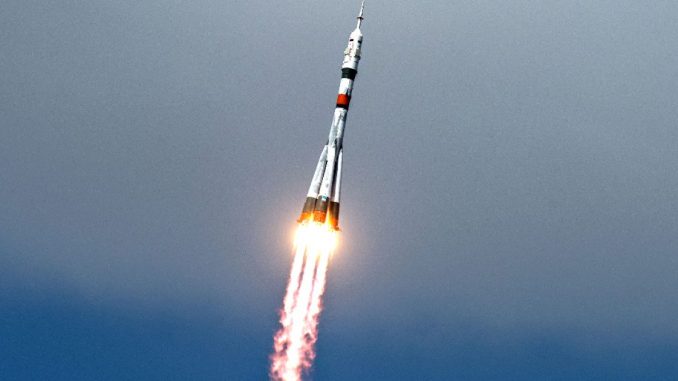
Russian Soyuz rocket, photo by NASA-GCTC-Andrey Shelepin/Wiki Commons
Published March 22, 2026
Russia has successfully launched a Soyuz rocket from its newly repaired Baikonur launch facility, marking a major return to full operational capability—though a technical glitch aboard its cargo spacecraft is raising concerns about the upcoming docking with the International Space Station.
Launch Marks Comeback for Critical Space Facility
The Soyuz-2.1a rocket lifted off from the Baikonur Cosmodrome, carrying the Progress MS-33 cargo spacecraft—also known as Progress 94—on a resupply mission to the ISS.
This mission is especially significant as it is the first launch from the repaired Site 31 pad, which had been out of service since suffering heavy damage during a launch incident in late 2025.
The damage had temporarily disrupted Russia’s ability to send crew and cargo missions to the ISS, making this launch a key milestone in restoring normal operations.
Cargo Mission Carrying Critical Supplies
The Progress MS-33 is carrying approximately three tons of supplies, including food, fuel, and equipment needed to support astronauts aboard the station.
Like previous Progress missions, the spacecraft is designed to:
- Deliver essential cargo
- Reboost the station’s orbit if needed
- Eventually dispose of waste by burning up in Earth’s atmosphere
Glitch Detected After Launch
Despite a successful liftoff, a technical issue emerged shortly after the spacecraft separated from the rocket.
According to NASA, one of the antennas required for automatic docking failed to deploy properly, potentially affecting the spacecraft’s ability to dock autonomously.
“One of the Progress spacecraft’s antennas used for automatic docking did not deploy as planned.”
While all other systems remain operational, engineers are continuing to troubleshoot the issue as the spacecraft approaches the ISS.
Backup Plan: Manual Docking
If the antenna problem cannot be resolved, a Russian cosmonaut aboard the station may be required to manually guide the spacecraft during docking using a backup system.
This procedure, while rare, is not unprecedented and highlights the redundancy built into spaceflight systems to ensure mission success even when complications arise.
The spacecraft is expected to attempt docking at the ISS’s Poisk module within approximately two days of launch.
A Mixed Outcome for Russia’s Space Program
The mission reflects both progress and ongoing challenges for Russia’s space operations.
On one hand, the successful launch demonstrates that repairs to the Baikonur facility are complete and that critical launch capabilities have been restored.
On the other hand, the antenna malfunction underscores the technical risks that remain in complex space missions—where even minor hardware issues can require human intervention in orbit.
🔍 Analyst Insight:
This mission highlights both the resilience and the limits of modern space systems. While the successful launch from the Baikonur Cosmodrome signals recovery and capability, the onboard glitch reinforces a critical reality: technology alone is never infallible.
- Restoration of Strategic Capability
Launching from a repaired pad shows that Russia can quickly recover from setbacks and maintain its presence in orbit, particularly in missions supporting the International Space Station. - Dependence on Redundant Systems
The antenna failure demonstrates why backup systems—and trained personnel—remain essential. Automation may dominate headlines, but redundancy ensures mission continuity. - Human Skill Still Matters
The possibility of manual docking underscores that space programs still rely heavily on highly trained individuals, not just software and automation. - Operational Risks Remain Constant
Even routine missions carry risk. A single component failure can shift an entire operation from automated precision to manual intervention. - Broader Implications for Space Reliability
As more nations and private players expand into space, consistent reliability—not just innovation—will define long-term success.
👥 Human Element:
Behind every launch are people—both in orbit and on the ground—who must respond in real time when things don’t go as planned.
- Pressure on Cosmonauts
Crew members aboard the International Space Station may need to manually guide a multi-ton spacecraft, a task that requires precision under pressure. - Ground Control Responsibility
Engineers and mission controllers must quickly diagnose and adapt, knowing that even small miscalculations can have major consequences. - Risk in High-Stakes Environments
Spaceflight leaves no room for error. Every decision carries weight, especially when equipment does not perform as expected. - Global Cooperation Under Strain
Despite political tensions on Earth, missions like this still rely on coordination between international partners aboard the ISS. - Public Confidence and Perception
Incidents like this can influence how the public views space programs—raising concerns about safety, reliability, and long-term sustainability.
🎯 Conclusion:
Russia’s latest Soyuz launch represents a significant step forward after months of disruption, reaffirming its role in supplying the International Space Station.
However, the unexpected glitch aboard the Progress spacecraft serves as a reminder that space exploration remains inherently unpredictable. Whether through automated systems or manual control, mission success will now depend on careful coordination and real-time decision-making in orbit.
SOURCES: THE GATEWAY PUNDIT – Russia Successfully Launches Soyuz Rocket From Repaired Baikonur Launchpad, but a Glitch in the Cargo Spaceship May Force Cosmonaut to Manually Dock It on the ISS
SPACE.COM – Russian cargo spacecraft suffers glitch after launching toward International Space Station