Reported by:

Cherry Meigh Timbol
News Content Editor
Published September 4, 2026
MADRID — September 4, 2026 — Spanish Prime Minister Pedro Sánchez has rejected allegations that Morocco deliberately orchestrated the massive migrant surge into Spain’s North African enclave of Ceuta, insisting that Madrid has received no “solid proof” linking the Moroccan government to the operation.
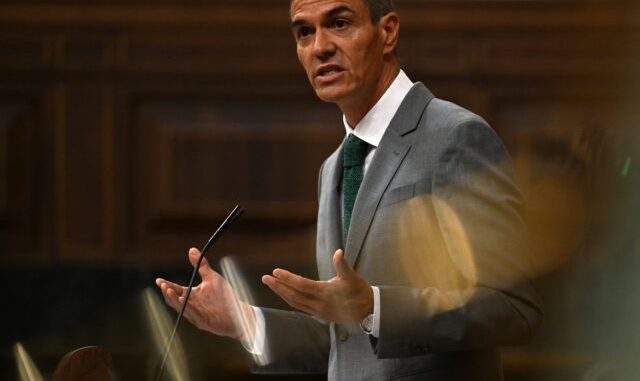
Sánchez made the remarks before Spain’s Congress on Thursday as his government faced mounting political pressure over the crisis and a Spanish police report that raised serious questions about the conduct of Moroccan security forces during the mass border crossings.
According to Sánchez, neither Spain’s diplomatic service, the European Commission nor any international organization has provided the government with conclusive evidence that Morocco planned or carried out the operation.
The prime minister’s position comes despite findings contained in a Spanish police report that have intensified scrutiny of Rabat’s role.
Police report raises questions over Moroccan forces
The report reportedly described what investigators characterized as an unusually permissive response by Moroccan security personnel during the crisis. Evidence examined by Spanish investigators included videos and accounts indicating that some Moroccan officers may have failed to prevent migrants from reaching the border and, in some instances, may have directed or facilitated their movement.
The report has fueled allegations that the extraordinary influx was more than a spontaneous migration event.
However, the report does not by itself establish that Morocco’s national government ordered or coordinated the operation. Other Spanish institutions have also cautioned against drawing definitive conclusions about Rabat’s involvement.
Morocco has denied deliberately facilitating the mass crossing, instead pointing to factors including social-media activity, migrant traffickers and misunderstandings surrounding migration rules.
Tens of thousands entered Ceuta
The crisis unfolded at the end of July, when an unprecedented number of migrants attempted to cross from Morocco into Ceuta.
Spanish authorities have put the number of people involved at roughly 72,000, while other reports have placed the overall figure closer to 80,000. The episode overwhelmed the small Spanish territory and created significant pressure on local authorities and reception facilities.
The human cost has also been severe. Spanish authorities have reported dozens of deaths connected to the crisis, while thousands of migrants, including large numbers of unaccompanied minors, have remained in Ceuta.
A separate report delivered by Spain’s Civil Guard to the National Court addressed the scale of the influx, prior warnings, available personnel and deaths but did not assess Morocco’s role because that question was not part of the court’s request.
Political pressure mounts on Sánchez
Sánchez’s defense of the government’s assessment has triggered fierce criticism from opposition parties, which accuse his administration of failing to adequately prepare for the border crisis and of withholding or downplaying information concerning Morocco.
The controversy has become particularly sensitive because Spain and Morocco have sought closer diplomatic relations in recent years, including cooperation on migration and border security.
Critics argue that evidence of Moroccan security forces allowing large numbers of migrants to approach the Spanish border warrants a much more forceful response from Madrid.
Sánchez, however, has maintained that Spain must distinguish between evidence that Moroccan officers failed to control the border and proof that the Moroccan government deliberately organized the migrant surge.
That distinction has become central to the political dispute.
Evidence remains contested
The available evidence paints a complicated picture.
Spanish investigators have documented what they consider significant failures or permissiveness by Moroccan security forces. At the same time, Sánchez says no authoritative institution has established that Morocco’s government planned the mass crossing. Reuters likewise reported that the Spanish government has acknowledged Moroccan police allowed crossings during a critical period but questioned whether that reflected deliberate action or simply an inability to control the situation.
The disagreement leaves a crucial question unresolved: Was the Ceuta crisis an uncontrolled migration surge that Moroccan authorities failed to stop, or was the failure itself part of a deliberate strategy?
For now, Sánchez says Spain does not possess sufficient evidence to make the latter conclusion.
The issue is likely to remain politically explosive as Spanish authorities continue investigating the events and opposition parties demand greater transparency over what the government knew before the border was overwhelmed.
🧩 Bottom Line:
Spain’s Ceuta crisis has exposed serious questions about Morocco’s role in the mass migrant surge, but Prime Minister Pedro Sánchez says there is still no conclusive evidence that Rabat deliberately orchestrated the operation. While Spanish investigators have documented what they describe as extraordinary permissiveness by Moroccan security forces, the evidence currently falls short of proving a coordinated government plan. The dispute is therefore shifting from what happened at the border to the far more consequential question of whether Morocco knowingly allowed the crisis to unfold—and why.
SOURCES: BREITBART NEWS – Spanish PM Sánchez Insists No ‘Solid Proof’ Morocco Drove Ceuta Invasion
REUTERS – Spain’s PM Sanchez says no evidence Morocco orchestrated Ceuta border surge
FRANCE 24 – No ‘solid proof’ Morocco planned Ceuta migrant rush, says Spanish PM Sanchez