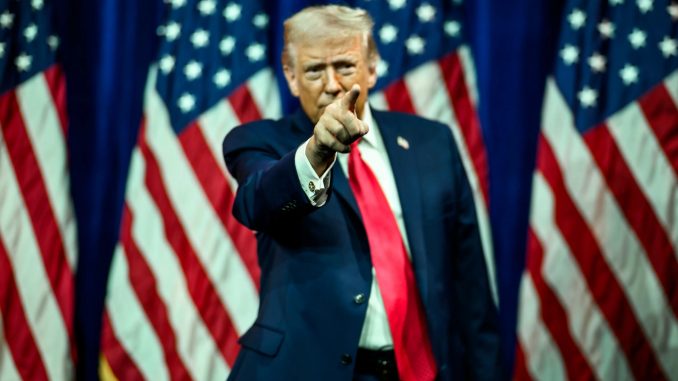
Credit: The White House
Published April 8, 2026
A major confrontation between political leadership and the media erupted this week after Donald Trump announced an investigation into CNN, accusing the network of spreading a “fraudulent” statement tied to sensitive Iran ceasefire negotiations.
The dispute comes at a moment of extraordinary global tension, as Washington and Tehran navigate a fragile agreement that many analysts say could determine whether the region moves toward stability—or slides back into conflict.
A Disputed Statement Sparks a Federal Probe
The controversy began when CNN reported on a statement attributed to Trump regarding the terms and tone of the ceasefire with Iran. Shortly after, Trump publicly rejected the report, insisting the statement was false and possibly fabricated.
In a post on Truth Social, Trump described the report as a “total fabrication” and suggested that legal authorities would examine whether the dissemination of the statement constituted wrongdoing.
The announcement of a potential investigation marks a significant escalation—not just a political rebuttal, but a move toward formal scrutiny of media conduct during a national security event.
Timing: A Fragile Ceasefire With Global Stakes
The clash unfolded just as the United States and Iran entered a two-week ceasefire agreement, a deal reached under intense pressure and just hours before a critical deadline.
Key elements of the agreement reportedly include:
- A halt to military strikes between both sides
- The reopening of the Strait of Hormuz
- Continued negotiations aimed at a longer-term resolution
Trump characterized the agreement as a “total and complete victory,” framing it as a successful use of pressure diplomacy. However, the ceasefire remains temporary and highly conditional, with compliance on both sides still uncertain.
Media Accuracy Under the Microscope
At the center of the dispute is a fundamental question: what was actually said—and who verified it?
Trump’s criticism suggests that CNN relied on:
- Unverified or anonymous sourcing
- Misinterpretation of internal communications
- Or potentially inaccurate attribution during a fast-moving situation
While CNN has not admitted wrongdoing, the situation highlights the challenges of reporting in real time during high-stakes geopolitical developments.
In moments like these, even minor discrepancies can carry outsized consequences, affecting markets, diplomacy, and public perception.
National Security Meets Information Warfare
The stakes go far beyond a media dispute.
The Iran ceasefire itself sits at the center of a volatile regional landscape, involving:
- Ongoing tensions in the Persian Gulf
- Military positioning by both U.S. and Iranian forces
- Global reliance on energy routes passing through the Strait of Hormuz
Any confusion or misinformation surrounding official statements can:
- Undermine diplomatic credibility
- Create uncertainty among allies and adversaries
- Potentially trigger unintended escalation
This is why, supporters argue, accuracy is not just a journalistic standard—it is a national security requirement.
A Longstanding Battle With the Press
The investigation also reflects a broader and long-running conflict between Trump and major media institutions.
Throughout his political career, Trump has frequently accused outlets like CNN of:
- Bias in coverage
- Misrepresentation of statements
- Reliance on unnamed or partisan sources
Supporters see this latest move as part of a broader push for media accountability, especially in moments where global stability is at stake.
Critics, however, warn that investigations targeting media organizations could raise concerns about:
- Press freedom
- Government overreach
- The independence of journalism
Economic and Global Ripple Effects
The timing of the dispute has also raised concerns in financial markets.
The Strait of Hormuz alone carries nearly one-fifth of global oil supply, making any instability—or even perceived instability—a major factor in:
- Oil price fluctuations
- Shipping disruptions
- Investor confidence
Markets have already shown volatility in response to both the ceasefire and the uncertainty surrounding it.
A breakdown in trust—whether diplomatic or informational—could amplify these effects.
🔍 Critical View: Trump–CNN Clash Raises Questions About Media Accountability and National Security
As tensions rise over a fragile Iran ceasefire, a separate but equally significant conflict has emerged at home: a dispute between Donald Trump and CNN over a reportedly inaccurate statement tied to ongoing negotiations. While critics frame the situation as another political clash, it highlights deeper concerns about media accuracy, accountability, and the role of information during high-stakes global events.
In moments where diplomacy, military decisions, and global markets hang in the balance, the margin for error in reporting is not just small—it is critical.
1. Media Accuracy and Responsibility
At the center of the controversy is whether CNN reported a statement that was inaccurate or insufficiently verified.
- In fast-moving international crises, reliance on unnamed sources or partial information can lead to misreporting.
- Even minor inaccuracies can quickly spread, shaping public perception before corrections are issued.
The issue is not simply about one report—it is about whether major media organizations are exercising the level of scrutiny required when national security is involved.
2. National Security Implications of Misinformation
The stakes of inaccurate reporting rise dramatically when tied to geopolitical tensions.
- Statements attributed to U.S. leadership can influence how adversaries interpret intentions.
- Allies depend on clarity and consistency when coordinating responses.
If information is misrepresented, even unintentionally, it can undermine negotiations, weaken strategic positioning, and create unnecessary risks in already volatile situations.
3. Accountability vs. Press Freedom
The investigation announced by Trump raises an important balance:
- On one hand, media organizations must be held accountable for accuracy and integrity.
- On the other, a free press is essential to democracy and must operate without undue interference.
The challenge lies in ensuring that accountability mechanisms exist without crossing into actions that could discourage independent reporting.
4. Pattern of Distrust Between Media and Leadership
This incident is part of a broader, long-standing tension between Trump and major media outlets.
- Repeated accusations of bias and misrepresentation have fueled public skepticism.
- Media responses often reinforce perceptions of division rather than resolve them.
The result is a widening gap in trust, where large segments of the public question whether information is being presented fully and fairly.
5. Impact on Public Confidence and Global Perception
When disputes over accuracy emerge during critical global events, the consequences extend beyond domestic politics.
- Public confidence in both leadership and media institutions can erode.
- International observers may view the conflict as a sign of internal division or uncertainty.
In high-stakes diplomacy, credibility is a form of leverage—and once weakened, it is difficult to restore.
👥 On the Ground: Trump–CNN Clash Reveals Real-Time Impact of Media Disputes During Global Crisis
As the United States navigates a fragile ceasefire with Iran, the conflict between Donald Trump and CNN is not just playing out in headlines—it is being felt in real time by officials, analysts, and observers working closest to the situation.
On the ground, where decisions must be made quickly and based on reliable information, even a single disputed report can create confusion, hesitation, or miscalculation. This moment highlights how information, credibility, and timing directly affect national security and diplomatic outcomes.
1. Decision-Making Under Pressure
Officials and analysts monitoring the ceasefire rely on accurate, timely information to guide decisions.
- Reports attributed to leadership can influence military posture and diplomatic responses.
- Conflicting information forces decision-makers to pause, verify, or reassess strategies.
On the ground, uncertainty is not theoretical—it can slow responses or complicate already delicate negotiations.
2. Impact on Diplomatic Channels
Diplomats working behind the scenes depend on clear and consistent messaging.
- Misreported statements can create misunderstandings between negotiating parties.
- Adversaries may interpret conflicting reports as signs of weakness or division.
In high-stakes talks, clarity is essential. Even minor discrepancies can undermine trust and disrupt progress toward agreements.
3. Military and Security Considerations
Military personnel in the region operate in an environment where information can directly affect readiness.
- Statements about ceasefires or escalation influence operational decisions.
- Inaccurate reporting can create uncertainty about intent, increasing risk.
Those closest to the situation understand that precision in communication is critical to avoiding unintended escalation.
4. Media Influence in Real Time
Modern media operates at a pace where information spreads instantly across the globe.
- Reports are amplified within seconds, often before full verification.
- Corrections or clarifications may not reach the same audience as the original claim.
On the ground, this creates a dynamic where initial narratives can shape reactions before facts are fully established.
5. Public Perception and Confidence
The dispute also affects how the public interprets unfolding events.
- Conflicting accounts from leadership and media can lead to confusion and skepticism.
- Public trust becomes strained when narratives appear inconsistent.
Those observing the situation in real time see how confidence in both institutions and information can quickly erode.
🎯 The Final Word: Clarity and Accountability Are Essential in Moments of Crisis
The unfolding dispute underscores a fundamental reality: in high-stakes situations, accuracy is not optional—it is critical. When information tied to national security and diplomacy is questioned, the consequences are immediate, affecting decision-making, negotiations, and public trust. Moving forward, rigorous verification, responsible reporting, and clear accountability must remain the standard. Without them, confusion replaces clarity, credibility is weakened, and the risks extend far beyond a single headline.
SOURCES: THE GATEWAY PUNDIT – BREAKING: Trump Launches Investigation Into CNN World for Pushing ‘FRAUDULENT’ Iranian Ceasefire Statement — Says CRIMINAL ACT May Have Been Committed
NEWSWEEK – Donald Trump Launches Investigation Into CNN Over Iran Ceasefire
DEADLINE – CNN Defends Authenticity Of Iranian “Victory” Statement After Donald Trump Posts Irate Claim It Was A “Fraud”
BUSINESS INSIDER – Trump says he’s extending the deadline for Iran by 2 weeks in exchange for immediate opening of the Strait of Hormuz