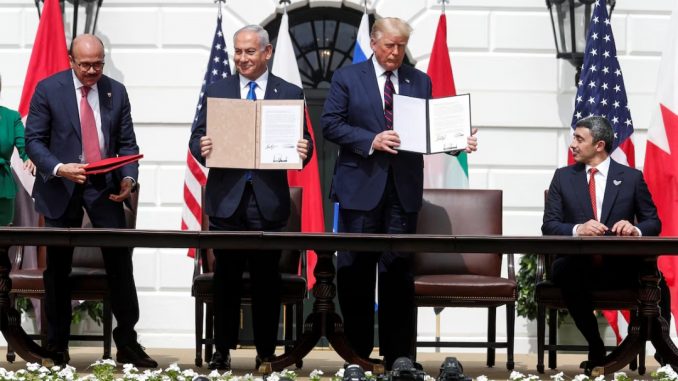
Bahrain’s Foreign Minister Abdullatif Al Zayani, Israel’s Prime Minister Benjamin Netanyahu, U.S. President Donald Trump and United Arab Emirates (UAE) Foreign Minister Abdullah bin Zayed participate in the signing of the Abraham Accords, normalizing relations between Israel and some of its Middle East neighbors in a strategic realignment of Middle Eastern countries against Iran, on the South Lawn of the White House in Washington, U.S., September 15, 2020. REUTERS/Tom Brenner/File Photo Purchase Licensing Rights, opens new tab
Published May 25, 2026
WASHINGTON — A Bigger Push for Regional Realignment
President Donald Trump is pressing ahead with an ambitious effort to expand the Abraham Accords, urging a wide group of Middle Eastern and Muslim-majority nations to join the U.S.-brokered normalization framework with Israel as part of a broader regional strategy tied to ongoing Iran negotiations.
The push reportedly includes countries such as Saudi Arabia, Qatar, Egypt, Turkey, Jordan, and Pakistan, with Trump framing participation as a key step toward a long-term peace structure in the region.

Saudi Arabia has rejected calls to join the Abraham Accords until the Palestinian issue is resolved.Getty Images
Linking Iran Talks to a Broader Deal
The push to expand the Abraham Accords is not happening separately from the Iran negotiations — it is being tied into them as part of a much larger regional strategy.
The idea being discussed is that any progress with Iran would not stand alone. Instead, it would be connected to a wider political framework where more Middle Eastern countries normalize relations with Israel under the Abraham Accords. This includes countries like Saudi Arabia, Qatar, Egypt, Turkey, Jordan, and Pakistan being encouraged to join at the same time or shortly after a possible Iran agreement.
In simple terms, the strategy is trying to bundle two big issues together:
- First, reduce tensions with Iran through a nuclear or ceasefire-style agreement
- Then, use that momentum to expand diplomatic recognition of Israel across the region
Supporters of this approach say it could reshape Middle East alliances by turning separate conflicts into one large peace framework. The idea is that if major regional players are already negotiating with the U.S. over Iran, it may be easier to also bring them into broader diplomatic agreements with Israel.
But critics warn that combining the two tracks could make everything harder. Countries that are willing to talk about Iran may not want to be pushed into formal ties with Israel at the same time, especially while tensions in Gaza and other conflicts are still fresh. There is also concern that adding political conditions could slow down or derail the Iran negotiations themselves.
At the center of it all is a strategic gamble: whether linking two of the region’s most sensitive issues — Iran and Israel normalization — will speed up peace, or overload the talks with too many demands at once.

President Trump also wants Qatar to join the accords.Getty Images
Mixed Reactions from the Region
The proposal has triggered a mixed response across the region:
Pakistan has rejected the idea outright
Other governments, including Saudi Arabia and Qatar, have not publicly committed.
Several states remain cautious due to domestic political pressure and the ongoing Gaza conflict .
Officials in Saudi Arabia have long maintained that progress on Palestinian statehood remains a key condition before any formal normalization with Israel.
🧩 Reading Between the Lines:
This push to expand the Abraham Accords while Iran talks are still ongoing is more than just another round of diplomacy. It’s an attempt to reshape how the Middle East handles its biggest conflicts — all at the same time, under one broader framework.
1. One big package instead of separate deals
Instead of treating Iran negotiations and Israel normalization as separate issues, the strategy is to connect them. The idea is that progress with Iran could open the door for more countries to formally align with Israel through the Abraham Accords.
2. Who joins — and who resists
Some countries are being encouraged to join this wider framework, but not everyone is on board. Governments have to balance regional politics, security concerns, and domestic public opinion before making any public commitments.
3. U.S. influence in regional structure
This approach reflects an effort by Washington to guide the overall structure of Middle East diplomacy, not just respond to events. It’s about building a long-term alignment rather than handling crises one at a time.
4. Risk of overloading negotiations
The challenge is that combining sensitive issues — Iran’s nuclear concerns, regional security, and Israel normalization — could slow everything down. Countries willing to negotiate on one issue may hesitate if too many conditions are tied together.
5. Bigger strategic shift
At its core, this reflects a shift toward a more interconnected diplomatic approach in the region, where peace agreements, security concerns, and alliances are being negotiated as part of one larger system instead of separate tracks.
🔗 The Stakes:
This push to expand the Abraham Accords while Iran negotiations are still underway carries major consequences for the region. It is not just about diplomacy on paper — it affects security, alliances, and long-term stability across the Middle East.
1. Regional alignment and alliances
Expanding the Accords would reshape which countries openly cooperate with Israel and how regional blocs are formed. That could strengthen some alliances while deepening divides with others, especially Iran.
2. Impact on Iran negotiations
Linking normalization with Iran talks adds complexity. Countries involved may support one track but hesitate on the other, making it harder to reach fast or simple agreements.
3. Security balance in the Middle East
Any shift in alliances affects military planning, deterrence strategies, and how countries respond to threats. Even diplomatic changes can alter how safe or tense the region feels.
4. Domestic political pressure
Leaders in the region must consider public opinion at home. Some governments may avoid joining broader agreements if it creates internal backlash or is seen as moving too quickly.
5. Economic and energy ripple effects
Changes in stability directly influence oil routes, shipping lanes, and investor confidence. Even uncertainty in talks can move global markets and affect energy prices worldwide.
🏁 The Final Word:
At this stage, the push to expand the Abraham Accords alongside Iran negotiations is a high-risk, high-reward strategy. If it works, it could lock in a broader network of cooperation in the Middle East and reduce the chance of future conflicts by bringing more countries into a shared diplomatic framework. But if it fails, it could slow down already fragile talks and create more resistance from countries that don’t want multiple sensitive issues tied together at once. In simple terms, the outcome depends on whether regional governments are ready to commit to a bigger long-term realignment — or whether the added pressure ends up making already complicated negotiations even harder to finish.
SOURCES: REUTERS – Trump links Abraham Accords to any Iran deal
THE NEW YORK POST – Trump demands six Muslim countries join Abraham Accords if they want to be part of Iran deal that ‘is proceeding nicely’