Screenshot
Published May 29, 2026
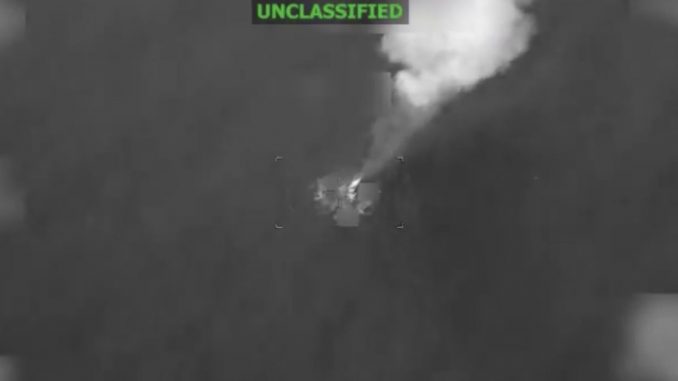
US forces executed another strike on a drug trafficking vessel operated by narcoterrorists in the Eastern Pacific on Wednesday, killing two male narcoterrorists.
Washington / Caribbean Sea —
U.S. Southern Command has carried out another deadly strike on a suspected drug-trafficking vessel in international waters, continuing a controversial military campaign that has now resulted in nearly 200 deaths since operations began last year, according to officials and recent reporting.
The latest strike, confirmed by SOUTHCOM, targeted a small boat allegedly used by narcotics traffickers. Video released by the command showed the vessel being hit and engulfed in flames, part of an ongoing series of operations aimed at disrupting drug routes flowing toward the United States.
Campaign Expands Across Caribbean and Eastern Pacific
The strike is the latest in a broader U.S. military campaign targeting suspected “narco-terrorist” networks operating in the Caribbean and Eastern Pacific.
Since the operation began in September 2025, U.S. forces have conducted dozens of maritime strikes, often targeting fast-moving boats on known smuggling routes. Military officials say the missions are part of a wider strategy to disrupt cartels responsible for trafficking fentanyl and cocaine into the United States.
Southern Command reports indicate the total death toll from these operations has now approached or exceeded 190 individuals, with multiple vessels struck in succession during recent months.
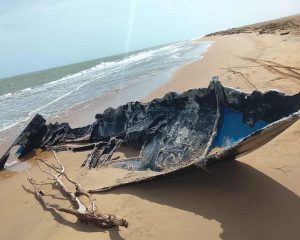
The remains of a boat allegedly struck by the US military, in the Alta Guajira region of Colombia. Photograph: Courtesy of CLIP
Pentagon Defends Operations as Counter-Drug War Intensifies
The Pentagon has defended the strikes as necessary actions in what officials describe as an escalating conflict with transnational drug cartels.
Supporters argue the operations are long overdue, saying traditional interdiction methods were no longer effective against highly mobile, well-funded trafficking networks operating across open waters.
Military officials have pointed to intercepted intelligence, surveillance tracking, and known trafficking routes as justification for the targeting decisions.
Growing Questions Over Evidence and Legal Authority
However, the campaign has sparked growing scrutiny in Washington, with lawmakers and legal analysts questioning the lack of publicly released evidence confirming that every targeted vessel was carrying narcotics.
Reports have also raised concerns about rules of engagement and oversight, particularly in cases where survivors were reportedly present after initial strikes.
The Pentagon’s inspector general has launched a review into whether targeting procedures were properly followed, though the review will not evaluate the broader legality of the strikes themselves.

From left: Eduard Hidalgo, Dushak Milovcic, Ricky Joseph and Chad Joseph. Composite: Courtesy of the CLIP
Strategic Debate Over Escalation
The Trump administration has framed the campaign as part of a broader “war on cartels,” arguing that drug trafficking organizations should be treated as armed threats rather than conventional criminal networks.
Critics, however, warn that the operations blur the line between law enforcement and military action, raising concerns about long-term escalation and accountability in international waters.
Nearly 200 Deaths as Operations Continue
With each new strike, the total number of deaths tied to the maritime campaign continues to climb, now approaching roughly 200 since operations began.
Despite the controversy, SOUTHCOM shows no indication of slowing operations, signaling that the campaign against suspected drug-smuggling vessels will continue as long as trafficking routes remain active.
🧩 Reading Between the Lines:
The latest wave of U.S. military strikes on suspected drug boats is being framed as a hardline escalation in the fight against cartel trafficking, but it also raises bigger questions about how far the government is willing to go in treating the drug war as a military conflict instead of a traditional law enforcement issue.
Drug Cartels Treated as Battlefield Threats
A major topic here is the shift in how cartels are being handled. Instead of relying mainly on coast guard interceptions or arrests, the strategy now involves direct military strikes in international waters. Supporters see this as a necessary response to heavily armed, fast-moving trafficking networks that no longer behave like ordinary criminal groups.
Escalation of Military Force at Sea
Another key issue is the level of force being used. With repeated strikes on boats and a rising death toll, the campaign is starting to resemble a sustained military operation rather than isolated interdiction missions. The concern is that once this level of force becomes routine, it can be difficult to scale back.
Evidence and Targeting Questions
There is also ongoing discussion about how targets are identified before strikes are carried out. Officials say intelligence and surveillance confirm trafficking activity, but critics are asking how much evidence is publicly available and how decisions are independently verified before lethal force is used.
Law Enforcement vs. War Model
A bigger underlying debate is whether this should be treated as a war or a policing operation. Moving the drug fight into a military framework changes the rules, the accountability structure, and the level of transparency — which is why the shift is drawing so much attention in Washington.
Public Safety and Domestic Impact
Supporters argue the goal is straightforward: stop deadly drugs like fentanyl from reaching American communities. The logic is that disrupting supply chains at sea is more effective than waiting for drugs to reach U.S. soil. Critics counter that the long-term consequences of militarizing the drug war could create new legal and diplomatic complications.
🔗 The Stakes:
The escalating U.S. military campaign against suspected drug-trafficking boats marks a major turning point in how the country is choosing to fight the cartel crisis. With the death toll rising and strikes happening at sea in international waters, the stakes now go beyond drug interdiction and into broader questions about national security, military power, and how far the government should go to stop narcotics from reaching the U.S.
Drug Flow Into the United States
At the center of the issue is the continued flow of deadly drugs, especially fentanyl, into American communities. Supporters of the strikes argue that traditional enforcement methods have not been enough to stop highly organized trafficking networks, and that stronger action is needed to cut off supply routes before drugs reach U.S. streets.
Safety of U.S. Military and Operational Risk
Another major concern is the safety and exposure of U.S. forces carrying out these operations. Each strike carries operational risk, and repeated engagements at sea increase the chances of escalation, retaliation tactics, or changes in how trafficking groups operate to avoid detection.
Expanding Use of Military Force
The campaign also raises the question of how far military force should be used in what has traditionally been a law enforcement problem. Moving from interdiction and arrests to direct strikes represents a significant shift in policy, with long-term implications for how future administrations handle similar threats.
Accountability and Transparency
There is growing focus on how targets are selected and what level of proof is required before a strike is carried out. Supporters say intelligence-driven operations are necessary against fast-moving criminal networks, while critics worry about limited public transparency and oversight in life-or-death decisions.
Global and Legal Implications
Because these strikes take place in international waters, they also raise legal and diplomatic questions. Other countries in the region are watching closely, and any expansion of the campaign could affect international relations and maritime norms.
🏁 The Final Word:
The ongoing U.S. military campaign against suspected drug-trafficking boats signals a major shift in how the country is confronting the cartel crisis, moving from traditional enforcement toward direct military action at sea. Supporters argue this approach is a necessary response to increasingly dangerous and organized smuggling networks that continue to flood American communities with lethal drugs despite years of law enforcement efforts. At the same time, the rising death toll, questions about targeting transparency, and the use of military force in international waters are fueling debate over how far this strategy should go and what limits, if any, should be placed on it moving forward.
SOURCES: THE GATEWAY PUNDIT – WATCH: US Southern Command SMOKES Another Drug Boat, Killing Two Narcoterrorists in Second Attack This Week
NEWSWEEK – Nearly 200 Killed in US Strikes on ‘Drug Boats’ in Latin America
AP NEWS – US military strikes another alleged drug boat in the eastern Pacific, killing 2