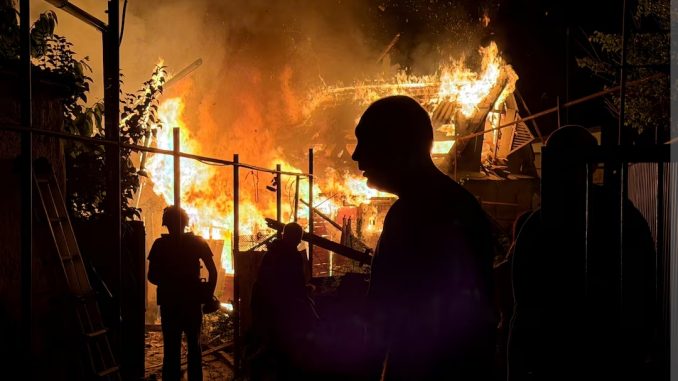
Residents look at a private house that burns after an overnight Russian drone strike, amid Russia’s attack on Ukraine, in Zaporizhzhia, Ukraine. Picture taken with a mobile phone. REUTERS/Serhii Chalyi
Published June 22, 2026
Escalation on Both Sides Marks New Phase of Long-Range Warfare
The war between Russia and Ukraine intensified over the weekend as Ukraine launched one of its largest drone offensives against Russian territory while Russian missile and drone attacks killed civilians across several Ukrainian regions.
Russian authorities reported intercepting dozens of Ukrainian drones headed toward Moscow, with air defense systems downing 84 drones aimed at the capital over a 24-hour period and more than 300 drones across the country. The attacks forced the temporary suspension of flights at several major Moscow airports before operations later resumed.
The large-scale drone campaign is part of Ukraine’s broader effort to target military infrastructure, fuel supplies, and logistics facilities deep inside Russian territory.
 A firefighter works at the site of a private house that burns after an overnight Russian drone strike, amid Russia’s attack on Ukraine, in Zaporizhzhia, Ukraine June 22, 2026. Picture taken with a mobile phone. REUTERS/Serhii Chalyi
Civilian Casualties Mount in Ukraine
While Ukrainian drones struck targets inside Russia, Russian attacks continued to inflict casualties across Ukraine.
In the northeastern city of Sumy, a Russian drone strike hit a residential area, killing three members of the same family, including a 13-year-old boy, his father, and an elderly relative. Two additional family members were injured in the attack. Ukrainian officials condemned the strike, saying it targeted a civilian home.
Further south, a Russian drone attack in Zaporizhzhia killed two people and wounded several others, including a child. In Odesa, a missile strike killed one civilian and injured three more while damaging infrastructure and setting fuel storage facilities ablaze.
The attacks come amid growing concerns over civilian casualties. International monitoring groups have reported a significant increase in deaths and injuries resulting from aerial attacks in recent months.
 A firefighter attempts to put out a fire after a Russian strike, amid Russia’s attack on Ukraine, at a location given as Odesa Region, Ukraine, in this still image from video released June 22, 2026. State Emergency Service of Ukraine in Odesa…
Moscow Faces Growing Pressure
Ukraine’s expanding drone capabilities have increasingly brought the war closer to Russia’s capital and strategic infrastructure.
Recent Ukrainian strikes have targeted oil refineries, fuel depots, communications facilities, and military-industrial sites. Earlier attacks damaged Moscow’s largest refinery, a key supplier of fuel to the Russian capital. Ukrainian officials have argued that such operations are aimed at weakening Russia’s ability to sustain military operations.
Russian authorities have responded by strengthening air defenses around Moscow and other major cities while continuing long-range strikes against Ukrainian targets.
 Firefighters work at the site of a Russian strike, amid Russia’s attack on Ukraine, at a location given as Odesa Region, Ukraine, in this still image from video released June 22, 2026. State Emergency Service of Ukraine in Odesa Region/Handout..
Crimea Feels the Impact
Russian-controlled Crimea has also been affected by Ukraine’s campaign against logistics and fuel infrastructure.
Authorities in the peninsula have suspended children’s summer camps and restricted fuel sales amid growing shortages linked to repeated attacks on supply routes and refineries. Reports indicate disruptions to gasoline and diesel availability, forcing local authorities to prioritize essential services.
The developments highlight Ukraine’s strategy of targeting support networks that sustain Russian military operations far from the front lines.
Strategic Shift Toward Long-Range Strikes
Military analysts increasingly describe the conflict as a war of deep-strike capabilities, with both sides relying heavily on drones, missiles, and precision attacks against infrastructure beyond the battlefield.
Ukraine continues to expand its ability to strike strategic targets inside Russia, while Moscow maintains pressure through sustained missile and drone attacks on Ukrainian cities and civilian infrastructure. Neither side has shown signs of reducing military operations, and prospects for a ceasefire remain uncertain.
 Public / Political Reactions:
🇺🇦 Ukrainian Government and Officials
Ukrainian officials condemned the latest Russian strikes on civilian areas, particularly the attack in Sumy that killed multiple members of the same family.
- Ukrainian authorities accused Russia of deliberately targeting civilian-populated areas
- Officials renewed calls for additional air defense systems and military assistance from Western allies
- Kyiv emphasized that attacks on residential neighborhoods demonstrate the continued threat facing Ukrainian civilians
➡️ Position: Increased international support remains necessary to protect civilians and critical infrastructure.
🇷🇺 Russian Government and Military Officials
Russian authorities focused on Ukraine’s large-scale drone offensive, highlighting the interception of dozens of drones targeting Moscow and other regions.
- Officials praised air defense forces for preventing damage to critical facilities
- Moscow characterized the drone attacks as threats to civilian safety and transportation infrastructure
- Russian authorities reiterated their commitment to maintaining military operations while strengthening domestic security measures
➡️ Position: Russia portrays the drone attacks as evidence of escalating Ukrainian strikes on Russian territory.
🌍 Western Allies and International Partners
Several Western governments continued expressing support for Ukraine while condemning attacks that result in civilian casualties.
- Allied nations reiterated support for Ukraine’s right to self-defense
- Leaders called for greater protection of civilians and adherence to international humanitarian law
- Discussions continued regarding military aid, air defense support, and long-term security assistance
➡️ Position: Continued backing for Ukraine alongside calls to minimize civilian harm.
⚖️ International Observers and Humanitarian Organizations
Humanitarian groups and international observers expressed concern over the growing civilian toll from the conflict.
- Organizations highlighted rising casualties caused by drone and missile attacks
- Concerns were raised about damage to homes, public infrastructure, and essential services
- Analysts noted that the increasing use of long-range strikes by both sides is expanding the conflict beyond traditional front lines
➡️ Position: Escalating attacks are increasing humanitarian risks and complicating prospects for de-escalation.
📊 Security and Military Analysts
Defense analysts view the latest developments as evidence of a continuing shift toward long-range warfare.
- Ukraine is increasingly targeting infrastructure, logistics hubs, and military-industrial facilities inside Russia
- Russia continues large-scale missile and drone campaigns against Ukrainian cities and strategic assets
- Experts believe both sides are seeking to weaken each other’s capacity to sustain prolonged military operations
➡️ Position: The conflict is evolving into a sustained contest of drone, missile, and infrastructure warfare with no immediate breakthrough in sight.
 Resulting Effects
The latest exchange of drone and missile attacks has further intensified the Russia–Ukraine conflict, highlighting the growing importance of long-range warfare and deep-strike capabilities on both sides.
1. Increased Pressure on Russian Air Defenses
Ukraine’s large-scale drone offensive forced Russian authorities to activate extensive air defense measures around Moscow and other regions.
🛡️ Russian air defense systems intercepted dozens of drones targeting the capital.
✈️ Several Moscow-area airports temporarily suspended operations due to security concerns.
🏙️ Authorities increased monitoring and protective measures around key infrastructure.
➡️ Result: Expanded Ukrainian drone operations → heightened security pressure inside Russia.
2. Continued Civilian Casualties in Ukraine
Russian missile and drone strikes continued to affect civilian communities across Ukraine.
🏠 Residential areas in Sumy, Zaporizhzhia, and Odesa suffered damage from attacks.
👥 Multiple civilians were killed or injured, including members of the same family in Sumy.
🚑 Emergency services were deployed to affected areas to assist victims and assess damage.
➡️ Result: Ongoing aerial attacks → rising humanitarian and civilian impact.
3. Strain on Russian Logistics and Fuel Supplies
Ukraine’s deep-strike campaign continues to target infrastructure supporting Russian military operations.
🏭 Fuel facilities, logistics hubs, and industrial sites remain key targets.
🚚 Supply disruptions have reportedly affected fuel availability in parts of Russian-controlled Crimea.
📉 Authorities have taken measures to prioritize essential fuel distribution.
➡️ Result: Infrastructure strikes → increased logistical and supply challenges.
4. Growing International Attention
The latest escalation has renewed global focus on the conflict and its humanitarian consequences.
🤝 Western allies continue discussions on military and air defense support for Ukraine.
⚖️ International organizations have expressed concern over civilian casualties and infrastructure damage.
📡 Diplomatic efforts remain active despite continued fighting.
➡️ Result: Escalation of hostilities → increased international scrutiny and diplomatic engagement.
5. Expansion of Long-Range Warfare
Both Russia and Ukraine are increasingly relying on drones and precision strikes beyond frontline areas.
🚁 Ukraine continues expanding its ability to strike targets deep inside Russian territory.
🚀 Russia maintains missile and drone campaigns against Ukrainian cities and infrastructure.
🛰️ Technological and strategic competition is becoming a defining feature of the conflict.
➡️ Result: Conventional battlefield operations → broader long-range warfare across both countries.
 Future Outlook
The latest wave of drone and missile attacks suggests that the Russia–Ukraine war is likely to remain highly active in the near term, with both sides continuing to expand their long-range strike capabilities while seeking strategic advantages beyond the front lines.
1. More Deep-Strike Drone Operations Expected
Ukraine is expected to continue targeting military and logistical assets inside Russian territory.
🎯 Drone attacks may increasingly focus on airfields, fuel depots, military factories, and transportation hubs.
🛡️ Russia is likely to strengthen air defense systems around major cities and critical infrastructure.
📍 Strategic targets deeper inside Russian territory could face growing security challenges.
➡️ Outlook: Expanded drone warfare → increased pressure on Russian infrastructure and defenses.
2. Continued Missile and Drone Strikes on Ukraine
Russia is expected to maintain its campaign of long-range attacks against Ukrainian targets.
🚀 Missile and drone strikes may continue against energy facilities, logistics centers, and urban areas.
🏙️ Ukrainian cities could remain vulnerable to periodic large-scale aerial attacks.
🛡️ Air defense systems will continue playing a critical role in protecting civilian populations.
➡️ Outlook: Sustained Russian strike campaigns → ongoing security and humanitarian concerns.
3. Increased International Military Support Discussions
The latest escalation is likely to fuel further discussions among Ukraine’s allies.
🤝 Western governments may consider additional air defense systems and military assistance packages.
📦 Continued support for ammunition, drone technology, and defense infrastructure remains likely.
🗣️ International leaders are expected to maintain pressure for accountability regarding civilian casualties.
➡️ Outlook: Continued battlefield pressure → stronger focus on military assistance and defense cooperation.
4. Limited Prospects for Immediate Peace Talks
Despite ongoing diplomatic contacts, significant obstacles remain to a negotiated settlement.
📡 Communication channels between international stakeholders remain open.
⚖️ Major differences over territory, security guarantees, and war objectives continue to hinder progress.
🔥 Active military operations on both sides reduce the likelihood of a near-term ceasefire.
➡️ Outlook: Diplomatic engagement continues → but a breakthrough remains unlikely in the immediate future.
 Bottom Line
The latest escalation in the Russia–Ukraine war underscores a continued shift toward long-range drone and missile warfare, with both sides intensifying strikes far beyond the front lines.
Ukraine’s expanding drone operations have increased pressure on Russian air defenses and disrupted key infrastructure, including temporary interruptions in Moscow’s air traffic. At the same time, Russian strikes continue to cause civilian casualties and damage across multiple Ukrainian regions, reinforcing the humanitarian toll of the conflict.
Despite growing international attention and ongoing diplomatic discussions among allies, there are no clear indications of an approaching ceasefire. Both Russia and Ukraine continue to prioritize military pressure and strategic strikes, suggesting that the conflict is likely to remain prolonged and highly volatile.
➡️ Final Outlook: Escalating long-range warfare → sustained conflict with no immediate path to resolution.
SOURCES: REUTERS – Moscow shoots down more than 80 drones; Russian attacks kill six in Ukraine
AP NEWS – Ukraine and Russia exchange deadly strikes, with at least one child killed