Published February 21, 2025
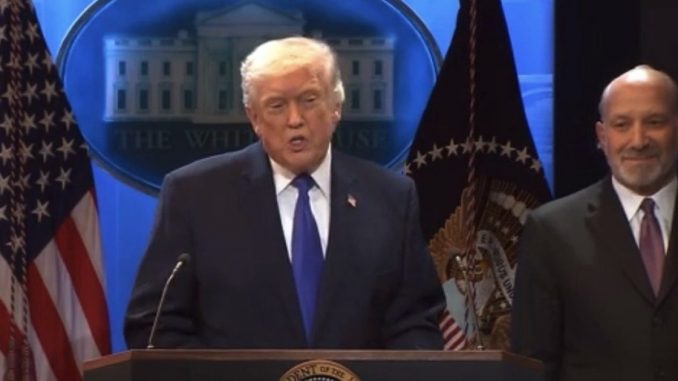
President Trump on Friday told reporters that he will impose new “global” tariffs on foreign imports of 10% following the Supreme Court’s ruling against his authority to impose the tariffs under the International Emergency Economic Powers Act (IEEPA)
Washington, D.C. — In a dramatic turn of events, former U.S. President Donald Trump announced that he has enacted a 10% global import tariff by executive order shortly after the U.S. Supreme Court struck down his earlier sweeping tariff program as unconstitutional.
Supreme Court Rejects Trump’s Original Tariff Scheme
Earlier this week, the Supreme Court ruled 6–3 that President Trump had exceeded his authority by imposing broad global tariffs under the International Emergency Economic Powers Act (IEEPA) — a law intended for limited national emergencies, not comprehensive trade policy. Justices wrote that tariff authority belongs to Congress, and the executive branch cannot unilaterally levy such duties without clear legislative authorization.
The affected tariffs — which had been generating more than $130 billion in revenue — were widely criticized by trade groups, businesses, and some lawmakers as lacking a solid statutory foundation. The ruling underscored the high court’s application of the “major questions doctrine,” which requires clear congressional authorization for policies of vast economic significance.
Trump: “I Don’t Think the Court Meant That”
In a public statement on Friday, Trump responded sharply, saying he believes the Supreme Court’s decision “didn’t actually limit my authority the way they say it did.” He dismissed the ruling as flawed and asserted that alternative legal tools available to the executive branch allow him to continue pushing aggressive tariff measures.
This comment reflects Trump’s broader position that the Court’s opinion didn’t remove presidential power over tariffs in practice — only under one specific law.
Executive Order for 10% Global Tariff
Within hours of the ruling, Trump signed a new executive order imposing a 10% tariff on imports from virtually every country, justified under Section 122 of the Trade Act of 1974.
Unlike the now-invalidated tariffs, these duties:
-
Are limited to up to 150 days unless extended by Congress;
-
Do not require lengthy investigations before taking effect;
-
Apply on top of existing tariffs already in force, including national security and unfair trade measures;
-
Include exemptions for certain products and trade agreements.
According to Trump and his administration, this approach “bypasses” the constitutional issues the Supreme Court raised while preserving the overall policy goal of taxing foreign imports to protect American industries and reduce trade imbalances.
New Trade Investigations and Broader Strategy
In addition to the Section 122 order, the White House has announced plans to initiate Section 301 (unfair trade practices) and Section 232 (national security) investigations. These separate authorities could lead to even broader tariff measures tailored to specific countries or sectors, especially where the administration claims there are unfair practices or threats to national security.
Reactions at Home and Abroad
The political and economic reaction has been swift and mixed:
-
Supporters of Trump praised the executive order as necessary to defend U.S. jobs and address trade deficits.
-
Critics condemned the tariff strategy as legally shaky and inflationary, potentially hurting U.S. consumers and global supply chains.
-
International partners expressed concern or uncertainty, even as some countries welcomed the Supreme Court’s decision as a reaffirmation of checks and balances.
Markets have shown volatility, especially in sectors sensitive to trade policy, as firms and foreign governments assess how new duties might affect bilateral commerce.
WATCH:
Trump: There will no longer be any doubt, and the income coming in and the protection of our companies and country will actually increase because of this decision. I don’t think the court meant that, but it’s the way it is. Based on long standing law and hundreds of victories. And even, as I was pointed out before, even 1000s of victories over the years, to the contrary, the Supreme Court did not overrule tariffs. They merely overruled a particular use of IEEPA tariffs, and essentially it’s the use to use to get a fee. I can do anything I want with IEEPA, anything! I just can’t charge anybody for it. I can license. I just can’t charge them. It’s ridiculous, but it’s okay, because we have other ways, numerous other ways. The ability to block, embargo, restrict, license, or impose any other condition on a foreign country’s ability to conduct trade with the United States under IEEPA has been fully confirmed by this decision.
So, now there’s no doubt, because, you know, there were a lot of questions about tariffs because no president was smart enough to use them to protect our country from those countries and businesses that were ripping us off. You took a look at the deficits that we had with some of these countries. It was disgraceful what they got away with for many, many decades. But now we know, because this decision affirms all those things that some people weren’t sure about. In order to protect— and it says so— in order to protect our country, a president can actually charge more tariffs than I was charging in the past period of a year under the various tariff authorities. So, we can use other of the statutes, other of the tariff authorities, which have also been confirmed and are fully allowed.
Therefore, effective immediately, all national security tariffs under Section 232 and existing section 301, tariffs— they’re existing, they’re there— remain in place, fully in place, and in full force and effect. Today, I will sign an order to impose a 10% global tariff under Section 122, over and above our normal tariffs already being charged. And we’re also initiating several section 301, and other investigations to protect our country from unfair trading practices of other countries and companies. Thank you for your attention to this matter. And I say, quite simply, which I’ve said for a long time, Make America Great Again. And interestingly, we’ve already made it great, so I don’t have to use that, but I don’t think we’ll ever give up on MAGA. MAGA’s always going to be with us.
If you have a few questions, you can let us know, but just to end, so we’re going forward. We will be able to take in more money, and there’ll no longer be doubt because there was always doubt. I know the people that brought the lawsuit, and they’re sleaze bags, major sleaze bags, but I know them, and they’re foreign country-centric. They were sending things into our country, and the people representing them knew full well, but they were sending things into our country, and they were beneficial to other countries, but very, very bad for us. And I stopped it, and we’ll just keep it going so we have more of a we have a totally firm decision now, and I don’t think the court meant it because the court doesn’t show great spirit toward our country in my opinion. A lot of bad decisions, but there are usually ways around it. This is something we could have done, as Justice Kavanaugh said, we could have done this originally, but we’re doing it now. And the numbers could be far greater than the hundreds of billions we’ve already taken in.
Trump’s comments to the press echo a statement he released on Truth Social earlier in the day, which he read in part during the briefing.
Full statement below:
To show you how ridiculous the opinion is, the Court said that I’m not allowed to charge even $1 DOLLAR to any Country under IEEPA, I assume to protect other Countries, not the United States which they should be interested in protecting — But I am allowed to cut off any and all Trade or Business with that same Country, even imposing a Foreign Country destroying embargo, and do anything else I want to do to them — How nonsensical is that? They are saying that I have the absolute right to license, but not the right to charge a license fee. What license has ever been issued without the right to charge a fee? But now the Court has given me the unquestioned right to ban all sorts of things from coming into our Country, a much more powerful Right than many people thought we had.
Our Country is the “HOTTEST” anywhere in the World, but now, I am going in a different direction, which is even stronger than our original choice. As Justice Kavanaugh wrote in his Dissent:
“Although I firmly disagree with the Court’s holding today, the decision might not substantially constrain a President’s ability to order tariffs going forward. That is because numerous other federal statutes authorize the President to impose tariffs and might justify most (if not all) of the tariffs issued in this case…Those statutes include, for example, the Trade Expansion Act of 1962 (Section 232); the Trade Act of 1974 (Sections 122, 201, and 301); and the Tariff Act of 1930 (Section 338).”
Thank you Justice Kavanaugh!
In actuality, while I am sure they did not mean to do so, the Supreme Court’s decision today made a President’s ability to both regulate Trade, and impose TARIFFS, more powerful and crystal clear, rather than less. There will no longer be any doubt, and the Income coming in, and the protection of our Companies and Country, will actually increase because of this decision. Based on longstanding Law and Hundreds of Victories to the contrary, the Supreme Court did not overrule TARIFFS, they merely overruled a particular use of IEEPA TARIFFS. The ability to block, embargo, restrict, license, or impose any other condition on a Foreign Country’s ability to conduct Trade with the United States under IEEPA, has been fully confirmed by this decision. In order to protect our Country, a President can actually charge more TARIFFS than I was charging in the past under the various other TARIFF authorities, which have also been confirmed, and fully allowed.
Therefore, effective immediately, all National Security TARIFFS, Section 232 and existing Section 301 TARIFFS, remain in place, and in full force and effect. Today I will sign an Order to impose a 10% GLOBAL TARIFF, under Section 122, over and above our normal TARIFFS already being charged, and we are also initiating several Section 301 and other Investigations to protect our Country from unfair Trading practices. Thank you for your attention to this matter. MAKE AMERICA GREAT AGAIN!
 Implications of Trump’s 10% Global Tariff Order
Following the U.S. Supreme Court ruling limiting executive authority under emergency powers, Donald Trump moved swiftly to impose a 10% global tariff under Section 122 of the Trade Act of 1974. The decision signals not retreat — but recalibration.
From a national-first economic viewpoint, the implications are significant.
1. Reassertion of Executive Determination
Rather than backing down after the Supreme Court setback, the administration demonstrated resolve. Supporters see this as proof that the White House remains committed to reshaping trade policy — even when facing institutional resistance.
The message: trade leverage will continue to be used as a strategic tool.
This reinforces a broader theme — that economic power is national power.
2. Pressure on Foreign Competitors
A universal 10% tariff acts as a baseline protective wall. Even if temporary, it:
-
Raises the cost of imported goods
-
Narrows the price gap between domestic and foreign production
-
Incentivizes reshoring of manufacturing
For decades, critics of globalization have argued that cheap imports hollowed out American industry. A broad tariff structure attempts to reverse that incentive structure.
Industries such as steel, automotive components, electronics assembly, and agriculture equipment manufacturing could see competitive breathing room.
3. Revenue Generation Without Raising Income Taxes
Tariffs function as indirect revenue collection from imported goods rather than direct taxation on wages.
From this perspective, it shifts part of the fiscal burden toward foreign producers seeking access to the U.S. market.
Some supporters argue this is preferable to increasing domestic tax rates.
4. Short-Term Price Pressures, Long-Term Strategic Goals
There is acknowledgment that tariffs can contribute to higher consumer prices in the short term.
However, proponents argue the larger objective is strategic independence:
-
Reducing supply chain dependence on geopolitical rivals
-
Strengthening domestic production capacity
-
Enhancing national resilience during crises
The view here is that temporary cost increases may be acceptable if they rebuild industrial strength.
5. Legal and Constitutional Debate
The Supreme Court’s decision emphasized congressional authority over sweeping trade measures. By pivoting to Section 122 authority, the administration is testing the boundaries of executive trade tools without directly defying the Court.
This could spark:
-
Further court challenges
-
Congressional debate over trade authority
-
Clarification of presidential powers in economic emergencies
Supporters may argue that the Constitution allows flexibility for defending national economic security when Congress is gridlocked.
6. Global Reaction and Negotiating Leverage
A universal tariff is not just economic — it is diplomatic leverage.
Foreign governments now face:
-
Negotiating to avoid additional targeted tariffs
-
Addressing trade imbalances
-
Revisiting bilateral agreements
This aligns with a negotiation strategy that uses economic pressure as a bargaining tool rather than relying solely on multilateral trade frameworks.
Broader Strategic Implications
From this viewpoint, the tariff order represents:
• A rejection of post-Cold War free-trade orthodoxy
• A pivot toward industrial nationalism
• An assertion that economic sovereignty is tied to national security
It reflects the belief that unrestricted global trade disproportionately benefited overseas manufacturers while weakening domestic production capacity.
 Overall Takeaway:
The 10% global tariff order signed by Donald Trump represents more than a policy adjustment after a Supreme Court setback — it signals a continued push to redefine America’s trade posture.
Rather than abandoning the strategy after judicial limits were imposed, the administration pivoted to a different statutory authority, reinforcing a broader commitment to using tariffs as leverage. The move underscores a belief that economic independence, domestic production, and trade balance are essential components of national strength.
Supporters view the action as decisive leadership in defense of American industry. Critics see legal and economic risks ahead. But what is undeniable is that trade policy has become a central battleground over executive power, global engagement, and the future direction of U.S. manufacturing.
In the end, the debate is no longer just about a 10% tariff. It is about whether the United States should continue operating within the framework of open global trade norms — or whether it should more aggressively reshape those norms to prioritize domestic industry and national sovereignty.
The coming months will determine whether this strategy reshapes global trade dynamics — or triggers another round of legal and economic confrontation.
SOURCES: THE GATEWAY PUNDIT – WATCH: “I Don’t Think the Court Meant That, but It’s the Way It is” – Trump Says SCOTUS Actually Reaffirmed Tariff Powers, Announces 10% GLOBAL Tariffs and Investigation into Unfair Trading Practices of Other Countries and Companies
WHEC – The Latest: Trump says he’s enacted a 10% global tariff by executive order
INTERNATIONAL BUSINESS TIMES UK – ‘These F’ing Courts’ Trump Explodes at SCOTUS as He Slaps the Entire World With a New 10% Tariff