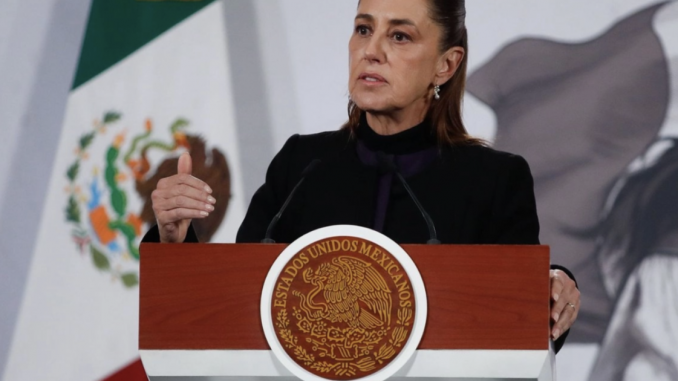
Mexican President Claudia Sheinbaum has been unwilling or unable to wrest control of Mexico from the cartels. Now she wants to sue Elon Musk. Photo: yoporlajusticia.gob.mx
Published February 26, 2025
Mexico City — Mexican President Claudia Sheinbaum is considering legal action against tech billionaire Elon Musk after his social-media remarks suggesting she is influenced by drug cartels sparked a political controversy and raised questions about free speech, security policy, and diplomatic tensions.
What Musk Said
The dispute began when Musk responded to a social media post on X (formerly Twitter) involving a 2025 video of Sheinbaum explaining her administration’s approach to cartel violence. In the post, Musk wrote that Sheinbaum was “just saying what her cartel bosses tell her to say,” alleging without evidence that her decisions were dictated by criminal organizations.
Musk’s comment came days after Mexican security forces captured and killed Nemesio Oseguera Cervantes, alias El Mencho, leader of the powerful Jalisco New Generation Cartel (CJNG).
Sheinbaum’s Response
In her daily press conference at the Palacio Nacional, Sheinbaum described Musk’s remarks as “absurd” and unfounded. She said her legal team is reviewing whether to pursue a defamation lawsuit against Musk under U.S. law. She noted that options remain under consideration and emphasized that her priority is public opinion in Mexico, not engaging in a media fight.
“We are considering whether to take legal action,” Sheinbaum said, adding that her lawyers are evaluating the matter. She also reiterated her administration’s stance on cartel violence.
In later remarks, she pointed to Musk’s success as a businessman but indicated that she was still weighing whether a formal legal case was worthwhile.
Political and Legal Context
Defamation cases in the United States are difficult to win due to strong free-speech protections. To prevail against Musk in U.S. courts, Sheinbaum would likely have to prove that he knowingly made false statements or showed reckless disregard for the truth — a high legal bar.
Several Mexican lawmakers and political figures have defended Sheinbaum, accusing Musk of misusing his platform and spreading misinformation. Some critics also suggested Musk should focus on societal issues in the U.S. that fuel demand for cartel drug products.
Broader Security Tensions in Mexico
The episode takes place against the backdrop of escalated cartel violence following the operation against El Mencho, which triggered road blockades and violent clashes in several states. Mexican authorities have stressed that security forces are regaining control and continue preparations for the FIFA World Cup 2026 tournaments in Mexico.
Sheinbaum’s administration has rejected proposals for a return to a militaristic “war on drugs,” advocating instead for strategies designed to reduce violence while protecting human rights — an approach that has drawn both domestic support and criticism.
Musk’s Reaction
After Sheinbaum’s statements were reported, Musk responded with a sarcastic comment on X, joking about his own “human rights” — underscoring the ongoing tension between the two figures.
 Implications of the Sheinbaum–Musk Clash: A Law-and-Order and Free Speech Perspective
The public dispute between Claudia Sheinbaum and Elon Musk goes far beyond a war of words. It touches on core issues of sovereignty, cartel power, border security, free speech, and the role of tech platforms in shaping global political narratives.
1. Free Speech vs. Government Retaliation
When a sitting head of state considers legal action over criticism made on a U.S.-based platform like X, it raises questions about cross-border limits on speech.
The United States maintains strong protections for public debate—especially when it involves elected officials. Lawsuits targeting critics can be perceived as attempts to chill speech, particularly when directed at private citizens expressing political opinions.
From this perspective, even sharp or controversial rhetoric should be countered with evidence and transparency—not legal threats. Governments using courts to respond to criticism risks reinforcing perceptions of insecurity rather than strength.
2. Cartel Influence and Public Trust
The underlying accusation—whether fair or not—connects to a long-standing concern: the influence of drug cartels over political institutions in Mexico.
Cartels such as the Jalisco New Generation Cartel have demonstrated the ability to destabilize entire regions. The killing of its leader, Nemesio Oseguera Cervantes, intensified scrutiny of Mexico’s internal security environment.
When political leaders emphasize negotiation, “hugs not bullets,” or de-escalation strategies, critics argue this can project weakness. Even if such strategies are intended to reduce violence, they must be accompanied by visible enforcement wins and institutional reform. Otherwise, public skepticism grows.
The key issue isn’t Musk’s phrasing—it’s whether Mexico’s anti-cartel strategy convinces citizens and international partners that the rule of law is firmly in control.
3. U.S.–Mexico Relations and Economic Fallout
Musk is not only a tech figure; he is also the CEO of Tesla, a company with major manufacturing investments in Mexico. Escalating tensions between Mexico’s presidency and a prominent U.S. industrial leader could complicate business confidence.
Stable trade relations are critical under agreements like USMCA. If political friction escalates into economic retaliation, investment flows could suffer—especially as North America competes with China for manufacturing dominance.
4. The Border Security Debate
The cartel issue is inseparable from U.S. border concerns. American communities continue to struggle with fentanyl trafficking and human smuggling networks tied to Mexican criminal groups.
Any perception that Mexico’s leadership is soft—or defensive—on cartel enforcement directly feeds into calls for stronger border controls and stricter enforcement policies in the United States.
Public frustration over drug overdoses and cross-border crime increases pressure on policymakers to adopt tougher stances rather than cooperative or gradual reforms.
5. The Power of Billionaire Platforms
This episode also highlights the influence of private tech leaders in global political discourse. Musk’s ownership of X gives him direct access to millions of followers and immediate global reach.
Supporters argue that this decentralizes power away from traditional media gatekeepers. Critics argue it amplifies unverified claims.
The deeper question is whether political leaders should attempt to regulate or intimidate platform owners when disagreements arise—or engage them publicly and transparently.
 Overall Takeaway:
The clash between Claudia Sheinbaum and Elon Musk ultimately underscores a larger reality: credibility is earned through results, not rebuttals.
Legal threats against criticism—especially when it involves a public official—risk amplifying the original accusation rather than silencing it. In contrast, decisive action against cartel networks, measurable reductions in violence, and transparent governance would speak louder than any courtroom battle.
At the same time, influential private figures who command massive digital platforms carry undeniable weight in shaping public opinion. That power can expose weaknesses, but it also intensifies political tensions across borders.
In the end, the public—both in Mexico and the United States—will judge leadership not by rhetoric or online exchanges, but by whether security improves, institutions strengthen, and the rule of law is visibly enforced.
SOURCES: THE GATEWAY PUNDIT – Mexico President Sheinbaum Retaliates Against Musk for Accusing Her of Cartel Ties
XATAKA – “He only says what his cartel bosses want”: Sheinbaum considers lawsuit against Elon Musk after attack on X
EL FINANCIERO – Musk responds sarcastically to Sheinbaum after the mayor’s statements about suing him: what did he say?
REUTERS – Mexico weighs legal action after Musk links president to drug cartels
UNIVISION – Mexican President Does Not Rule Out Lawsuit Against Elon Musk: This Is What She Said About the Owner of X and Tesla