
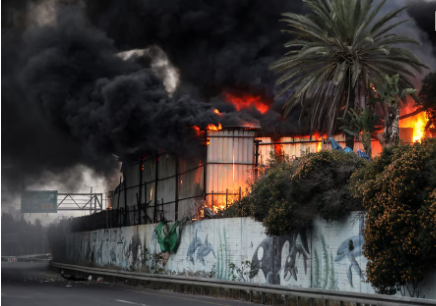
Fire ignited at the impact site following an Iranian missile strike, amid the U.S.-Israeli conflict with Iran, in central Israel March 13, 2026. REUTERS/Gideon Markowicz Purchase Licensing Rights
Published March 14, 2025
Israel has significantly escalated its military operations against Iran by targeting checkpoints inside Iranian territory, including in the capital Tehran, based on intelligence provided by informants on the ground, according to a senior security source familiar with the situation.
The operations focus on locations held by the Islamic Revolutionary Guard Corps (IRGC) and associated paramilitary forces such as the Basij, which are often involved in internal security and suppression duties. Informants inside Iran reportedly identified at least three checkpoint sites in recent days, helping Israeli forces refine strike targets.
Use of Human Intelligence
Unlike earlier phases of the conflict that relied heavily on aerial surveillance and long‑range strikes, this latest phase appears to incorporate direct human intelligence from inside Iran. The informants’ reports, according to the source, have guided some of the recent precision operations — including drone attacks that struck Basij and IRGC checkpoints in urban areas.
Israel’s military has declined to officially comment on these specific operations. However, the shift toward using civilian and insider intelligence signals efforts to identify and hit dispersed security targets more effectively and perhaps to reduce collateral damage in densely populated areas.
Joint Air Operations With U.S.
These Iranian checkpoint strikes are part of a wider joint military campaign with the United States, aimed at degrading Iran’s military infrastructure and capabilities. The coordinated strikes have targeted a range of military, nuclear, and strategic facilities, reflecting an intensification of the conflict that began with larger air raids earlier in late February 2026.
This cooperation underlines the U.S. and Israeli goal of weakening Iran’s capacity to wage long‑range attacks or expand influence through proxy forces across the Middle East.
Strategic Goals and Leadership Statements
Israel’s leaders have framed the campaign as essential for national security, while also suggesting that a change of government in Tehran could occur only if driven by internal pressures within Iran itself. Israeli Prime Minister Benjamin Netanyahu has acknowledged the uncertainty of achieving such a regime shift solely through military pressure, emphasizing that such political outcomes must ultimately come from within Iranian society.
Iranian authorities have not publicly confirmed the specific checkpoints hit but have repeatedly condemned foreign strikes on their territory. Tehran’s leadership has warned of retaliation for what it calls violations of its sovereignty and has threatened to escalate attacks on Israeli and Western targets in response.
Wider Conflict and Regional Impact
The latest checkpoint strikes occur amid a broader escalation that has seen:
-
Iranian missile and drone barrages hitting targets in Israel and Gulf states hosting Western forces.
-
Disruption of global energy flows, particularly through the Strait of Hormuz, contributing to surging oil prices.
-
Humanitarian challenges in Lebanon and Iran as the war expands, with significant civilian displacement reported.
-
U.S. political dynamics, including comments by President Donald Trump about international actors’ roles in the conflict and an ongoing effort to negotiate a diplomatic ceasefire over time.
 Public / Political Reactions
🗺️ Government & Leadership Reactions
🇮🇱 Israel
-
Prime Minister Benjamin Netanyahu framed ongoing operations as part of a historic campaign to degrade Iran’s military and nuclear capabilities, claiming it has reshaped the strategic balance in the Middle East and reaffirming close partnership with the United States. He also urged the Iranian people to seize the moment to oppose their government’s leadership.
🇮🇷 Iran
-
Iranian leaders rejected the strikes as aggression, staging widespread mass rallies showing unity and defiance against what Tehran calls an “existential war.” President Masoud Pezeshkian and other officials were present at events where chants condemned Israel and its allies. Supreme Leader Mojtaba Khamenei vowed continued resistance.
🇨🇳 China & Other States
-
China publicly condemned U.S. and Israeli strikes on Iran as unacceptable and called for an immediate ceasefire and talks to reduce escalation.
🇺🇸 United States
-
U.S. involvement alongside Israel has drawn wartime cooperation but also internal scrutiny, including bipartisan concern over civilian casualties and calls from some U.S. lawmakers for investigations into strikes that harmed children.
📣 Public Opinion & Demonstrations
Iran
-
Pro‑government demonstrations have mobilized masses in cities like Tehran, condoning resistance and denouncing attackers. These rallies often coincide with national occasions like Quds Day to symbolically showcase solidarity.
International Protests
-
Worldwide anti‑war demonstrations have taken place in the U.S., Europe, and Middle East, with many participants condemning the conflict as unlawful aggression and demanding peace. Some scenes have involved clashes near diplomatic facilities.
Iranian Diaspora & Mixed Views
-
Within Iranian diaspora communities and online discussions, reactions are mixed. Some express relief at perceived blows to Tehran’s military elites; others are deeply worried about civilian harm or fear reprisals against purported informants.
🧠 Political & Civil Society Responses
Globally
-
Political commentators and human rights observers have raised alarm over escalating civilian casualties and destruction of cultural sites, urging protection of heritage and humanitarian law compliance. Independent voices emphasize risks of a broad regional war if hostilities continue unchecked.
Local Political Groups
-
Some national political organizations outside the conflict zone (e.g., in the Philippines) have issued statements condemning strikes by U.S. and Israeli forces, characterizing them as violations of international law and calling for peace advocacy.
🧩 Summary of Reaction Themes
| Group | Core Sentiments |
|---|---|
| Israeli leadership | Support for intensified military action; assertion of strategic gains |
| Iranian government & supporters | Denunciation of foreign aggression; streets shows of national unity |
| Western politicians & civil society | Mixed — from cautious calls for de‑escalation to legal and humanitarian concerns |
| Pro‑war & anti‑war activists worldwide | Split between opposing conflict vs. advocating for regime change in Iran |
 Resulting Effects of Israel’s Targeted Strikes on Iranian Checkpoints:
The recent intelligence‑driven strikes by Israel on Iranian checkpoints have produced several notable effects across military, political, and regional dimensions:
1. Military Impact
-
Disruption of IRGC Operations: By using informant-supplied intelligence, Israel has been able to strike checkpoints and Basij positions with precision, temporarily degrading Iran’s internal mobility for security forces and complicating the coordination of military operations.
-
Increased Iranian Countermeasures: Tehran has responded by reinforcing checkpoints, deploying additional surveillance, and restricting civilian movement, indicating heightened security tension and the risk of escalation.
-
Psychological Pressure on Iranian Forces: The strikes signal that even internal points thought to be secure are vulnerable, potentially lowering morale among certain units and complicating command decisions.
2. Political and Diplomatic Effects
-
Heightened Domestic Unity in Iran: While intended to weaken Tehran’s military posture, the strikes have provoked nationalist rallies and public demonstrations, consolidating internal support for the government in the short term.
-
Increased International Scrutiny: The operations have attracted global attention, prompting both criticism and calls for restraint from major powers. Countries like China have urged immediate dialogue to prevent further escalation, while U.S. lawmakers debate the legality and humanitarian consequences of the strikes.
3. Regional Security and Stability
-
Escalation Risk: Targeted strikes within Iranian territory risk provoking retaliatory actions against Israel or allied forces in the region, potentially triggering broader regional instability.
-
Influence on Proxy Conflicts: Iran-aligned militias across the Middle East may respond to perceived vulnerability, which could destabilize neighboring countries and affect shipping routes, trade, and energy markets.
4. Strategic Signaling
-
Demonstration of Operational Reach: These precision strikes communicate Israel’s ability to conduct highly selective operations even deep within Iran, serving as both a deterrent and a signal to allies about its capabilities.
-
Encouragement for Internal Intelligence Networks: The reliance on human intelligence highlights the growing importance of local informants in modern conflicts, potentially encouraging further cooperation by dissident groups or civilians opposed to Iran’s regime.
 Future Outlook:
Looking ahead, the evolving Israel-Iran conflict is likely to produce a mix of strategic opportunities and significant risks for the region. Several key trends are expected:
1. Continued Intelligence-Driven Operations
Israel is likely to maintain its reliance on human intelligence to identify high-value targets within Iran. Precision strikes based on verified informant tip-offs may continue to degrade Iran’s internal security infrastructure, though the effectiveness will depend on the reliability of local sources and Tehran’s counterintelligence efforts.
2. Potential for Escalation
-
Regional Retaliation: Iran may respond to the strikes through attacks on Israeli or allied targets in the Middle East, including proxy forces in Syria, Lebanon, and Iraq.
-
Proxy and Asymmetric Threats: Militias and paramilitary groups aligned with Iran could launch limited but disruptive operations, including sabotage or cross-border attacks, keeping regional security forces on high alert.
-
Risk of Wider Conflict: While both sides currently appear to be limiting large-scale conventional warfare, miscalculations or high-profile incidents could trigger a broader escalation.
3. Diplomatic and Economic Considerations
-
International Pressure: Global powers, particularly China and the EU, may push for negotiations or ceasefire initiatives, emphasizing humanitarian protection and regional stability.
-
Energy and Trade Impacts: Prolonged conflict could affect energy markets and shipping lanes in the Persian Gulf, influencing global oil prices and trade patterns.
-
Internal Political Dynamics: Sustained strikes may strengthen Israeli and U.S. positions in regional security discourse, while also intensifying domestic pressures within Iran to balance national pride with pragmatic risk management.
4. Strategic Significance
-
The ongoing campaign underscores the importance of precision, intelligence-driven actions in modern conflict.
-
It may encourage other regional actors to invest in surveillance, intelligence-sharing networks, and counterintelligence measures to protect sensitive infrastructure.
-
Long-term, the conflict could reshape perceptions of power projection in the Middle East, reinforcing deterrence capabilities for Israel and its partners while highlighting vulnerabilities in Iran’s security architecture.
 Bottom Line:
Israel’s recent intelligence-driven strikes on Iranian checkpoints demonstrate a clear emphasis on precision, operational planning, and strategic signaling. These actions have achieved tangible tactical effects, disrupting internal Iranian military operations and showcasing Israel’s ability to conduct targeted operations deep within hostile territory.
At the same time, the strikes have heightened geopolitical tension, sparked domestic rallies in Iran, and drawn international scrutiny. The resulting landscape is one of both opportunity and risk: operational gains must be weighed against potential escalation, regional instability, and the humanitarian implications of continued conflict.
Moving forward, the balance of careful, intelligence-led action and vigilant regional monitoring will remain crucial. Israel’s approach highlights the importance of combining military precision with strategic foresight, as the conflict continues to influence the broader dynamics of Middle Eastern security and international diplomacy.
The situation remains fluid, and outcomes will largely depend on how each side manages escalation, internal morale, and international pressure in the coming months.




