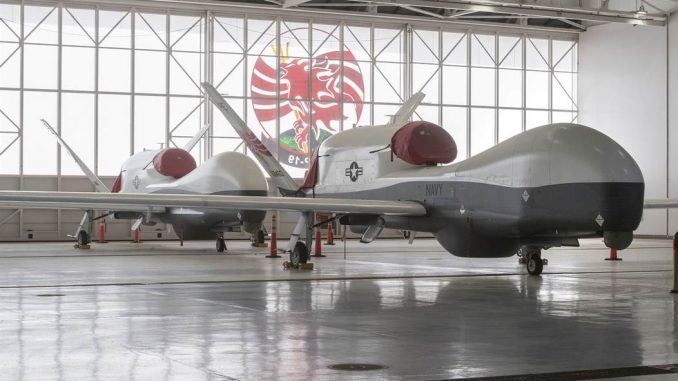
Bob Brown/Northrop Grumman Corporation via AP
Published April 10, 2026
A high-value U.S. Navy surveillance drone worth an estimated $200 million has reportedly gone missing after declaring an in-flight emergency while operating near Iranian airspace—triggering fresh concerns over escalating tensions in one of the world’s most sensitive maritime corridors.
The MQ-4C Triton, a long-endurance unmanned intelligence, surveillance, and reconnaissance (ISR) platform, is believed to have transmitted a distress signal before disappearing from tracking systems over the Strait of Hormuz, according to multiple open-source flight monitoring reports and regional media coverage.
The U.S. Navy has not yet issued an official confirmation regarding the aircraft’s status, and details surrounding the incident remain unclear.
Emergency Signal Reported Before Disappearance
According to aviation tracking data cited in early reports, the drone reportedly issued a “mayday” or emergency code while flying over the Gulf region before losing contact and disappearing from public tracking feeds.
The MQ-4C Triton is designed to fly at extremely high altitudes for more than 24 hours at a time, collecting real-time intelligence across vast ocean regions. Its disappearance during a mission near Iran has raised questions about whether the incident was caused by mechanical failure, electronic interference, or possible hostile action.
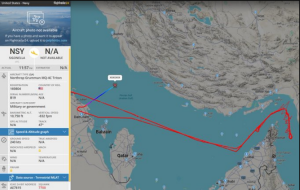
On its way back to base, the US Navy MQ-4C Triton reconnaissance drone that had been patrolling the Strait of Hormuz took a turn towards Iran, squawked code 7700 (general emergency), and started descending, falling off ADS-B as it dropped under 10k feet.
Strategic Waters Raise Immediate Concerns
The incident occurred in the Strait of Hormuz, a critical chokepoint through which nearly one-fifth of global oil shipments pass. The area has long been a flashpoint between U.S. and Iranian forces, with repeated encounters involving drones, naval vessels, and surveillance aircraft.
Recent months have already seen heightened military activity in the region, including multiple reconnaissance flights and reported drone interceptions near Iranian airspace.
Military analysts say the loss of a high-altitude surveillance platform in such a sensitive zone immediately raises escalation risks, even in the absence of confirmed combat engagement.
Possible Causes Still Unclear
At this stage, officials have not confirmed what caused the drone’s disappearance. However, several scenarios are being considered:
- Technical malfunction or system failure
- Electronic warfare disruption or GPS jamming
- Mechanical or structural failure
- Possible shootdown (unconfirmed)
The MQ-4C Triton has previously operated in contested airspace near Iran, where electronic interference and air defense systems are known operational risks.
Part of a Growing Drone Confrontation Pattern
The disappearance comes amid a broader pattern of escalating drone activity in the Persian Gulf region, where both U.S. and Iranian forces have increasingly relied on unmanned systems for surveillance and deterrence.
In recent years, similar incidents have included drones being tracked, intercepted, or lost under unclear circumstances—highlighting the fragile nature of unmanned operations in contested airspace.
Military Silence Adds to Speculation
As of now, U.S. defense officials have not publicly detailed the status of the aircraft or confirmed whether it was recovered, lost at sea, or potentially downed.
The lack of official information has fueled speculation across defense forums and tracking communities, where analysts continue to review flight data and satellite traces in an attempt to reconstruct the final moments of the mission.
🔍 Critical View: Regional Tensions, Military Uncertainty, and Strategic Pressure in the Strait of Hormuz
While official statements remain limited, the disappearance of a U.S. Navy MQ-4C Triton drone near Iran is being felt most strongly in operational circles, defense communities, and regional security analysis. On the ground—both in the Gulf region and within military monitoring networks—the incident is reinforcing concerns about how fragile surveillance operations have become in one of the world’s most contested waterways.
Several key dynamics are emerging.
1. Heightened Military Awareness in a High-Risk Corridor
The Strait of Hormuz remains one of the most heavily monitored and strategically sensitive maritime zones in the world.
On the ground, military personnel and maritime operators are operating under constant awareness of surveillance flights, naval movements, and electronic interference risks. The disappearance of a high-value drone in this environment immediately raises alert levels, even without confirmed cause.
For regional operators, every unexplained incident reinforces the expectation that tensions can escalate without warning.
2. Electronic Interference as a Daily Operational Concern
In the Gulf region, electronic disruption is not a theoretical risk—it is a recurring operational challenge.
GPS interference, signal degradation, and tracking inconsistencies are frequently reported in contested zones. On the ground, this forces both military and commercial operators to constantly adapt navigation and communication protocols.
The MQ-4C incident has intensified discussions among analysts about whether advanced surveillance systems are fully prepared for this level of persistent electronic pressure.
3. Intelligence Gaps and Operational Uncertainty
When a surveillance asset disappears, the immediate concern is not just the loss of equipment, but the potential loss of intelligence coverage.
On the ground within defense planning circles, missing ISR (intelligence, surveillance, reconnaissance) platforms create temporary blind spots. These gaps can affect maritime monitoring, threat detection, and broader situational awareness across the region.
Even short-term disruptions are treated seriously due to the sensitivity of the area.
4. Regional Actors Watching Closely
In strategic hubs across the Middle East, incidents like this are closely observed by multiple regional actors.
Each unexplained event involving surveillance aircraft or drones is analyzed for signals about capability, response thresholds, and operational boundaries. On the ground, such incidents often contribute to recalibration of expectations among both allied and adversarial observers.
The uncertainty itself becomes part of the strategic environment.
5. Increased Pressure on Military Operations and Planning
For U.S. and allied forces operating in the region, the disappearance adds another layer of operational pressure.
Commanders must balance intelligence collection needs with asset survivability in a space where surveillance platforms face both technological and geopolitical risks. On the ground, this often translates into more cautious routing, expanded support measures, and reassessment of mission profiles.
The challenge is maintaining coverage without overexposing high-value systems.
👥 On the Ground: Deterrence Pressure, Operational Risk, and Escalation Anxiety in the Gulf
While officials continue to review the disappearance of the U.S. Navy MQ-4C Triton drone near Iran, the situation on the ground in the broader Gulf security environment is being interpreted through a more immediate and operational lens. In defense circles, maritime monitoring channels, and regional security hubs, the incident is reinforcing concerns about vulnerability, deterrence credibility, and the risks of operating advanced systems in contested airspace.
Several key realities are emerging.
1. Constant Pressure on U.S. and Allied Surveillance Operations
In the Strait of Hormuz and surrounding waters, surveillance flights are not occasional—they are continuous and highly contested.
On the ground, operators describe an environment where every flight is monitored, tracked, and potentially challenged through electronic means. The disappearance of a high-value drone intensifies awareness that even long-endurance platforms are not immune to disruption in this corridor.
This adds pressure to maintain persistent coverage while avoiding unnecessary exposure.
2. Electronic Warfare as an Everyday Operational Challenge
Electronic interference is now a routine factor in Gulf operations.
GPS jamming, signal disruption, and intermittent tracking loss are frequently reported, forcing crews and command centers to rely on layered navigation systems and backup protocols. On the ground, this creates an environment where uncertainty is expected rather than exceptional.
The MQ-4C incident has renewed focus on whether current countermeasures are sufficient against increasingly sophisticated electronic warfare tactics.
3. Deterrence Messaging Under Close Observation
Beyond the technical loss, regional actors closely analyze how incidents like this are handled.
On the ground, military observers note that responses—or the lack of immediate clarity—are often interpreted as signals of resolve or restraint. In a region already marked by tension, even ambiguous incidents can influence how boundaries are tested in future encounters.
This makes communication and posture as important as hardware capability.
4. Operational Risk vs. Intelligence Demand
The disappearance highlights a persistent tension: the need for intelligence versus the risk of collecting it.
On the ground, commanders are constantly weighing whether the value of real-time surveillance justifies exposure in high-threat areas. Each loss or disruption forces recalibration of how aggressively ISR assets are deployed near sensitive zones.
This balancing act is becoming more difficult as regional threats evolve.
5. Escalation Sensitivity in a Volatile Corridor
The Strait of Hormuz remains one of the most escalation-sensitive waterways in the world.
On the ground, even unconfirmed incidents can trigger heightened alert levels, adjusted patrol patterns, and increased readiness postures. Military planners operate with the understanding that miscalculation or misinterpretation in this environment can escalate quickly.
As a result, every unexplained event carries strategic weight beyond its immediate operational impact.
🎯 The Final Word:
On the ground in the Gulf region, the MQ-4C Triton disappearance is being viewed through the lens of operational risk, deterrence credibility, and escalating electronic warfare challenges. In a theater defined by constant surveillance and strategic friction, the incident reinforces a central reality: maintaining dominance in contested airspace now requires not only advanced technology, but sustained resilience against disruption, ambiguity, and evolving threats.