Published April 10, 2026
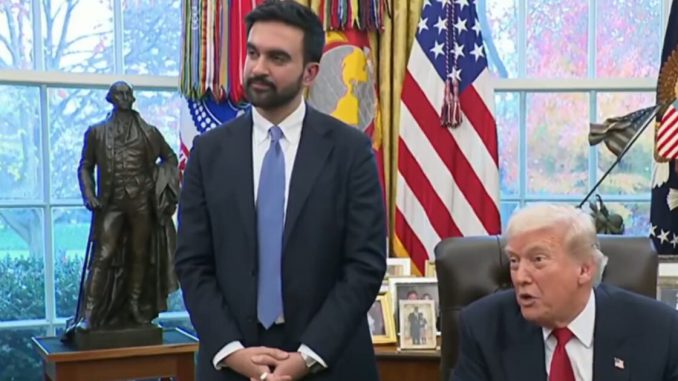
President Donald Trump has once again inserted himself into New York City politics, offering a set of blunt but practical recommendations to Mayor Zohran Mamdani during a recent public exchange that has drawn widespread attention across political circles.
According to reporting from The Gateway Pundit, Trump delivered what he described as simple “common-sense” advice aimed at improving the city’s struggling economic and public safety conditions, despite his past sharp criticism of Mamdani’s political ideology and governance style.
Trump’s Message: Taxes, Safety, and Clean Streets
During the exchange, Trump reportedly urged the mayor to take a hard look at three key issues he believes are driving residents and businesses out of New York City.
First, Trump emphasized tax policy, arguing that high taxes are accelerating an exodus of middle-class families and businesses to lower-cost states. He suggested that easing the tax burden could help stabilize the city’s shrinking economic base.
Second, Trump focused on public safety, calling for stronger enforcement measures and greater cooperation with federal authorities to reduce crime. He has repeatedly pointed to crime rates in major cities as a central issue in urban governance.
Finally, Trump highlighted urban cleanliness and infrastructure, telling Mamdani that restoring pride in the city’s appearance—particularly in Manhattan—would be critical to reviving tourism and local business confidence.
A Strained but Active Political Relationship
While Trump and Mamdani come from starkly different political backgrounds, recent interactions suggest a surprisingly functional working relationship has emerged.
Reports indicate the two have met in private discussions focused on housing development, federal funding, and urban planning initiatives. One recent White House meeting included discussions on large-scale housing proposals and redevelopment projects across New York City.
Despite ideological clashes in the past, both sides have acknowledged overlapping interests in addressing housing shortages and improving city infrastructure.
Political Contrast Remains Sharp
Trump has previously criticized Mamdani’s progressive policy agenda, particularly proposals involving expanded public services, tax increases, and city-run programs. Mamdani, meanwhile, has positioned himself as a reform-minded progressive focused on redistributive economic policy and expanded social services.
However, recent developments suggest that governance realities have pushed both figures toward selective cooperation on infrastructure and public safety concerns.
🔍 Critical View: Policy Concerns Over New York City’s Direction Under Mayor Zohran Mamdani and Trump’s Public Intervention
The recent public exchange between President Donald Trump and New York City Mayor Zohran Mamdani has reignited debate over the future direction of America’s largest city. While framed as advice on governance and urban recovery, the discussion highlights deeper disagreements about taxation, public safety, and the role of government in managing a major metropolitan economy. Critics argue that these tensions reflect a broader struggle over whether New York City is moving toward fiscal restraint and law-and-order priorities or continued expansion of progressive policy experiments.
1. Taxation and Economic Flight
A central concern raised in the discussion is the city’s tax structure. Critics argue that high taxation risks accelerating the outflow of businesses, professionals, and middle-income families to lower-cost states. The concern is not only revenue loss but also long-term erosion of the city’s economic competitiveness.
From this perspective, Trump’s warning about economic migration reflects a long-standing argument that excessive fiscal pressure can weaken urban centers that rely heavily on a stable tax base.
2. Public Safety and Crime Enforcement
Another major issue is public safety. The debate centers on whether current policies place enough emphasis on policing and deterrence.
Critics of the current direction argue that weakened enforcement signals can contribute to rising disorder, reduced quality of life, and declining public confidence in law enforcement institutions. They stress that major cities require strong coordination between local leadership and federal resources to maintain stability.
3. Urban Livability and Civic Order
Beyond crime and economics, attention is also being placed on the physical condition of the city—cleanliness, infrastructure maintenance, and overall urban appearance.
The argument here is that visible deterioration in public spaces can have a compounding effect on tourism, investment, and resident morale. Supporters of stronger enforcement and management policies claim that restoring order in public areas is essential for long-term urban revival.
4. Ideological Governance Divide
The exchange between Donald Trump and Zohran Mamdani also underscores a broader ideological divide over governance philosophy.
On one side is a model prioritizing reduced taxation, stricter enforcement, and private-sector-driven growth. On the other is a framework emphasizing expanded public services, redistributive policies, and government-led solutions to inequality. Critics argue that these approaches are increasingly difficult to reconcile in high-cost urban environments like New York City.
5. Federal–City Relations
Finally, the discussion highlights the evolving relationship between federal leadership and municipal governance. Cooperation on housing, infrastructure, and funding remains essential, but political disagreements often complicate implementation.
Some observers warn that ideological friction between city leadership and federal figures can delay policy execution, particularly on large-scale development and public safety initiatives.
👥 On the Ground: New York City Faces Pressure Over Crime, Costs, and Governance Under Mayor Zohran Mamdani
Tensions surrounding New York City’s leadership under Mayor Zohran Mamdani continue to intensify as residents, business owners, and political observers assess the real-world impact of city policies. While debates in Washington and media circles focus on ideology and political messaging, the situation on the ground is increasingly defined by everyday concerns—public safety, affordability, and the livability of the city’s neighborhoods. Recent commentary from national figures, including President Donald Trump, has amplified scrutiny of how the city is being managed and whether current strategies are meeting basic urban needs.
1. Public Safety Concerns in Neighborhoods
Across multiple boroughs, residents continue to express concerns about visible disorder and inconsistent enforcement. Reports of petty crime, transit disturbances, and quality-of-life offenses remain central to public discussion.
Critics argue that without a stronger enforcement posture, community confidence in public institutions risks weakening further. They point to the need for consistent policing strategies that deter repeat offenses and restore a sense of predictability in daily life.
2. Cost of Living and Resident Outmigration
Affordability remains one of the most pressing issues for New Yorkers. Rising housing costs, taxes, and general expenses continue to push some families and small businesses to consider relocation.
This trend has become a focal point in political debates, with critics warning that sustained outmigration could gradually erode the city’s middle-class base. The concern is not only population loss, but also the long-term impact on local tax revenue and economic stability.
3. Business Climate and Economic Confidence
Small business owners in particular have expressed mixed sentiment about the current environment. While some sectors benefit from tourism and population density, others report challenges related to regulation, operating costs, and public safety conditions affecting customer traffic.
From this perspective, economic confidence is closely tied to perceptions of stability and predictability in city governance.
4. Urban Cleanliness and Infrastructure Strain
Another recurring issue is the condition of public spaces. Complaints about sanitation, subway maintenance, and visible infrastructure strain have become part of everyday discussion among commuters and residents.
Critics argue that even incremental declines in cleanliness and maintenance can significantly affect tourism, investor sentiment, and overall city pride.
5. Governance Priorities and Policy Direction
The leadership approach of Mayor Zohran Mamdani continues to draw scrutiny, particularly regarding the balance between expanded public programs and traditional enforcement-based governance.
Supporters of stricter policy approaches argue that cities like New York require a stronger emphasis on order, fiscal discipline, and enforcement-first strategies to maintain global competitiveness.
6. Federal Attention and Political Pressure
The involvement of national political figures, including President Donald Trump, has added another layer of pressure. Public remarks urging changes in taxation, safety policy, and urban management have intensified the spotlight on city leadership decisions.
This dynamic underscores the growing national significance of New York City’s governance choices, as outcomes in the city are often viewed as indicators of broader urban policy trends.
🎯 The Final Word:
The ongoing debate over New York City’s direction under Mayor Zohran Mamdani ultimately comes down to results on the ground rather than political messaging. Concerns over public safety, rising living costs, business departures, and declining urban order continue to shape public perception of the city’s trajectory. While policy discussions often focus on expanding government programs and reshaping economic priorities, critics argue that the immediate priority should be restoring stability, strengthening law enforcement, and rebuilding confidence among residents and investors. The involvement of national figures like President Donald Trump further underscores how closely the city’s performance is being watched, with many viewing New York as a test case for whether large urban centers can maintain prosperity while addressing basic governance challenges effectively.