
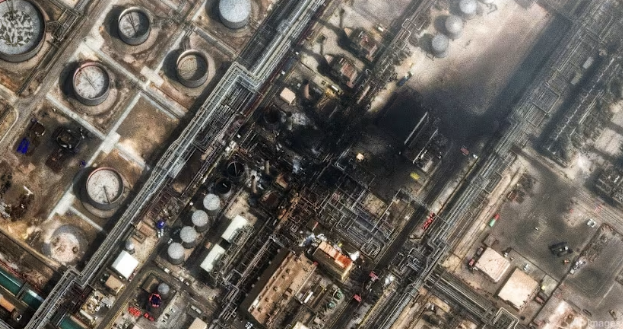
This satellite image provided by Vantor shows damage after a drone attack at Ras Tanura oil refinery, in Saudi Arabia, on Mar 2, 2026. (Photo: AP/Vantor/Satellite image)
Published April 11, 2026
A fresh wave of attacks tied to Iran has struck at the heart of Saudi Arabia’s energy infrastructure, cutting oil production, halting key operations, and sending shockwaves through already fragile global markets.
Saudi officials confirmed that multiple strikes in recent weeks targeted critical oil and gas facilities across the kingdom—impacting production, refining, and transportation systems at a time when global supply is under intense pressure.
Strategic Targets Hit, Production Slashed
The damage is far from symbolic.
Saudi Arabia says its oil production capacity has been reduced by roughly 600,000 barrels per day, while throughput on the vital East-West Pipeline—its main alternative to the Strait of Hormuz—has been cut by about 700,000 barrels per day.
Key facilities hit include:
- Major oilfields such as Manifa and Khurais
- Refineries in Jubail, Yanbu, and Ras Tanura
- Gas processing plants and petrochemical sites
In some cases, operations were fully halted, underscoring the severity of the disruption.
One Saudi security worker was killed and several others injured in the attacks, highlighting the growing human toll alongside economic damage.
Pipeline Attack Raises Stakes
Perhaps most alarming: the East-West Pipeline—Saudi Arabia’s critical export route to the Red Sea—was struck shortly after a fragile ceasefire.
This pipeline has become a lifeline after Iran effectively disrupted access to the Strait of Hormuz, through which a significant portion of the world’s oil supply typically flows.
Energy analysts warn that targeting this infrastructure signals a dangerous escalation:
- It directly threatens global oil exports
- It limits Saudi Arabia’s ability to reroute supply
- It increases vulnerability to future strikes
Global Energy Markets on Edge
The attacks come amid a broader regional conflict that has already destabilized energy markets.
Across the Gulf:
- Dozens of energy facilities have been damaged
- Millions of barrels per day in refining capacity have been disrupted
- Supply chains for oil, gas, and petrochemicals are under strain
The result? Volatility.
Oil prices have swung sharply in recent weeks, with analysts warning that continued disruptions could push prices significantly higher—even as diplomatic talks attempt to cool tensions.
A Calculated Energy War?
The pattern is becoming clear: energy infrastructure is now a primary battlefield.
Since the escalation of the 2026 Iran conflict:
- Saudi refineries and export hubs have faced repeated drone and missile threats
- Iran’s own oil and gas facilities have also been targeted in retaliatory strikes
- The Strait of Hormuz has effectively become a chokepoint in global trade
Experts say the strategy is simple—hit energy supply, and you hit the global economy.
🔍 Critical View: Oil Attacks, Rising Risks: A Critical Look at What This Means for Everyday People
Think of the global oil supply like a massive water system feeding homes around the world. Saudi Arabia is one of the biggest pipes. When that pipe gets damaged—even a little—pressure drops everywhere. That means higher fuel prices, more expensive food, and rising costs for ordinary families.
Recent attacks on Saudi oil facilities, widely linked to Iran-backed forces, have done exactly that: damaged a key “pipe” in the global system. But beyond the headlines, there are deeper concerns about leadership, energy policy, and whether the world is repeating the same mistakes.
TOPIC 1: Weak Deterrence Encourages More Attacks
When major oil infrastructure gets hit repeatedly, it sends a message—not just to one country, but to the world—that there are limited consequences.
Critics argue that a lack of firm response invites further aggression. If attackers believe they can disrupt global energy supplies without serious pushback, the pattern may continue. Over time, this raises the risk of larger, more coordinated strikes—not just in Saudi Arabia, but across other energy-producing regions.
TOPIC 2: Overreliance on Unstable Regions
The situation exposes a long-standing issue: too much of the world’s energy supply depends on politically unstable areas.
When conflict breaks out in the Middle East, the entire global economy feels it. Gas prices rise, shipping costs increase, and everyday goods become more expensive. Critics say this is the result of years of failing to diversify energy sources and strengthen domestic production in more stable countries.
TOPIC 3: Energy Policy Choices Are Catching Up
There is growing concern that policy decisions in recent years—particularly moves away from traditional energy production—have left many countries more vulnerable.
Reducing investments in oil and gas without reliable alternatives fully in place can backfire during crises like this. When supply is disrupted, there are fewer backup options, leading to price spikes and economic strain.
In simple terms: if you shut down some of your own “water pipes” while relying on others far away, you’re at risk when those external pipes break.
TOPIC 4: Economic Pain Hits Ordinary People First
While geopolitical leaders debate strategy, the immediate impact lands on regular households.
- Fuel prices increase
- Transportation costs rise
- Food and basic goods become more expensive
This creates a ripple effect across the economy. Small businesses, commuters, and low-income families feel the pressure first and hardest.
TOPIC 5: A Warning Sign for Future Conflicts
Targeting energy infrastructure is becoming a strategic weapon. Instead of traditional battlefield clashes, attacks are now aimed at economic lifelines.
This raises a critical question: if this approach continues, could other countries or groups adopt the same tactics?
If the answer is yes, the world could face a future where energy disruptions become more frequent—and more damaging.
👥 On the Ground: Inside the Saudi Oil Attacks and What People Are Seeing Firsthand
Imagine your workplace suddenly shuts down because someone damaged the building—and nobody knows if it’ll happen again tomorrow. That’s what workers and nearby communities in Saudi Arabia are dealing with right now.
These aren’t just distant geopolitical events. On the ground, this is about disrupted jobs, safety fears, and uncertainty spreading through towns that depend on energy facilities to survive.
TOPIC 1: Workers Facing Sudden Shutdowns
Employees at oil and gas facilities were among the first to feel the impact.
When attacks hit:
- Operations were paused or completely stopped
- Workers were evacuated or sent home
- Shifts were canceled with little notice
For many, that means lost income and uncertainty about when—or if—things will return to normal. These are not abstract numbers; these are families suddenly dealing with instability.
TOPIC 2: Communities Living With Fear of More Strikes
Residents near affected sites are now on edge.
Reports indicate:
- Loud explosions and visible fires during attacks
- Increased military and security presence
- Fear that more strikes could happen at any time
People living nearby aren’t thinking about global oil markets—they’re thinking about safety, their children, and whether their homes could be next.
TOPIC 3: Fragile Security Raising Hard Questions
Despite Saudi Arabia’s significant investment in defense systems, attackers were still able to hit multiple high-value targets.
This raises concerns on the ground:
- Are current defenses enough?
- How were key facilities exposed?
- Could future attacks be worse?
For workers and locals, confidence in protection has been shaken.
TOPIC 4: Supply Chain Disruptions Felt Immediately
Even before global markets react, disruptions are already visible locally.
On the ground:
- Transportation tied to oil operations slows down
- Supporting industries (maintenance, logistics, catering) lose business
- Local economies tied to energy facilities take a hit
When a major facility stops, it’s not just one company affected—it’s an entire network of livelihoods.
TOPIC 5: Frustration Over Bigger Decisions Made Far Away
There’s growing frustration that decisions made at high levels—whether diplomatic or strategic—are not preventing repeated attacks.
From the ground perspective:
- People want stronger protection, not just statements
- There is concern that responses have not been strong enough to deter future strikes
- Many feel caught in the middle of a larger conflict they cannot control
🎯 The Final Word:
At the end of the day, this situation shows what happens when big problems are left unchecked for too long. When key oil facilities can be hit again and again, it tells the world that the rules aren’t being enforced strongly enough. And when that happens, regular people end up paying the price—through higher gas, more expensive food, and growing uncertainty. The lesson here is simple: if you don’t protect your most important resources and respond firmly when they’re threatened, the problem doesn’t go away—it gets bigger, more frequent, and harder to control.




With the peace talks ended, Trump has a powerful, brilliant new plan for Iran UPDATED