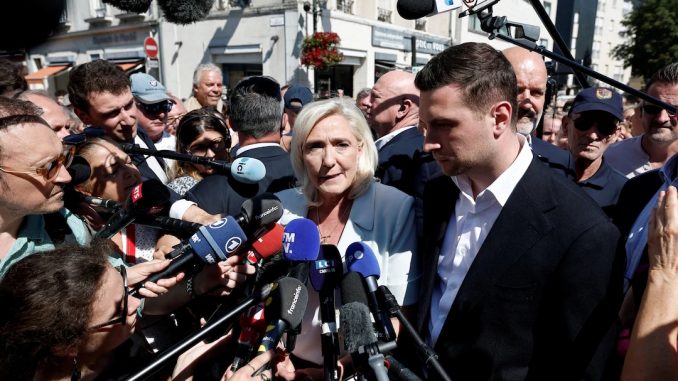
French far-right leader Marine Le Pen and Jordan Bardella, president of the French far-right Rassemblement National (National Rally – RN) political party, talk to journalists as they arrive to visit a market in La Fleche, in the Sarthe department, a day after Le Pen announced her candidacy for the 2027 French presidential election following an appeals court ruling that shortened her ban on running for office while upholding her conviction for embezzling EU funds, France, July 8, 2026. REUTERS/Benoit Tessier
Published July 10, 2026
French far-right leader Marine Le Pen has officially launched her bid for the 2027 French presidential election, returning to the campaign trail despite a recent court ruling that upheld her conviction for embezzling European Parliament funds.
The decision marks a dramatic political comeback after a French appeals court reduced the restrictions that had threatened to end her presidential ambitions. With the revised ruling allowing her to seek public office, Le Pen immediately confirmed she would run for president for a fourth time while continuing to appeal her conviction.
Court Ruling Revives Presidential Ambitions
Earlier this year, Le Pen’s political future appeared uncertain after she was convicted of misusing European Parliament funds through her party. The appeals court upheld the conviction but shortened the period during which she would be barred from holding public office, effectively reopening the path for her 2027 presidential campaign. She was also sentenced to one year of home detention under electronic monitoring, although her appeal to France’s highest court suspends enforcement of that sentence while the case is reviewed.
Le Pen has repeatedly denied wrongdoing and says she will continue fighting the conviction through France’s judicial system.
Polls Suggest Le Pen Remains the Front-Runner
Despite the legal controversy, recent opinion polls indicate that Le Pen remains the leading candidate for the 2027 election.
According to surveys conducted by Ifop and Harris Interactive, Le Pen is currently projected to receive around 36% of first-round votes, placing her ahead of potential rivals including former Prime Ministers Édouard Philippe and Gabriel Attal. Several polling scenarios also suggest she would be competitive—or even favored—in a second-round runoff.
Political analysts note that while the conviction has generated controversy, it has not significantly weakened support among her core voters.
National Rally Seeks Historic Victory
Le Pen leads the National Rally, France’s largest far-right political party.
The party campaigns on issues including:
- Stricter immigration controls
- Stronger border security
- Combating crime
- Reducing the influence of the European Union on French domestic policy
- Protecting French national identity
- Increasing purchasing power for French families
Supporters argue these policies respond to growing public concerns about immigration, inflation, and security, while critics contend that some proposals could deepen social divisions and strain France’s relationship with European partners.
Legal Battle Continues Alongside Campaign
Although Le Pen is free to campaign, her legal case remains unresolved.
France’s Court of Cassation, the country’s highest court for criminal and civil appeals, will review her appeal. If the conviction is overturned, the case could be retried. If upheld, legal and political questions could continue to influence the presidential race.
The legal process is expected to continue well into the campaign period, making the election one of the most closely watched in modern French politics.
Why the 2027 Election Matters
The 2027 election is expected to reshape France’s political landscape.
Current President Emmanuel Macron cannot seek another consecutive term due to constitutional term limits. This has created one of the most open presidential contests in years, with candidates from across the political spectrum preparing for a highly competitive race.
Le Pen has previously reached the presidential runoff twice, losing to Macron in 2017 and 2022. Her supporters believe 2027 represents her strongest opportunity yet to win the presidency, while opponents argue that her criminal conviction raises important questions about ethics and public trust.
👥 Public / Political Reactions:
⚠️ Resulting Effects:
Marine Le Pen’s return to the 2027 French presidential race has reshaped the country’s political landscape. Despite her criminal conviction, recent opinion polls showing her in the lead have intensified debates over judicial accountability, voter confidence, immigration, and the future direction of France and the European Union.
1. Renewed Momentum for the National Rally
Le Pen’s eligibility to run has energized her political movement.
🗳️ National Rally supporters have rallied behind her campaign following the appeals court decision.
📈 Recent opinion polls placing Le Pen in first place have boosted confidence within the party.
🤝 Party officials are expected to strengthen campaign efforts ahead of the 2027 election.
➡️ Result: Court ruling → renewed momentum for the National Rally’s presidential campaign.
2. Increased Political Polarization
The case has further divided French politics.
🇫🇷 Supporters argue Le Pen represents change and stronger national sovereignty.
⚖️ Critics believe her conviction raises serious concerns about ethics and public trust.
📢 Political debates surrounding immigration, crime, economic policy, and judicial independence have become even more intense.
➡️ Result: Le Pen’s candidacy → deeper political polarization across France.
3. Greater Scrutiny of France’s Judicial System
The appeals ruling has drawn attention to the role of the judiciary during election periods.
🏛️ Supporters praise the court for allowing voters—not judges—to determine the country’s next leader.
⚖️ Others maintain that judicial accountability must apply equally to all politicians, regardless of popularity.
📚 Legal experts continue discussing the balance between protecting democratic participation and enforcing anti-corruption laws.
➡️ Result: High-profile legal case → increased public debate over judicial independence and accountability.
4. Heightened Focus on Immigration and National Identity
Le Pen’s campaign has placed immigration and national sovereignty back at the center of French politics.
🛂 The National Rally continues advocating stricter immigration controls and stronger border security.
🏳️ Discussions about French identity, public safety, and integration are expected to dominate campaign debates.
📊 Political parties across the spectrum may adjust their platforms in response to voter concerns.
➡️ Result: Campaign launch → renewed focus on immigration, security, and national identity.
5. Increased Attention Across Europe
The election is being closely monitored beyond France.
🇪🇺 European leaders are watching the race because France is one of the European Union’s most influential member states.
🤝 The outcome could influence future EU policies on migration, defense, trade, and European integration.
🌍 International markets and diplomatic partners are also assessing the potential political and economic implications.
➡️ Result: Strong polling numbers → heightened international attention and geopolitical interest.
6. An Unpredictable Road to 2027
Although Le Pen currently leads many opinion polls, the election remains far from decided.
📅 The campaign is still in its early stages, and voter preferences could change significantly before election day.
⚖️ Ongoing legal proceedings may continue to shape public perception of Le Pen’s candidacy.
🗳️ Political analysts expect a highly competitive race that could redefine France’s future political direction.
➡️ Result: Early polling lead → continued uncertainty and an increasingly competitive presidential race.
🔮 Future Outlook:
Marine Le Pen’s return to the 2027 presidential race is expected to shape French politics over the coming months. With opinion polls placing her among the leading candidates, France is likely to experience an intense campaign centered on immigration, the economy, national identity, and its future role within the European Union. At the same time, Le Pen’s ongoing legal appeal is expected to remain a significant factor throughout the election season.
1. A Highly Competitive Presidential Race
France is expected to witness one of its most closely watched elections in recent history.
🗳️ Marine Le Pen is likely to remain one of the leading contenders as campaigning intensifies.
📊 Other presidential hopefuls will continue working to consolidate support and challenge her lead.
🇫🇷 Voter priorities such as inflation, public security, immigration, and economic growth are expected to dominate the campaign.
➡️ Outlook: Strong polling → an increasingly competitive race for the French presidency.
2. Continued Legal Proceedings
Le Pen’s legal case is expected to remain in the public spotlight.
⚖️ France’s highest court will continue reviewing her appeal against the conviction.
📑 Any future court decisions could influence political narratives and public opinion during the campaign.
🏛️ Legal experts expect continued debate over the relationship between judicial accountability and democratic participation.
➡️ Outlook: Ongoing appeal → continued legal and political attention throughout the election period.
3. Immigration and National Identity Will Remain Central Issues
The National Rally is expected to continue emphasizing immigration and border security.
🛂 Campaign discussions will likely focus on migration policies, crime prevention, and national sovereignty.
🏳️ Competing political parties may adjust their platforms in response to changing voter concerns.
💬 Public debate surrounding identity, integration, and social cohesion is expected to remain highly visible.
➡️ Outlook: Core campaign themes → sustained national debate on immigration and security.
4. Growing International Interest
The 2027 election will continue attracting attention from governments and political observers around the world.
🇪🇺 European Union leaders are expected to closely monitor developments because France plays a central role in EU decision-making.
🌍 International partners will watch for potential changes in France’s foreign policy, defense cooperation, and economic priorities.
🤝 Financial markets and diplomatic allies are also expected to assess how different election outcomes could affect regional stability.
➡️ Outlook: France’s global influence → continued international attention throughout the campaign.
5. Potential Shift in French Politics
If elected, Le Pen could significantly reshape France’s domestic and foreign policies.
🏛️ Her administration would likely prioritize stricter immigration controls, stronger border security, and policies emphasizing national sovereignty.
🇪🇺 Analysts believe a Le Pen presidency could lead to renewed negotiations over France’s relationship with certain European Union policies while remaining within the EU framework.
📈 Supporters see the possibility of major political reforms, while critics warn of increased tensions over immigration and European integration.
➡️ Outlook: Possible National Rally victory → significant political and policy changes in France.
6. The Election Could Influence Europe’s Political Direction
Many analysts believe France’s election will have consequences beyond its borders.
🌍 A Le Pen victory could encourage nationalist and conservative political movements in other European countries.
🗳️ Alternatively, a defeat could reinforce the position of France’s traditional or centrist political parties.
📚 Political observers expect the election to become a defining moment for the future direction of both France and the European Union.
➡️ Outlook: 2027 presidential election → potential long-term impact on European politics and regional governance.
🧩 Bottom Line:
As someone watching this election from the Philippines, I find France’s 2027 presidential race to be about much more than one candidate or one court case. It reflects a growing trend seen across many democracies, where voters are increasingly demanding stronger action on immigration, public safety, the rising cost of living, and national identity.
Marine Le Pen’s continued popularity—even after her conviction—shows that many French voters remain focused on the issues they believe affect their daily lives more than the legal controversy surrounding her. At the same time, others believe that integrity and accountability in public office should remain non-negotiable. These two perspectives are likely to shape the election until the final vote.
Regardless of where people stand politically, the French people now have the opportunity to decide their country’s future through the democratic process. Their decision will not only determine who becomes France’s next president but could also influence the direction of the European Union, immigration policy, economic cooperation, and international relations for years to come.
➡️ Bottom Line: France stands at a political crossroads. The 2027 presidential election is shaping up to be one of the country’s most consequential in decades. Whether Marine Le Pen ultimately wins or loses, the campaign has already highlighted deep divisions within French society while reaffirming that, in a democracy, it is ultimately the voters—not opinion polls, media narratives, or political opponents—who will decide the nation’s future at the ballot box.
SOURCES: THE GATEWAY PUNDIT – French Rightwing Leader Marine Le Pen Still Leading the Polls for Next Year’s Presidential Election, Despite Lawfare Conviction
REITERS – Opinion polls see France’s Le Pen winning 2027 election despite guilty verdict
MODERN DIPLOMACY – Marine Le Pen Launches 2027 Presidential Bid After Court Clears Election Run