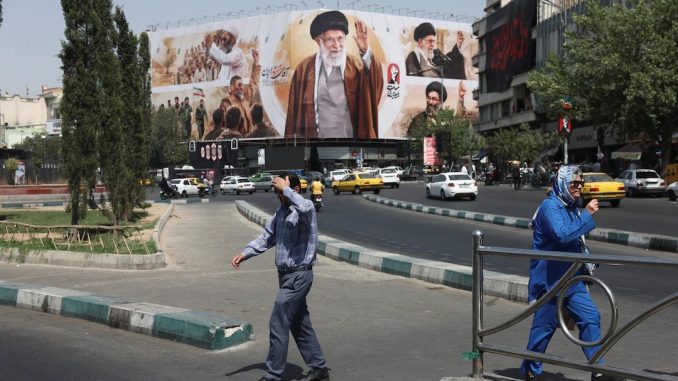
People walk past a billboard featuring images of Iran’s late Supreme Leader Ayatollah Ali Khamenei in Tehran, Iran, July 13, 2026. Majid Asgaripour/WANA (West Asia News Agency) via REUTERS
Published July 13, 2026
WASHINGTON — The fragile ceasefire understanding between the United States and Iran is showing signs of unraveling as both governments continue to accuse one another of failing to uphold key commitments following last month’s military confrontation.
Although the ceasefire has largely prevented a return to direct large-scale hostilities, disputes over sanctions, nuclear activities, regional security, and enforcement mechanisms have exposed deep mistrust between Washington and Tehran, raising concerns that the current calm may prove temporary.
The latest developments underscore how decades of hostility continue to complicate efforts to establish lasting stability in the Middle East.
Ceasefire Holds, But Trust Continues to Erode
The U.S.-Iran ceasefire was intended to halt direct military exchanges after weeks of heightened tensions that brought the two countries dangerously close to a broader conflict.
While neither side has resumed major military operations, disagreements over the implementation of the ceasefire have intensified.
Iran has accused the United States of failing to fulfill certain understandings related to sanctions relief and diplomatic commitments, while U.S. officials maintain that Iran continues activities that threaten regional stability, including its nuclear program and support for armed proxy groups.
The continuing disputes demonstrate that ending active fighting is only the first step toward achieving a durable peace.
Nuclear Program Remains a Central Flashpoint
Iran’s nuclear activities continue to be one of the most significant obstacles to improved relations.
American officials have repeatedly stated that Iran must not be allowed to develop a nuclear weapon, while Tehran insists that its nuclear program is intended for peaceful civilian purposes.
Despite the ceasefire, disagreements over uranium enrichment, inspections, and future negotiations remain unresolved.
The absence of a comprehensive nuclear agreement continues to fuel uncertainty throughout the region.
Proxy Groups Continue to Complicate Regional Security
Another major source of tension involves Iran’s relationships with armed groups operating throughout the Middle East.
The United States and its regional allies have long accused Tehran of providing support to organizations operating in Lebanon, Iraq, Syria, Yemen, and elsewhere.
American officials argue that any long-term agreement must address Iran’s regional influence and support for proxy forces, while Iranian leaders maintain that these groups operate independently and are part of legitimate regional resistance movements.
The issue remains one of the most difficult challenges facing future negotiations.
Diplomatic Progress Faces Significant Obstacles
Although diplomatic channels remain open, officials acknowledge that negotiations have become increasingly difficult.
The lack of mutual trust, combined with decades of political hostility, continues to limit opportunities for meaningful progress.
Regional allies are also closely monitoring developments, recognizing that any collapse of the ceasefire could quickly affect security across the Middle East.
Diplomats continue urging restraint while seeking confidence-building measures that could reduce the risk of renewed military confrontation.
Trump Administration Maintains Pressure
The Trump administration has emphasized that peace will depend on Iran demonstrating measurable changes in its behavior.
Administration officials have continued to stress that the United States will maintain pressure on Tehran while remaining prepared to respond decisively to any renewed threats against American personnel, allies, or regional interests.
The administration argues that deterrence remains essential to preventing future escalation and ensuring stability in the region.
⚠️ Implications:
The growing strain on the U.S.-Iran ceasefire underscores how difficult it will be to achieve lasting peace after years of confrontation. While large-scale military operations have paused, deep disagreements over Iran’s nuclear program, regional influence, sanctions, and enforcement mechanisms continue to threaten the stability of the agreement.
⚔️ 1. The Ceasefire Faces a Critical Test
- Although active fighting has subsided, both Washington and Tehran continue accusing each other of failing to uphold parts of the agreement.
- The absence of mutual trust makes even minor disputes difficult to resolve.
- Without additional diplomatic progress, the ceasefire could gradually weaken.
🔍 Implication: The current ceasefire may prevent immediate conflict, but it remains vulnerable to collapse if disagreements continue to grow.
☢️ 2. Iran’s Nuclear Program Remains the Biggest Obstacle
- Iran’s uranium enrichment activities continue to be the central point of disagreement.
- The United States maintains that Iran must never acquire a nuclear weapon, while Iran insists its program is peaceful.
- Future negotiations are likely to focus heavily on inspections, verification, and enrichment limits.
⚠️ Implication: Until the nuclear dispute is resolved, long-term stability between the two countries will remain difficult to achieve.
🌍 3. Regional Security Could Become Increasingly Unstable
- Iran’s relationships with armed groups across the Middle East remain a major concern for the United States and its allies.
- Israel and Gulf nations continue monitoring Iran’s regional activities closely.
- Any renewed confrontation involving proxy groups could quickly draw multiple countries into the conflict.
🌐 Implication: Even if direct U.S.-Iran fighting is avoided, regional proxy conflicts could continue fueling instability.
🛡️ 4. Military Deterrence Is Likely to Continue
- The Trump administration has signaled that it intends to maintain military readiness while pursuing diplomacy.
- U.S. forces throughout the Middle East remain prepared to respond to threats against American personnel and allies.
- Iran is also expected to continue strengthening its defensive capabilities.
🚨 Implication: Both countries are likely to maintain a policy of deterrence, increasing the risk of miscalculation during future incidents.
🤝 5. Diplomatic Negotiations Face Significant Challenges
- Decades of hostility have created deep political mistrust on both sides.
- Future negotiations will require compromises on sanctions, nuclear oversight, and regional security concerns.
- International mediators may continue attempting to prevent the ceasefire from collapsing.
📢 Implication: Diplomatic progress is possible, but meaningful agreements will likely require sustained negotiations over an extended period.
📈 6. Global Economic and Energy Markets Remain Sensitive
- Any renewed conflict involving Iran could disrupt shipping through the Strait of Hormuz, a critical route for global energy supplies.
- Oil prices and international markets remain sensitive to geopolitical developments in the Middle East.
- Businesses and governments continue watching the situation closely.
🧭 Implication: Even limited military escalation could have consequences far beyond the region by affecting global energy security and economic stability.
💬 Overall Takeaway:
The growing strain on the U.S.-Iran ceasefire illustrates that ending active military conflict is only the first step toward achieving lasting peace. Although both sides have so far avoided a return to large-scale hostilities, fundamental disagreements over Iran’s nuclear program, sanctions, regional influence, and security guarantees continue to undermine confidence in the agreement.
For the Trump administration, maintaining pressure on Iran while preventing another major conflict will require a careful balance of diplomacy and military deterrence. For Iran, the challenge remains securing economic relief and international recognition of its interests without provoking renewed confrontation with the United States and its allies.
As tensions continue to simmer, the Middle East remains one of the world’s most volatile regions. A single military incident, proxy attack, or diplomatic breakdown could quickly undo the fragile ceasefire and trigger another dangerous escalation with consequences extending well beyond the region.