
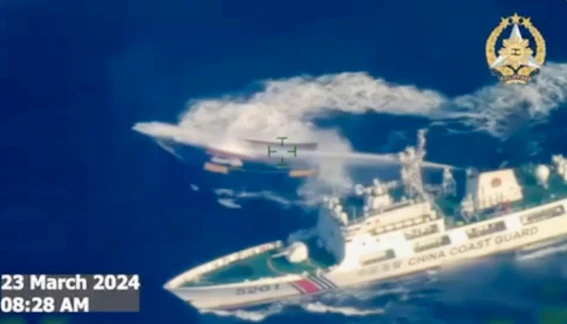
In this image made from video provided by the Armed Forces of the Philippines, a Chinese coast guard ship uses water cannon on a Philippine resupply vessel Unaizah May 4 as it approaches Second Thomas Shoal, locally called Ayungin shoal, at the disputed South China Sea on March 23, 2024. (Armed Forces of the Philippines via AP, File)
Published July 13, 2026
MANILA, Philippines — A coalition of 14 nations has issued one of the strongest collective rebukes yet of China’s sweeping claims in the South China Sea, declaring that Beijing’s expansive maritime assertions have “no basis in international law.” The joint statement reaffirms the 2016 international arbitration ruling that invalidated China’s so-called “nine-dash line” and underscores growing international support for freedom of navigation and the rules-based international order in one of the world’s busiest waterways. (Sources: Reuters, AP, Times of India)
The statement was endorsed by countries including Japan, Australia, Canada, France, Germany, Italy, the Netherlands, New Zealand, the Philippines, South Korea, Spain, the United Kingdom, and the United States, marking a broad multinational front against Beijing’s maritime claims.
China swiftly condemned the declaration, accusing participating nations of interfering in regional affairs and insisting that its sovereignty over much of the South China Sea remains legitimate under what it describes as historical rights.
 APIn this photo provided by the Philippine Coast Guard, a Chinese Coast Guard vessel, right, fires it’s water cannon at the Philippine’s BRP Datu Pagbuaya
Coalition Reaffirms Landmark Arbitration Ruling
The joint declaration marks the 10th anniversary of the 2016 ruling by the Permanent Court of Arbitration in The Hague, which overwhelmingly sided with the Philippines after Manila challenged China’s maritime claims under the United Nations Convention on the Law of the Sea (UNCLOS).
The tribunal concluded that China’s “nine-dash line” has no legal basis under international law and that Beijing violated the Philippines’ sovereign rights within its Exclusive Economic Zone (EEZ).
Although China has consistently rejected the ruling and refused to recognize the tribunal’s authority, many governments continue to regard the decision as legally binding under international law.
China Rejects International Criticism
Beijing responded forcefully to the multinational statement, accusing outside powers of politicizing regional disputes and attempting to contain China’s rise.
Chinese officials reiterated that territorial disputes should be resolved directly between claimant states and maintained that foreign governments should refrain from intervening in matters involving the South China Sea.
China also defended its historical claims, despite repeated international legal findings rejecting those assertions.
Philippines Welcomes Renewed International Support
For the Philippines, the joint statement represents another significant diplomatic victory as Manila continues to rally international backing for the 2016 arbitration ruling.
Philippine officials have increasingly strengthened security cooperation with allies while continuing to challenge Chinese activities within the country’s Exclusive Economic Zone, particularly around disputed features such as Second Thomas Shoal, Scarborough Shoal, and other contested waters.
The renewed support comes amid continued encounters between Philippine and Chinese vessels in the South China Sea over the past several years.
South China Sea Remains a Global Flashpoint
The South China Sea carries approximately one-third of global maritime trade and is believed to contain significant oil, natural gas, and fisheries resources.
Besides China and the Philippines, overlapping territorial claims involve Vietnam, Malaysia, Brunei, and Taiwan.
The dispute has become one of the Indo-Pacific’s most significant security challenges, drawing increased involvement from countries seeking to preserve freedom of navigation and international maritime law.
Growing International Unity
The latest declaration signals that concern over China’s maritime activities is no longer limited to neighboring countries.
An increasing number of governments from Europe, North America, and the Indo-Pacific have publicly reaffirmed the importance of adhering to international law and respecting the 2016 arbitration ruling.
Analysts say the coordinated statement reflects growing international consensus that maritime disputes should be resolved through legal mechanisms rather than unilateral actions or coercion.
⚠️ Implications:
The joint declaration by 14 nations rejecting China’s expansive South China Sea claims represents one of the strongest coordinated international affirmations of the 2016 arbitral ruling in recent years. The statement reinforces the principle that maritime disputes should be resolved under international law and underscores the growing strategic importance of the Indo-Pacific. The development carries significant diplomatic, security, and geopolitical implications.
⚖️ 1. International Law Receives Renewed Support
- Fourteen nations reaffirmed that China’s “nine-dash line” has no legal basis under the 2016 arbitral ruling.
- The declaration reinforces the role of the United Nations Convention on the Law of the Sea (UNCLOS) in resolving maritime disputes.
- The statement signals continued international backing for legal mechanisms over unilateral territorial claims.
🔍 Implication: The coalition strengthens the credibility of international maritime law and increases diplomatic pressure on countries to respect established legal rulings.
🇵🇭 2. The Philippines Gains Diplomatic Momentum
- The joint statement represents a significant diplomatic boost for the Philippines, which initiated the arbitration case against China.
- Growing international support may strengthen Manila’s position in future diplomatic negotiations and regional security cooperation.
- Philippine officials are likely to continue citing the ruling in defending the country’s sovereign rights within its Exclusive Economic Zone (EEZ).
⚠️ Implication: The Philippines enters future regional discussions with broader international backing for its legal position.
🇨🇳 3. China Faces Increasing International Pressure
- Beijing continues to reject the arbitration ruling and maintains that its maritime claims are based on historical rights.
- The coordinated declaration demonstrates that criticism of China’s claims extends beyond regional neighbors to include major Western and Indo-Pacific democracies.
- China may respond by increasing diplomatic outreach while continuing to defend its position.
🌐 Implication: Beijing could face greater diplomatic isolation on the South China Sea issue even as it remains unlikely to alter its official policy.
🚢 4. Freedom of Navigation Remains a Strategic Priority
- The South China Sea is one of the world’s busiest maritime trade routes.
- Many participating nations have emphasized the importance of maintaining open sea lanes and lawful navigation.
- Continued international naval presence in the region is expected as countries seek to uphold freedom of navigation.
🛡️ Implication: Maritime security operations and multinational naval cooperation in the Indo-Pacific are likely to remain active.
🤝 5. Regional Alliances Could Continue to Strengthen
- The coordinated statement reflects growing cooperation among Indo-Pacific and Western partners.
- Security collaboration involving intelligence sharing, joint exercises, and defense partnerships may continue to expand.
- Countries concerned about regional stability are expected to deepen diplomatic coordination.
📢 Implication: Strategic partnerships in the Indo-Pacific are likely to become even more important as regional competition intensifies.
🌍 6. The South China Sea Will Remain a Global Flashpoint
- Competing territorial claims remain unresolved despite international legal rulings.
- Encounters between coast guard and naval vessels could continue as claimant states assert their positions.
- Diplomatic efforts will remain essential to preventing incidents from escalating into broader confrontations.
🧭 Implication: While the joint declaration reinforces international legal principles, the South China Sea is likely to remain one of the world’s most closely watched geopolitical hotspots for the foreseeable future.
💬 Overall Takeaway:
The joint declaration by 14 nations rejecting China’s sweeping South China Sea claims marks a significant display of international unity in support of the rules-based international order and the 2016 arbitral ruling that found Beijing’s “nine-dash line” has no legal basis under international law. For the Philippines, the statement reinforces years of diplomatic efforts to uphold its sovereign rights within its Exclusive Economic Zone and highlights growing international support for its legal position.
For China, however, the declaration is unlikely to alter its long-standing policy. Beijing has repeatedly rejected the arbitration ruling and continues to assert what it describes as historical rights over much of the South China Sea. As a result, tensions in the region are expected to persist despite increasing diplomatic pressure from the international community.
More broadly, the coordinated statement reflects the Indo-Pacific’s growing importance to global security, trade, and international law. As more nations voice support for freedom of navigation and peaceful dispute resolution, the South China Sea will remain a central arena of geopolitical competition, where diplomacy, deterrence, and adherence to international law will continue to shape the region’s future.




