

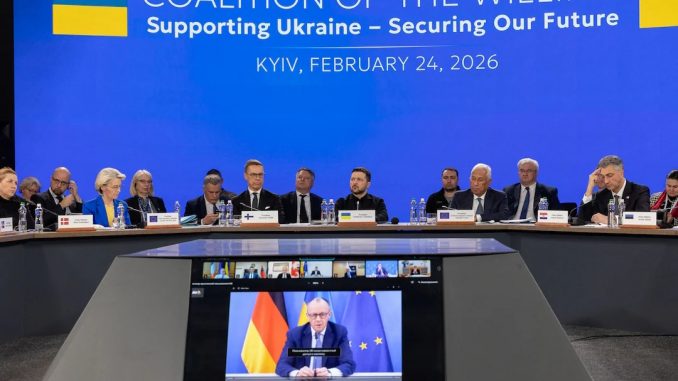
Ukrainian President Volodymyr Zelenskiy and EU leaders attend a meeting of ‘Coalition of the Willing’, amid Russia’s attack on Ukraine, in Kyiv, Ukraine February 24, 2026. Ukrainian Presidential Press Service/Handout via REUTERS/File Photo
Published July 13, 2026
PARIS — Ukraine and nine European nations have announced the formation of a new coalition aimed at building a shared ballistic missile defense system, signaling that European leaders are preparing for what they view as a long-term security challenge from Russia rather than a conflict nearing its end.
The announcement came during a high-level security summit in Paris attended by Ukrainian President Volodymyr Zelenskyy and leaders from France, Germany, the United Kingdom, Italy, Denmark, the Netherlands, Norway, Spain, and Sweden.
The coalition’s stated objective is to develop an integrated missile defense architecture capable of protecting Europe from the growing threat posed by ballistic missiles, while drawing on Ukraine’s experience gained after more than four years of defending against Russia’s full-scale invasion.
Europe Signals Long-Term Commitment
European leaders emphasized that Russia’s continued missile attacks against Ukraine have demonstrated the need for stronger continental defenses.
The coalition said its goal is not only to protect Ukraine but to establish a broader European missile shield capable of deterring future threats against NATO partners and neighboring countries.
Officials noted that the initiative remains open to additional nations that wish to participate.
The announcement reflects Europe’s growing recognition that the continent must strengthen its own defense capabilities as the war continues with no clear end in sight.
Ukraine’s Battlefield Experience Takes Center Stage
President Zelensky urged allied governments to use Ukraine’s wartime experience in designing Europe’s future missile defense network.
Since Russia’s invasion began in 2022, Ukraine has defended itself against thousands of missile and drone attacks, developing operational knowledge that European officials now consider invaluable.
Leaders participating in the summit said Ukraine’s experience could help shape more effective missile interception systems across Europe.
 French President Emmanuel Macron and Ukrainian President Volodymyr Zelensky pose for a group photo with heads of states and governments ahead of the Coalition of the Willing summit on security guarantees for Ukraine at the Hotel des Invalides in Paris, France, Monday, July 13, 2026. (Teresa Suarez/POOL photo via AP)
Putin Faces Increasing European Unity
The announcement comes as President Vladimir Putin continues military operations in Ukraine despite renewed diplomatic efforts and international pressure.
Rather than reducing support for Kyiv, European governments appear to be expanding military cooperation and planning for long-term regional security.
The coalition also reflects growing concern that Russia’s missile capabilities could pose future risks beyond Ukraine if left unchecked.
Defense Cooperation Expands Across Europe
The Paris summit also highlighted broader efforts to strengthen Europe’s defense industry, improve military coordination, and increase investments in advanced air and missile defense technologies.
Leaders stressed that protecting European airspace will require closer cooperation between governments, defense manufacturers, and military planners.
Officials acknowledged that developing a continent-wide missile defense network will take years, but argued that planning must begin immediately given the evolving security environment.
⚠️ Implications:
The creation of a new European missile defense coalition marks a significant shift in how European leaders view the long-term threat posed by Russia. Rather than treating the war in Ukraine as a temporary crisis, participating nations are investing in a broader security strategy designed to strengthen the continent’s defenses against future missile attacks.
🛡️ 1. Europe Is Preparing for a Long-Term Security Challenge
- The new coalition suggests European governments expect tensions with Russia to continue for years.
- Rather than relying solely on short-term military aid, allies are investing in permanent defense capabilities.
- The initiative reflects a growing belief that Europe must become more self-reliant in defending its territory.
🔍 Implication: European defense policy is shifting from crisis response to long-term strategic deterrence against future Russian threats.
🚀 2. Missile Defense Becomes a Top Strategic Priority
- Russia’s repeated use of ballistic missiles and drones against Ukraine has exposed vulnerabilities in European air defenses.
- The coalition aims to improve early warning systems, interception capabilities, and coordination among participating nations.
- Future investments are expected to focus on advanced missile defense technologies.
⚠️ Implication: Europe is likely to accelerate military modernization and expand its air and missile defense infrastructure.
🇺🇦 3. Ukraine’s Military Experience Is Reshaping European Defense Planning
- Ukraine has gained extensive battlefield experience defending against large-scale missile and drone attacks.
- European nations increasingly view Ukraine as a valuable source of operational knowledge rather than only a recipient of military aid.
- Kyiv’s experience may influence future NATO and European defense strategies.
🌐 Implication: Ukraine is emerging as an important contributor to Europe’s future security architecture.
🇷🇺 4. Pressure on Russia Is Likely to Continue
- The coalition sends a signal that European support for Ukraine remains strong despite the prolonged conflict.
- Rather than reducing military cooperation, participating nations are expanding joint defense initiatives.
- Moscow may view the coalition as further evidence of growing Western military coordination.
🚨 Implication: The move could deepen geopolitical tensions while reinforcing Europe’s commitment to deterring future Russian aggression.
🤝 5. European Defense Cooperation Is Expanding
- The coalition demonstrates increasing collaboration among European governments on shared security challenges.
- Joint procurement, intelligence sharing, and defense planning are expected to become more common.
- Additional countries may choose to join the initiative over time.
📢 Implication: Europe could become more unified in its defense planning, reducing dependence on individual national capabilities.
🌍 6. The War Is Reshaping Europe’s Security Landscape
- The conflict in Ukraine has fundamentally changed how many European governments assess regional threats.
- Long-term investments in defense, military readiness, and strategic partnerships are becoming national priorities.
- Even if active fighting eventually subsides, many of these security initiatives are expected to continue.
🧭 Implication: Russia’s invasion of Ukraine is likely to have lasting consequences for Europe’s defense policies, military spending, and regional security strategy for years to come.
💬 Overall Takeaway:
The launch of a new European missile defense coalition demonstrates that many of Ukraine’s allies are preparing for a prolonged period of heightened tensions with Russia rather than expecting a near-term end to the war. By investing in integrated missile defense and expanding military cooperation, European leaders are signaling that strengthening the continent’s security has become a long-term strategic priority.
For Ukraine, the initiative reinforces continued political and military support from key European partners while recognizing the country’s battlefield experience as a valuable asset in shaping future defense planning. For Russia, the coalition serves as another indication that Moscow’s invasion has prompted European nations to deepen their defense cooperation instead of scaling it back.
As the conflict continues with no comprehensive peace agreement in sight, Europe is increasingly shifting from simply responding to the war toward building a stronger collective defense posture designed to deter future aggression and protect regional stability for years to come.


