

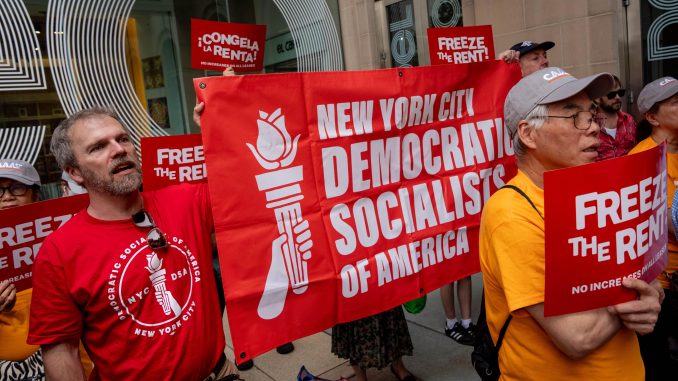
Several signatories on the Friends of Socialist China pledge are self-described DSA members.Bloomberg via Getty Images
Published July 31 , 2026
NEW YORK — A group of members affiliated with the Democratic Socialists of America (DSA), including individuals connected to the organization’s International Committee, have signed a public pledge expressing support for the People’s Republic of China, renewing scrutiny over the group’s engagement with Chinese officials and prompting debate over foreign influence and political ideology.
The pledge, organized by the UK-based advocacy group Friends of Socialist China, declares support for China and promotes what it describes as “Chinese socialism.” According to reports, more than a dozen DSA-affiliated activists signed the statement, which argues that China’s continued development is critical to the global socialist movement.
The development has drawn attention because the DSA played a significant role in supporting New York City Mayor Zohran Mamdani’s political rise, although the reports do not indicate that Mamdani himself signed the pledge or endorsed its language.
Delegation Trips to China Raise Questions
Reports indicate that several DSA members participated in organized visits to China over recent years, including trips coordinated with Chinese provincial foreign affairs offices.
Delegates reportedly attended official events in Beijing commemorating the 80th anniversary of the end of World War II in Asia and met with Chinese officials during the visits. Participants described receiving extensive hospitality and opportunities to observe China’s political and economic system firsthand.
According to internal meeting records previously reported by Newsweek and cited by both publications, some DSA members have promoted deeper engagement with China under an “anti-imperialist” framework, while others voiced concern that the organization was becoming too closely aligned with the Chinese Communist Party.
 The DSA appears divided on whether to publicly support the CCP.NG HAN GUAN/POOL/EPA/Shutterstock
Internal Debate Within the DSA
The reports describe ongoing internal disagreement over the organization’s relationship with China.
Meeting minutes reportedly show that some members questioned whether closer cooperation with Chinese officials reflected the DSA’s mission, with critics arguing that the organization should avoid appearing to endorse an authoritarian government. Others defended international engagement and argued that dialogue with socialist governments is consistent with the DSA’s international work.
Neither the national Democratic Socialists of America nor New York City DSA had publicly responded to the reports at the time of publication, according to both news organizations.
 DSA members have organized several trips to the communist country and have met with CCP officials.Bloomberg via Getty Images
Renewed Debate Over Foreign Influence
The reports have fueled broader political debate over foreign influence, U.S.–China relations, and the role of ideological organizations in American politics.
Critics argue that organized exchanges and public pledges could serve Beijing’s soft-power objectives, while supporters of international engagement contend that dialogue and political exchange do not necessarily represent endorsement of another country’s government or policies. Analysts say the controversy is likely to intensify scrutiny of political organizations’ overseas relationships as tensions between Washington and Beijing continue.
👥 Public / Political Reactions:
🇺🇸 Republican Leaders
Republican lawmakers and conservative commentators sharply criticized reports that some Democratic Socialists of America (DSA) members signed a pro-China pledge following delegation trips to China.
- Critics argued that publicly supporting the Chinese government raises concerns about foreign influence and national security.
- Several Republican officials called for greater transparency regarding overseas political trips and contacts with Chinese officials.
- Conservative voices said the reports reinforce concerns over the Chinese Communist Party’s global influence efforts.
➡️ Position: Republicans argue that U.S. political organizations should distance themselves from the Chinese Communist Party and oppose any appearance of support for Beijing.
🌹 Democratic Socialists of America (DSA)
The reports center on individual DSA members and activists rather than the organization as a whole.
- Some DSA members reportedly defended engagement with China as part of the organization’s international socialist and anti-imperialist work.
- Other members have expressed concern that close ties with Chinese officials could damage the organization’s credibility.
- At the time of the reports, the national DSA had not issued an official statement addressing the controversy.
➡️ Position: The issue has exposed differing views within the DSA over international engagement and relations with China.
🇨🇳 China
Chinese officials have not publicly commented on the reported pledge.
- Beijing has consistently promoted international exchanges with political, academic, and civic organizations.
- China regularly describes such exchanges as opportunities to strengthen mutual understanding and cooperation.
- Chinese officials reject allegations that these programs are intended to influence foreign political organizations.
➡️ Position: China maintains that international exchanges are part of normal diplomatic and cultural engagement.
🏛️ U.S. National Security and Policy Experts
Security analysts say the reports are likely to renew debate over China’s international influence efforts.
- Experts note that Beijing has long invested in educational, political, and cultural exchanges abroad.
- Some analysts argue that transparency is essential whenever foreign governments host political delegations.
- Others caution against assuming that participation in overseas exchanges automatically reflects political allegiance.
➡️ Position: Analysts support greater transparency while emphasizing the importance of distinguishing diplomatic engagement from direct political influence.
👥 Public Response
Reaction has been divided across the political spectrum.
- Critics viewed the reported pledge as inappropriate given ongoing U.S.-China tensions and concerns over human rights.
- Supporters argued that international dialogue and political exchanges should not automatically be interpreted as support for a foreign government.
- The controversy generated extensive debate on social media over ideology, foreign policy, and political accountability.
➡️ Position: Public opinion remains polarized, with some viewing the reports as evidence of troubling political alignment and others defending international engagement as a legitimate form of diplomacy.
🏛️ Broader Political Impact
The controversy is expected to increase scrutiny of political organizations’ international relationships.
- Lawmakers may seek greater transparency regarding overseas trips involving political activists and advocacy groups.
- The reports are likely to become part of broader debates over U.S.-China relations and foreign influence.
- Analysts say the issue could remain politically significant as tensions between Washington and Beijing continue.
➡️ Position: The reports have intensified discussion over foreign influence, political transparency, and the role of international engagement in American politics.
⚠️ Resulting Effects:
The reports that some Democratic Socialists of America (DSA) members signed a pro-China pledge following delegation trips to China have intensified debate over political transparency, foreign influence, and U.S.-China relations. While the reports focus on individual activists rather than the DSA as a whole, the controversy is expected to have political and public implications.
1. Scrutiny of Political Organizations Has Increased
The reports have renewed attention on how U.S. political organizations engage with foreign governments.
🏛️ Lawmakers and watchdog groups may seek greater transparency regarding overseas political delegations.
📋 Questions have emerged about the purpose, funding, and disclosure of foreign-sponsored trips.
🔍 Public interest in political organizations’ international activities has grown.
➡️ Result: Reports of overseas engagement → increased scrutiny of political organizations.
2. Debate Over China’s Influence Has Intensified
The controversy has reignited concerns about Beijing’s international outreach.
🇨🇳 Critics argue that China continues expanding its global influence through political, academic, and cultural exchanges.
🤝 Supporters of engagement maintain that international dialogue does not necessarily indicate political allegiance.
⚖️ Analysts stress the importance of distinguishing diplomatic exchanges from direct foreign influence.
➡️ Result: Pro-China pledge reports → renewed debate over China’s global influence efforts.
3. Internal Divisions Within the DSA Have Drawn Attention
The reports have highlighted differing views among DSA members regarding relations with China.
🌹 Some members reportedly support engagement under an anti-imperialist framework.
💬 Others have expressed concern that close ties with Chinese officials could damage the organization’s public image.
📖 Internal discussions over foreign policy and international partnerships are expected to continue.
➡️ Result: Differing views on China → increased attention to internal DSA debates.
4. U.S.-China Political Tensions Remain in Focus
The reports come amid already strained relations between Washington and Beijing.
🌍 The controversy has become part of broader discussions surrounding U.S.-China competition.
🏛️ Policymakers continue debating how American organizations should engage with Chinese institutions.
📡 Public attention remains focused on issues involving foreign influence and national security.
➡️ Result: Existing geopolitical tensions → heightened political sensitivity.
5. Public Debate Has Expanded
The reports have generated widespread discussion across political and social media platforms.
👥 Critics questioned whether political activists should participate in foreign government-sponsored exchanges.
💬 Others defended international engagement as an important component of diplomacy and dialogue.
📈 The issue has become another point of contention in broader ideological debates within the United States.
➡️ Result: Public controversy → expanded national debate over foreign engagement.
6. Calls for Greater Transparency Could Increase
The controversy may prompt renewed discussion about disclosure requirements.
📋 Some lawmakers may advocate stronger reporting standards for political delegations visiting foreign governments.
🔍 Advocacy groups could push for greater transparency regarding sponsorship and official contacts.
⚖️ Any future policy proposals would likely focus on improving public disclosure rather than restricting lawful international exchanges.
➡️ Result: Increased scrutiny → possible calls for stronger transparency measures.
7. Political Attention Is Expected to Continue
The reports are likely to remain part of ongoing political discussions surrounding U.S.-China relations.
🌍 Future developments may influence broader debates over foreign policy, national security, and political accountability.
🤝 The controversy is expected to be referenced as discussions continue over international political engagement.
🗳️ Analysts say the issue could remain politically relevant as U.S.-China relations continue evolving.
➡️ Result: Continued public interest → sustained political and policy debate over foreign influence and international engagement.
🔮 Future Outlook:
The reports involving some Democratic Socialists of America (DSA) members and their participation in pro-China activities are expected to remain part of broader debates over U.S.-China relations, political transparency, and foreign influence. While the controversy currently centers on individual activists rather than the DSA as a whole, it could continue to attract political attention in the coming months.
1. Political Scrutiny Is Expected to Continue
Lawmakers and advocacy groups are likely to continue examining political organizations’ overseas activities.
🏛️ Congressional leaders may call for greater transparency regarding foreign-sponsored trips and exchanges.
📋 Additional questions could arise over disclosure requirements for political delegations.
🔍 Public attention is expected to remain focused on organizations engaging with foreign governments.
➡️ Outlook: Continued scrutiny → greater focus on political transparency.
2. U.S.-China Relations Will Remain a Central Issue
The controversy comes as tensions between Washington and Beijing remain high.
🇺🇸 Policymakers are expected to continue debating how American organizations should engage with China.
🇨🇳 Beijing is likely to maintain international exchange programs as part of its broader diplomatic outreach.
🌍 Broader geopolitical competition will continue shaping public and political perceptions.
➡️ Outlook: Ongoing U.S.-China tensions → continued attention to international political engagement.
3. The DSA May Face Continued Internal Debate
Discussions within the organization could continue over its approach to international relationships.
🌹 Members may further debate the role of anti-imperialist organizing and engagement with socialist governments.
💬 Internal disagreements over public messaging and foreign policy positions could persist.
📖 Future organizational decisions may influence how the issue develops.
➡️ Outlook: Internal discussions → continued debate over the DSA’s international strategy.
4. Calls for Greater Transparency Could Grow
The controversy may encourage renewed efforts to improve public disclosure.
📋 Lawmakers and watchdog organizations may advocate stronger reporting standards for overseas political activities.
🔍 Greater transparency could help address concerns surrounding foreign influence.
⚖️ Any policy changes would likely focus on disclosure and accountability rather than restricting lawful international exchanges.
➡️ Outlook: Transparency initiatives → possible policy discussions and oversight.
5. Public Debate Is Likely to Continue
The issue is expected to remain active across political and social media platforms.
👥 Critics are likely to continue questioning relationships between U.S. political groups and foreign governments.
💬 Supporters may argue that international engagement and dialogue should not automatically be viewed as political endorsement.
📈 The controversy could remain part of broader ideological debates in American politics.
➡️ Outlook: Ongoing public discussion → continued political polarization.
6. Future International Engagement May Receive Greater Attention
Political organizations may face increased scrutiny when participating in overseas exchanges.
🌍 Future delegations to foreign countries could receive closer media and public attention.
🤝 Organizations may place greater emphasis on transparency regarding the purpose and funding of international visits.
📡 Public disclosure could become a more prominent expectation for similar exchanges.
➡️ Outlook: Increased oversight → greater visibility of international political activities.
7. The Broader Debate Over Foreign Influence Will Continue
The controversy is likely to remain part of larger national discussions over foreign policy and political accountability.
🏛️ Policymakers are expected to continue examining foreign influence concerns involving multiple countries.
🌍 Analysts believe public attention will remain focused on balancing international engagement with transparency and national security.
⚖️ The long-term impact will depend on whether additional information emerges and how political organizations respond to growing public scrutiny.
➡️ Outlook: The coming months are expected to bring continued debate over foreign influence, political transparency, and the role of international engagement in American politics.
🧩 Bottom Line:
Reports that some Democratic Socialists of America (DSA) members signed a pro-China pledge following delegation trips to China have intensified debate over political transparency, foreign influence, and the appropriate relationship between American political organizations and foreign governments. While the reports focus on individual activists rather than the DSA as a whole, the controversy has drawn national attention amid already strained U.S.-China relations.
🏛️ For U.S. policymakers, the episode is likely to reinforce calls for greater transparency surrounding overseas political delegations, foreign-sponsored exchanges, and disclosure of international contacts.
🌹 For the DSA, the reports have highlighted internal differences over international engagement, with members expressing varying views on relations with China and the organization’s broader foreign policy approach.
🇨🇳 For U.S.-China relations, the controversy reflects the heightened sensitivity surrounding political, academic, and cultural exchanges as strategic competition between Washington and Beijing continues.
🌍 For the public, the reports have fueled broader discussions about balancing international dialogue with concerns over foreign influence, accountability, and public trust in political organizations.
➡️ Bottom Line: The controversy is expected to remain part of the broader national conversation surrounding U.S.-China relations and political transparency. Whether it leads to policy changes or greater disclosure requirements will depend on future developments, official responses, and continued public scrutiny of international political engagement.
SOURCES: THE NEW YORK POST – Members of Mamdani’s DSA pledge to ‘support’ and ‘defend’ China: ‘Survival of Chinese socialism is a crucial matter’
THE TIMES – DSA members pledge support for Chinese Communist Party after VIP trip


