
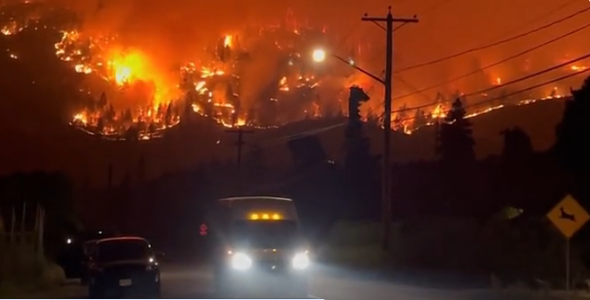
Wildfires in Summerland, British Columbia have forced thousands to evacuate as Canada endures an intense fire season. CBC
Published August 10, 2026
A new report highlighted by ABC News says human-caused climate change contributed to the extreme wildfire conditions behind Canada’s devastating 2026 fire season, citing a new attribution study. The report comes amid a parallel political debate over whether Canada’s forest-management policies have worsened the country’s wildfire risks. ABC News report
The finding is significant—but the wording deserves closer examination.
The researchers did not determine that climate change caused Canada’s wildfires, nor did they calculate that climate change was responsible for a specific percentage of the land burned or the resulting damage. Instead, the study examined extreme fire-weather conditions and estimated how human-caused warming had changed the probability of those conditions occurring.
That distinction matters.
Wildfire disasters are influenced by a combination of temperature, rainfall, drought, wind, vegetation and fuel conditions, lightning and other ignition sources, forest management, geography and firefighting response. Canada’s own natural-resources authorities recognize that wildfire behavior has multiple interacting causes. Natural Resources Canada — Climate Change and Wildland Fire
The study’s most attention-grabbing conclusion is that climate change approximately doubled the likelihood of the extreme fire-weather conditions examined.
But what does “doubled” actually mean? How is that number calculated? What uncertainties surround it? And does an increased probability of extreme fire weather necessarily tell us how much climate change contributed to the actual fires and destruction?
Those are important questions—particularly when a probabilistic scientific finding becomes a much broader claim in the public debate.
That brings us to the central question:
Did Climate Change Really Double Canada’s Wildfire Risk?
The answer requires looking beyond the headline—and examining what the study measured, what it didn’t measure, and how much confidence we should place in its attribution methodology.
Video: “Are wildfires getting worse because of climate change?”
The video provides context on the debate over whether increasing wildfire activity can be attributed primarily to climate change or whether other factors must also be considered.
🔥 Skeptics Say: “Twice as Likely” Is Not the Same as “Caused by Climate Change”
The central claim is that climate change doubled the likelihood of the weather conditions associated with the fires.
But that does not mean climate change doubled the number of fires, doubled the area burned, or caused 50% of the damage.
The study examined a combination of heat, lack of rainfall, humidity and wind using Canada’s fire-weather index. Researchers then estimated how frequently similar conditions would occur under different climate scenarios.
Skeptics argue that this is an important distinction that can easily disappear in news headlines.
A wildfire still requires an ignition source and is affected by fuels, vegetation, wind, terrain, firefighting response and other factors.
In Canada’s remote Northwest Territories, for example, the AP report says lightning was the source of the sparks for the large fires discussed in the study.
The skeptical question:
If the study measures weather conditions, how much can it actually tell us about the ultimate cause of the wildfire damage?
The video presents the study’s findings from the perspective that human-caused warming is a major driver of increasing wildfire risk. But that conclusion raises an important question: does an estimated increase in the probability of extreme fire-weather conditions establish that climate change caused Canada’s wildfire disaster—or does it demonstrate only that warming altered one component of the risk?
📊 What the Study Doesn’t Prove
The WWA methodology itself explains that attribution studies compare today’s climate with a hypothetical cooler climate without warming from fossil-fuel burning. Researchers then use observations and climate models to estimate how the probability or intensity of an event has changed.
That produces a useful scientific estimate—but it is not a controlled experiment.
There is no actual second Earth operating under the “no human warming” scenario against which researchers can directly compare Canada’s 2026 fires.
The study does NOT establish that:
- Climate change caused every Canadian wildfire.
- Climate change caused every acre burned.
- Climate change caused the lightning ignitions.
- Climate change was responsible for a specific percentage of the economic damage.
- Better forest management would have made no difference.
- Natural climate variability played no role.
- The “2×” estimate is an exact measurement rather than a modeled probability.
Indeed, WWA itself acknowledges that attribution studies face challenges from short observational records and high variability in weather phenomena. Its methodology says researchers therefore combine statistical results with models, physical understanding and other evidence.
🧪 A Scientific Critique of Attribution Methodology
One of the most useful sources for skeptics is not a political website but a scientific paper by Peter Sherman, Peter Huybers and Eli Tziperman.
Their research specifically examined an approach motivated by World Weather Attribution’s methodology.
The authors found that internal climate variability—including phenomena such as ENSO—can produce relationships between global mean temperature and regional extreme events even in simulations without changing greenhouse-gas forcing.
Their conclusion was that this can potentially lead to inaccurate attribution conclusions under the particular WWA approach they examined.
That doesn’t prove the Canadian study is wrong.
But it demonstrates that there is a legitimate scientific debate over how confidently extreme weather can be attributed to human-caused warming.
This is a far more substantive criticism than simply declaring climate science “fake.”
🌲 Key Questions About Canada’s Wildfires
1. How much did climate change contribute to the actual area burned?
The study’s headline number concerns fire-weather conditions.
That’s different from measuring the precise contribution of climate change to the total number of hectares burned.
2. What role did lightning play?
According to the AP report, lightning was the spark for major Northwest Territories fires. The same report says lightning accounts for more than 90% of Canada’s burned land area, according to fire scientist Mike Flannigan.
That doesn’t disprove the climate contribution—but it illustrates the difference between ignition and fire-weather conditions.
3. What role did forest conditions play?
Canada’s forests contain enormous quantities of combustible vegetation, and Canada’s remote northern forests can be exceptionally difficult to reach with firefighting resources.
The AP report notes that many northern fires occur far from airports and that firefighters may not reach some fires quickly enough to suppress them.
4. Could forest management reduce wildfire severity?
This deserves examination rather than being dismissed as a political talking point.
The debate shouldn’t necessarily be:
Climate change OR forest management.
It could be:
Climate + fuels + weather + ignition + forest management + geography + firefighting capacity.
⚖️ Skeptics Don’t Need to Claim Climate Change Doesn’t Exist
This is where a credible skeptical argument differs from outright climate denial.
There is abundant evidence that the climate has warmed.
The stronger skeptical position is:
“Warming may increase the probability of certain wildfire-favorable conditions, but that does not mean climate change is the sole cause—or even that the study can quantify its precise contribution to the 2026 wildfire disaster.”
That distinction is important.
Even the ABC/AP report acknowledges that the WWA study was focused on weather conditions connected to large wildfires, rather than directly measuring the complete causal chain behind every fire.
⚠️ Implications:
For policymakers
Governments should be cautious about using a single attribution number to justify sweeping policies.
If wildfire risk is influenced by several factors, policies should address several factors—including forest management, early detection, firefighting infrastructure and fuel reduction alongside climate adaptation.
For the media
Headlines such as “Climate Change Doubled Canada’s Wildfire Risk” can be technically defensible but potentially misleading if readers interpret them as meaning climate change caused twice as many fires.
The more precise formulation is:
Researchers estimate that human-caused warming approximately doubled the probability of the particular extreme fire-weather conditions examined.
That’s a considerably narrower claim.
For the public
People should distinguish between:
Observed fact: Canada experienced severe wildfires.
Scientific finding: Researchers estimate warming increased the probability of certain fire-weather conditions.
Interpretation: How much of the overall disaster should be attributed to climate change remains a more complicated question.
🚨 The Bigger Issue: Probability vs. Certainty
Perhaps the most important skeptical point is that probability estimates aren’t predictions of what must happen.
WWA itself describes its results as quantitative estimates accompanied by confidence intervals and notes that short observational records and natural variability can make attribution difficult.
And the Sherman, Huybers and Tziperman paper provides a specific warning: regional extremes can be influenced by internal variability in ways that complicate attribution to anthropogenic climate change.
So when the public hears:
“Climate change doubled the likelihood.”
the appropriate follow-up question is:
“How certain is that estimate, what exactly was doubled, and what wasn’t measured?”
That’s not denial.
That’s skepticism.
🗣️ Skeptics Say
A reasonable skeptical position would be:
The new study provides evidence that human-caused warming may have increased the likelihood of extreme fire-weather conditions in parts of Canada. But the study should not be portrayed as proving that climate change caused Canada’s wildfires or that it explains a specific percentage of the destruction. The analysis relies on statistical modeling and a hypothetical counterfactual climate, while natural variability, lightning, fuel conditions, geography, forest management and firefighting response also influence wildfire outcomes. The “twice as likely” figure therefore deserves context before being transformed into a sweeping claim about the cause of Canada’s wildfire crisis.
💬 Overall Takeaway:
The most defensible skeptical argument isn’t that climate change had nothing to do with Canada’s fires.
It is this:
The study addresses one piece of a much larger puzzle.
It estimates that warming increased the probability of certain extreme weather conditions. It does not establish that climate change caused the fires themselves, does not assign a percentage of the burned area to climate change, and does not eliminate other major contributors to wildfire behavior.
The fact that researchers continue to debate the statistical assumptions and limitations of extreme-event attribution makes it reasonable to scrutinize dramatic headlines and ask whether “twice as likely” is being communicated with more certainty than the underlying evidence warrants.
The real debate isn’t “climate change or no climate change.”
It’s:
How much did climate change contribute—and how confidently can scientists actually measure that contribution?
SOURCES: ABC NEWS – Climate change contributed to Canada fires, study says as Trump blames mismanagement
AMERICAN METEOROLOGICAL SOCIETY – On the Attribution of Weather Events to Climate Change Using Empirically Fit Extreme Value Distributions
ARXIV – Evidence Synthesis in Probabilistic Extreme Event Attribution: From Attribution Measures to Model Parameters
ARXIV – On the Importance of Tail Assumptions in Climate Extreme Event Attribution
Natural Resources Canada — Climate Change and Wildland Fire
Natural Resources Canada — Fire Regime
Natural Resources Canada — Fire Weather





Man-made global warming, now called “climate change,” doesn’t exist (in the real world). Something that doesn’t exist can’t cause ANYTHING!
Wildfires are down all over the globe despite the fact that a lot of “Greens” are starting fires, on purpose, to prove something that doesn’t exist, really do exist.
Global Greening Hits New Record as Climate Emergency Fails to Materialise